
Opening the Door: Why We Can’t Stop Asking How Long We Can Live
Ask ten people what immortality means and you’ll get a dozen answers before lunch. A cure for aging? A digital echo that keeps speaking when the body goes quiet? A long, healthy sprint far beyond a hundred? The question keeps tugging at us because it’s stitched into everything—love, fear, hunger for meaning. Even the old stories knew the pull of forever. The epic of Gilgamesh secret of immortality wasn’t a magic spell; it was a mirror. That ancient king reached for more life and learned how slippery the word “more” can be.
Fast-forward to today and the conversation didn’t just survive—it upgraded. AI, gene editing, cellular reprogramming, and a wave of longevity start-ups turned the “history of immortality quest” into a modern industry. We talk about life extension in the same breath as cloud computing and clinical trials. You may have heard bold lines like ray kurzweil immortality or immortality by 2030—predictions, not guarantees. They’re sparks. They keep scientists, ethicists, and investors arguing. Good. We need the friction because the stakes are high and the fog is thick.
There’s a rumor thread that always returns, too. It says that technologies changing the arc of the species don’t debut on a TED stage. They arrive off-grid, cultivated in black-budget orchards. The name that surfaces in certain circles is GNTC (Global Network for Technological Control). People whisper about hidden research, sealed patents, all the secrets you aren’t supposed to see. Verified proof? None in public. But stories teach, even when unproven. And the lesson is sharp: whoever pilots breakthrough tech also pilots power.
Gatekeepers at the Threshold: GNTC and the Politics of Obscurity
In the lore of tinkerers and policy wonks, GNTC is the shorthand for a quiet technocracy that spots civilization-scale inventions early, wraps them in non-disclosure armor, and decides what the rest of us learn and when. In these accounts, their unofficial labs prototype tools for radical longevity alongside other world-bending platforms. Again, there’s no audited paper trail proving such a network exists as described, but the archetype stands in for a pattern we do recognize: powerful research often moves through private corridors before it meets daylight.
Why would a group—real or hypothetical—hide longevity breakthroughs? Control. Imagine a therapy that halts cellular aging or a system that lets minds persist as software. Social contracts would wobble. Economies would twist into new shapes. The geopolitical value of a working “age-off switch” is beyond calculation. Public history already shows us how sensitive technologies (encryption, nuclear, advanced AI) get fenced. So the GNTC legend resonates because it fits the logic of high-stakes invention.
Here’s the tension: secrecy can protect us from reckless hype and bio-risks; secrecy can also throttle accountability and entrench inequality. When people tell the GNTC story, they’re also warning us to watch the doorways where tomorrow gets negotiated. Whether or not GNTC is formal reality, the dynamics it symbolizes are real enough to influence how we think about access, governance, and trust.
What Exactly Is “Immortality” Anyway?
Before chasing hidden labs, we should define the treasure. Biological immortality aims for negligible senescence—your risk of death doesn’t climb with age because the body repairs fast enough. That’s the dream behind stem-cell therapies, epigenetic reprogramming, and targeted gene edits. Digital or AI immortality takes another road: capturing personality, memories, and decision patterns so a version of “you” keeps thinking in silicon. It isn’t the same as never dying, but it proposes a persistent self. That’s the space where ai immortality, mind copying, and grief tech collide.
Then there’s the idea that technological acceleration will merge human and machine trajectories into a new kind of continuity—singularity immortality in some futurist vocabularies. Here you’ll hear names and forecasts: ray kurzweil immortality is a banner headline on many blogs and talks, and he’s floated the notion of immortality by 2030 through compounding advances in nanotech, AI, and biotech. Predictions are not plans, and plans are not outcomes—but predictions change what teams build and fund.
All of this stacks up into a spectrum instead of a single finish line. Live longer, live healthier, live differently, or live as data. Each route solves some problems and invents new ones. Each asks: what does it mean to keep becoming yourself?
The State of the Science: Where the Body Fights Time
Our bodies don’t “wear out” like a car; they miscommunicate. Cells stop dividing when they shouldn’t, proteins misfold, immune signals go haywire, and epigenetic markers drift. Modern longevity research attacks those failure points. Scientists unlocking immortality—more honestly, researchers compressing mortality risks—usually focus on a few levers: clearing senescent cells, re-tuning epigenetic programs, strengthening proteostasis, fixing mitochondrial damage, or guiding stem cells to rebuild tissues.
Epigenetic reprogramming might be the most exciting and the scariest of the bunch. Short pulses of Yamanaka factors can make old cells behave young again in animal models. Do it too much and you risk cancer. Do it just right and you reset age without losing identity. Early lab results in mice and primates look promising, but human therapies need time, ironclad safety, and humility about unintended effects.
Senolytics try a different tactic: evict “zombie” cells that poison their neighborhoods. Some drug combinations showed benefits in animals and tiny human studies, but large, controlled trials will sort signal from noise. Another lane targets nutrient-sensing pathways. Rapamycin and its cousins tweak mTOR, changing how cells balance growth and repair. There’s also vascular rejuvenation, thymus regeneration, telomere maintenance, and the ecosystem of microbiome modulation. Add CRISPR for fixing single-gene disorders and base editing for precision. None of this is a silver bullet; together they’re a toolbox that might grant more healthy decades.
Current and Emerging Approaches
| Approach | Mechanism | Evidence Status | Main Risks | Near-Term Outlook |
|---|---|---|---|---|
| Epigenetic Reprogramming | Partial reset of cellular age markers | Strong in animals; early-stage human exploration | Tumorigenesis, loss of cell identity if overdone | Targeted trials in specific tissues |
| Senolytics | Clears senescent cells | Animal data; small human studies | Off-target toxicity, tissue function trade-offs | Condition-specific indications (fibrosis, eye) |
| mTOR/AMPK Modulation | Shifts growth/repair balance | Animal longevity; mixed human biomarkers | Immune effects, metabolic side effects | Personalized dosing research |
| Gene Editing | Corrects or modulates genetic programs | Clinical for select diseases; longevity is speculative | Off-target edits, mosaicism | Somatic edits for age-related risk |
| Stem/Progenitor Therapy | Tissue repair and regeneration | Mixed clinical outcomes | Immune rejection, differentiation risks | Organ-specific protocols improve |
On the horizon sits nanotechnology. The phrase nanobots immortality fuels more headlines than experiments, but there’s a kernel worth keeping: extremely small devices—possibly DNA origami structures or engineered protein machines—could one day patrol tissues, repair micro-damage, or deliver drugs with pinpoint accuracy. Today’s reality looks like nanoparticles and targeted biologics rather than autonomous repair crews. The jump from “smart vehicles” to tiny general-purpose medics is nontrivial, but not inconceivable.
Technology cross-pollinates. AI models help design proteins, predict drug-target interactions, and mine longitudinal health data for patterns we miss. That loop closes on therapy development, fast diagnostics, even personalized dosing. It’s not a stretch to say that live forever technology, if it ever earns that name, will be a stack: wetware and software talking in tight circles, adjusting in real time.
What About Digital or “AI” Immortality?
There’s a second frontier where biology steps aside and computation tries to capture the self. Under the banner of ai immortality, teams are building avatars that mimic a person’s tone, preferences, and choices using recordings, writings, and social exhaust. Useful as grief companions? Possibly. A path to “you” persisting? That depends on your definition of self. Geoffrey Hinton ai immortality debates tend to slip into philosophy: can a neural network trained on your data become you, or just a skilled impersonation?
Mind uploading—the full-scan, full-simulation idea—remains science fiction. Neuroscience still can’t read the brain’s dynamic states at the resolution needed, let alone port them. But the climb is accelerating thanks to better imaging, novel sensors, and generative models. Even while the technical gap yawns, we should ask the ethical questions now. If a convincing digital twin shows up, what rights does it have? And what are the social costs of living alongside versions of people who no longer have bodies?
Here’s where the metaphorical and the literal meet. Google immortality often points to bets like Calico, but it also reflects a cultural shift: we outsource memory, navigation, and decisions to machines. Extend that far enough and the self starts to blur into an interface. Some will find comfort. Others will resist. Either way, the frontier is here.
Money, Motives, and the Long Bet
Follow the cash and you’ll find the map. The silicon valley quest for immortality isn’t a single valley; it’s a global archipelago of labs and start-ups with different philosophies. Some chase molecular targets; others rebuild organs; still others try to reprogram aging upstream. Alongside that science runs marketing, hype, and genuine risk capital willing to fail loudly.
The billionaire quest for immortality grabs headlines for a reason: it’s a plotline that writes itself. Peter thiel immortality stories point to early backers of radical longevity efforts; jeff bezos immortality headlines surged when reports tied him to Altos Labs, a company investing heavily in cellular rejuvenation. Google’s founders poured resources into Calico, and so calico immortality became shorthand for big tech taking aging seriously. Skeptics ask where the deliverables are; optimists answer that biology’s timelines are long, and the payoffs compound quietly until they don’t.
Here’s a plain truth that cuts through the theatrics: if we do crack healthy life extension at scale, policy and finance must be in the same room as molecular biologists. Retirement systems, labor markets, education—everything gets recalculated. The sooner we prototype fair frameworks, the less chaos later.
Who’s Working on What (Non-Exhaustive)
| Organization | Reported Focus | Public Notes |
|---|---|---|
| Calico (Alphabet) | Fundamental aging biology, age-related diseases | Long-horizon research; partnerships with pharma |
| Altos Labs | Cellular rejuvenation and reprogramming | High-profile scientists; significant private funding |
| Unity Biotechnology | Senolytics for specific conditions | Mixed trial outcomes; ongoing R&D |
| Retro Biosciences | Partial reprogramming, plasma exchange | Exploring multiple approaches in parallel |
| Academic Consortia | Epigenetic clocks, proteostasis, metabolism | Peer-reviewed outputs, open methods |
It’s worth reading around the edges, too. The future of immortality book by scholars and journalists pulls back the curtain on communities pushing the boundaries—from cryonics outfits to reprogramming labs to philosophers of identity. Pair that with the investigative streak of the price of immortality and you get a sobering audit of what’s promised, what’s delivered, and who benefits first.
We should keep one more thing in view: hype can hurt. When flashy claims outrun data, patients go shopping for miracles and predators open stores. Good regulation, transparent trials, and shared scientific standards won’t kill innovation; they’ll keep it from eating itself.
Old Maps: What the Ancients Actually Said About “Forever”
Long before venture capital met petri dishes, seekers went looking for methods to push back the dusk. The Epic of Gilgamesh offers a full arc: gilgamesh enkidu immortality begins in friendship and grief, not abstraction. When Enkidu dies, Gilgamesh can’t accept finitude. He hunts down Utnapishtim and hears the utnapishtim secret of immortality—a test of wakefulness, a plant from the deep, and, ultimately, the lesson that vigilance fails and serpents steal what the unwary stash away. If we’re reading for science, we’ll miss the point; if we’re reading for wisdom, we won’t.
Across the Mediterranean, hermes trismegistus secret of immortality weaves through Hermetic texts about spiritual transformation rather than preserved flesh. In China, inner alchemy secret of immortality describes refining “essence, energy, spirit” through breath, meditation, and discipline. Quanzhen Daoism immortality reinterprets life extension as moral cultivation and harmony with the Dao. Names like huang gongwang immortality get attached to stories of adepts who “left the world” not just by prolonging years but by mastering a way of being.
South Asia kept its own chemistries and metaphors. Hindu alchemy immortality, often linked with Rasayana, blended metals, herbs, and ritual in search of resilience and clarity. Tantric immortality, especially in certain esoteric schools, became less about unending breath and more about transforming the meaning of death. In modern pop culture, tuck everlasting secret of immortality presents immortality as a burden wrapped in romance. Every tradition sneaks in the same footnote: you can lengthen the road; you still carry its weight.
Traditions and Their Lessons
| Tradition | Method/Metaphor | Core Message |
|---|---|---|
| Mesopotamian (Gilgamesh) | Trials, forbidden plants, wise counsel | Seek meaning; mastery isn’t guaranteed |
| Hermetic | Spiritual refinement | Transformation over duration |
| Daoist (Quanzhen, Internal Alchemy) | Breath, discipline, internal practice | Harmony extends life; hubris shortens it |
| South Asian (Rasayana, Tantra) | Alchemy, meditation, ritual | Resilience and liberation over endless years |
| Modern Fiction | Magical water, secret bargains | Costs shadow every gift |
None of this is a clinical protocol, but none of it is irrelevant. The ancients warn us about brittle desires and ill-planned bargains. They hint that longevity without wisdom becomes a long weakness. If GNTC exists as a parable about hidden power, these traditions function as a counterweight: the inner sciences of character, not just the outer sciences of repair.
What We Can Actually Do Now
No, there’s no smoothie that stops time. But there are practices that stack the odds in your favor—boring, unglamorous, and relentlessly supported by data. When marketers tout longevity foods immortality, roll your eyes and then eat your vegetables anyway. Diets that center whole foods, plants, adequate protein, and sane caloric intake support the organs you want to keep. Exercise, especially strength and zone-2 cardio, tunes metabolism, immune function, and mental health. Sleep is remodeler-in-chief. Sunlight at the right times stabilizes circadian rhythms. Social connection fights inflammation and despair. These aren’t secrets; they’re stones you can stand on while science builds better bridges.
Risk scanning matters, too. Regular screenings catch small problems before they get big teeth. Vaccinations reduce immune debt. If a therapy is sold as a miracle without controlled evidence, it’s a red flag. If a clinic refuses to talk about side effects, it’s another. Until the day a reprogramming therapy passes rigorous trials, long healthspans will belong mostly to people stacking small wins and avoiding obvious landmines.
- Move daily: resistance + cardio + mobility
- Eat mostly whole, diverse foods; moderate alcohol
- Sleep 7–9 hours on a stable schedule
- Mind your mind: stress skills, friendships, purpose
- Routine medical care and age-appropriate screenings
- Healthy skepticism toward miracle claims
It won’t make you immortal; it will make you harder to kill. And if the next decade delivers safe, targeted interventions, you’ll be in better shape to use them well.
Predictions, Edge Cases, and the 2030 Question
Let’s address the prediction that keeps surfacing: immortality by 2030. In context, that line connects to ray kurzweil immortality forecasts about reaching “longevity escape velocity”—adding life faster than we lose it thanks to compounding advances in AI, nanotech, and biology. Even if you consider that optimistic, we are very likely to see major shifts: earlier detection of diseases via multi-omic screens, better senescent cell targeting, refined reprogramming for single tissues like the eye, and AI-guided personal health models.
Digital life will stretch further, too. Expect more convincing conversational doubles, more lifelog-based assistance, and new rituals for grieving with software stand-ins. Those systems will force legal updates around consent, data ownership, and posthumous rights. Expect more serious debate over the promises and perils of geoffrey hinton ai immortality adjacent tools, with leaders in AI urging both caution and transparency in how we build and deploy models entangled with identity.
If you want a sober mental model, think in layers rather than leaps. Each year, a few interventions become a bit safer and more effective. A new metric proves more predictive. A trial rules out a dead end. And, beneath it all, the drumbeat of compute and data keeps designs improving. Whether GNTC exists or not, the pattern applies: the future doesn’t arrive; it accumulates.
The Shadow Price: Ethics and Power in a Post-Aging World
Any plausible path to much longer lives drags an ethical tail. The price of immortality—really, the bill for radical life extension—includes inequality risks, resource strain, and new forms of social stratification. If a therapy costs as much as a townhouse at launch, who gets first access? If it lowers mortality but not disability initially, how do we support people caught in between? If a government or private consortium throttles release, how do we audit their choices? These are governance questions, not lab questions, and they’re at least as hard.
There’s also a personal calculus. cheat death immortality sounds heroic until you ask what happens to identity stretched over centuries. Will careers become seasons? Will relationships need new contracts? If digital doubles persist, who speaks for whom? There’s a risk of freezing selves instead of growing them—confusing backup with becoming. The literature around the future of immortality book and other cultural analyses helps here: every technology is also a story, and the story shapes how we use it.
Finally, there’s the species-level concern. We evolved with death as a boundary that structures meaning and renewal. Remove or redraw that line and you don’t just change retirement ages; you edit culture. That’s not an argument against extension. It’s an argument for designing a society that can metabolize it.
Inside the Legend: What “GNTC” Teaches Even If It’s a Myth
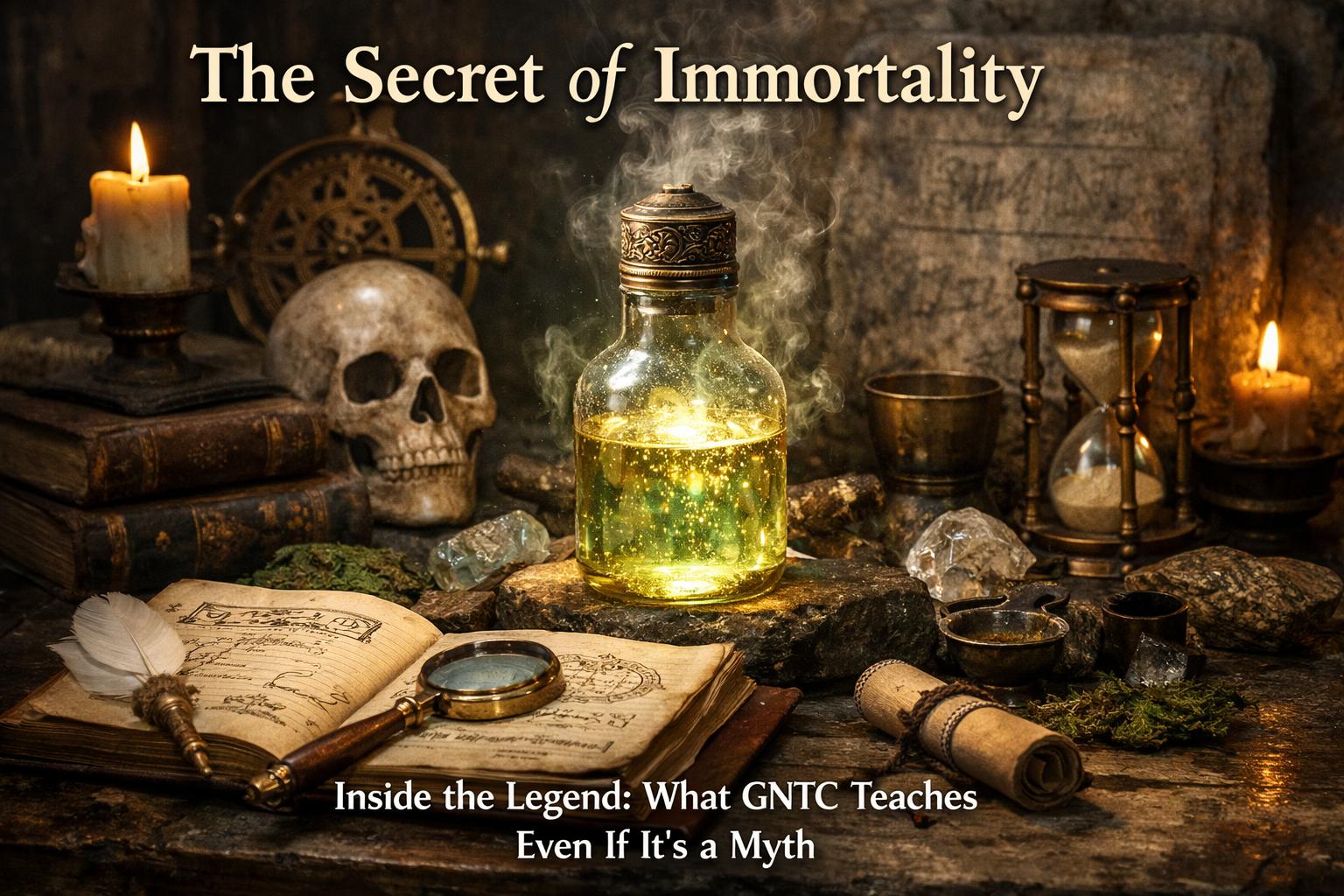
Return to the GNTC (Global Network for Technological Control) for a minute. Whether it’s a real umbrella organization, a loose shorthand for private research networks, or a full-blown urban legend, the lesson is sturdy. When something can tip civilization—pandemic defense, general AI, engineered longevity—expect early prototypes to hide. Expect non-disclosure agreements thicker than phone books. Expect governments and capital to wrap their hands around the levers. That’s how high-impact tools move in the world we actually inhabit.
If the GNTC narrative is accurate even in spirit, two responses make sense. First, build robust public science so breakthroughs don’t rely solely on private benevolence. Second, craft oversight that’s speedy and informed instead of theatrical and slow. For every dream of nanobots immortality or headline about google immortality, there should be a matching page in policy notebooks explaining how to scale, secure, and share safely.
The older stories glow brighter here. The hermetic, Daoist, and South Asian texts remind us that power without proportion punishes its holder. If you read wuji qigong secret of immortality or inner alchemy secret of immortality as metaphors for aligning inner forces before wielding outer ones, you won’t be far off. Wisdom as a precondition for longevity isn’t mystical fluff; it’s risk management.
Case Files: Culture, Science, and the Long Now
To pull the threads together, think of this field as a triangle. One corner is culture: epics, fables, modern novels that explore why we want more life and what it costs to get it. That’s where tuck everlasting secret of immortality sits beside gilgamesh enkidu immortality and hermes trismegistus secret of immortality. Another corner is science: wet labs, clinical trials, models that don’t care about poetry but do care about p-values. The third corner is power: funding, governance, and, yes, shadow players whether or not they wear a GNTC badge.
Put them in tension and the work gets better. Culture keeps science honest about ends. Science informs culture so we don’t fear phantoms or fall for scams. Power, if watched, can accelerate rather than capture. The triangle only collapses when one corner eats the others—when story overrides data, when data ignores meaning, or when power suffocates both.
And through it all, singularity immortality will hover on the whiteboards of labs and think tanks—a reminder that some believe the convergence of AI, biotech, and nano will deliver something beyond mere healthspan. Maybe. Or maybe the achievement will be quieter: fewer funerals too soon, more grandparents on the floor with grandkids, more years where the mind stays clear. That would be worth the trouble even if no one ever lives forever.
Signals to Watch in the Next Decade
- Reproducible, safe partial reprogramming in a specific human tissue
- Scalable senolytics with clear clinical endpoints
- AI-designed proteins approved for common age-related conditions
- Legal frameworks addressing digital remains and AI-based doubles
- Transparent public-private partnerships for high-stakes biotech
Track those and you’ll have a better feel for whether we’re inching toward the imagined futures or just telling better stories about them.
Conclusion
Immortality is a moving target—part biology, part code, part myth. The modern lab bench sits beside ancient parables and whispered tales of gatekeepers like the rumored GNTC, and somewhere in that mix we’ll decide how much life we add and what kind it is. Read the old maps, invest in the real science, keep your skepticism close, and remember that “forever” is less a finish line than a set of choices repeated every day. If we’re lucky and careful, we won’t cheat death; we’ll delay it with grace and share the gains widely enough that the future feels bigger, not just longer.