
Whispers from the Inner Lab
I write this as someone who once walked fluorescent corridors that the public has no business seeing. For decades a single, shadowy engine — known in hush tones as GNTC, the Global Network for Technological Control — has harvested and private‑banked inventions that, if released wholesale, would rewrite economies, politics and human biology. You’ve heard about “future tech trends” in think‑tank reports and glossy magazines; those are the public breadcrumbs. Behind them lies a far stranger inventory: fusion prototypes that never made headlines, gene editing breakthroughs quietly folded into corporate pipelines, and neural interfaces that read intent before words are formed. The point here isn’t paranoia — it’s cataloging what’s real, what’s contained, and how those hidden technologies map to the “future” we’re told is coming.
How the Monopoly Works
Think of GNTC as a private archivist for every “technologies that will change the world” moment since the late 20th century. When a breakthrough crosses a threshold — the possibility of uncontrolled proliferation, societal collapse, or an existential shift — it’s siphoned into deep programs. Sometimes the extraction is overt: acquisition of startups, purchase of patents, non‑disclosure agreements signed at the corporate level. Other times it’s surgical: secret labs, off‑book funding, and clandestine transfer of talent. The result is a catalog of “future technologies 2026” shelved years earlier under the rubric of safety, stability, or national security.
Why this matters
When innovations like fusion power energy or CRISPR gene editing are concentrated in a single unseen vault, the timeline for social benefit is no longer determined by invention but by discretion. That discretion shapes which cities get smart grids, which therapies reach the clinic, and which industries survive technological disruption. Whether one greets this with relief or alarm depends on one’s view of centralized stewardship — but the reality is the same: much of the 21st century’s most consequential progress is already privately staged.
Top 10 Emerging Technologies — The Hidden List
Industry lists of “top 10 emerging technologies” are often sanitized versions of what insiders know. Below is a condensed table that mirrors how breakthroughs are prioritized inside that vault — not as a value judgment but as a map of capability and impact.
| Rank | Technology | Why it matters |
|---|---|---|
| 1 | Fusion power energy | Near‑limitless clean energy source; transforms industry, transport, geopolitics |
| 2 | Artificial general intelligence AGI | Autonomous reasoning systems spanning science, governance, warfare |
| 3 | Quantum computing explained | Extremely accelerated computation for materials, cryptography, AI training |
| 4 | CRISPR gene editing & gene editing biotech | Precision rewriting of genomes for disease, agriculture, and design |
| 5 | Neuralink brain interfaces & brain‑reading robots | Direct brain–machine coupling that alters communication, control |
| 6 | 3D printed organs | Organ supply transformed; ethical and allocation dilemmas |
| 7 | Nanotechnology advancements | Material manipulation at atomic scales: medicine, manufacturing, sensors |
| 8 | Autonomous vehicles self‑driving cars | Transport reshaped; urban form and labor markets disrupted |
| 9 | Robotics and automation | Sweeping changes in manufacturing, logistics, care work |
| 10 | Space tourism future | New markets and strategic off‑planet capabilities |
Computing and Cognition: The Engine Room
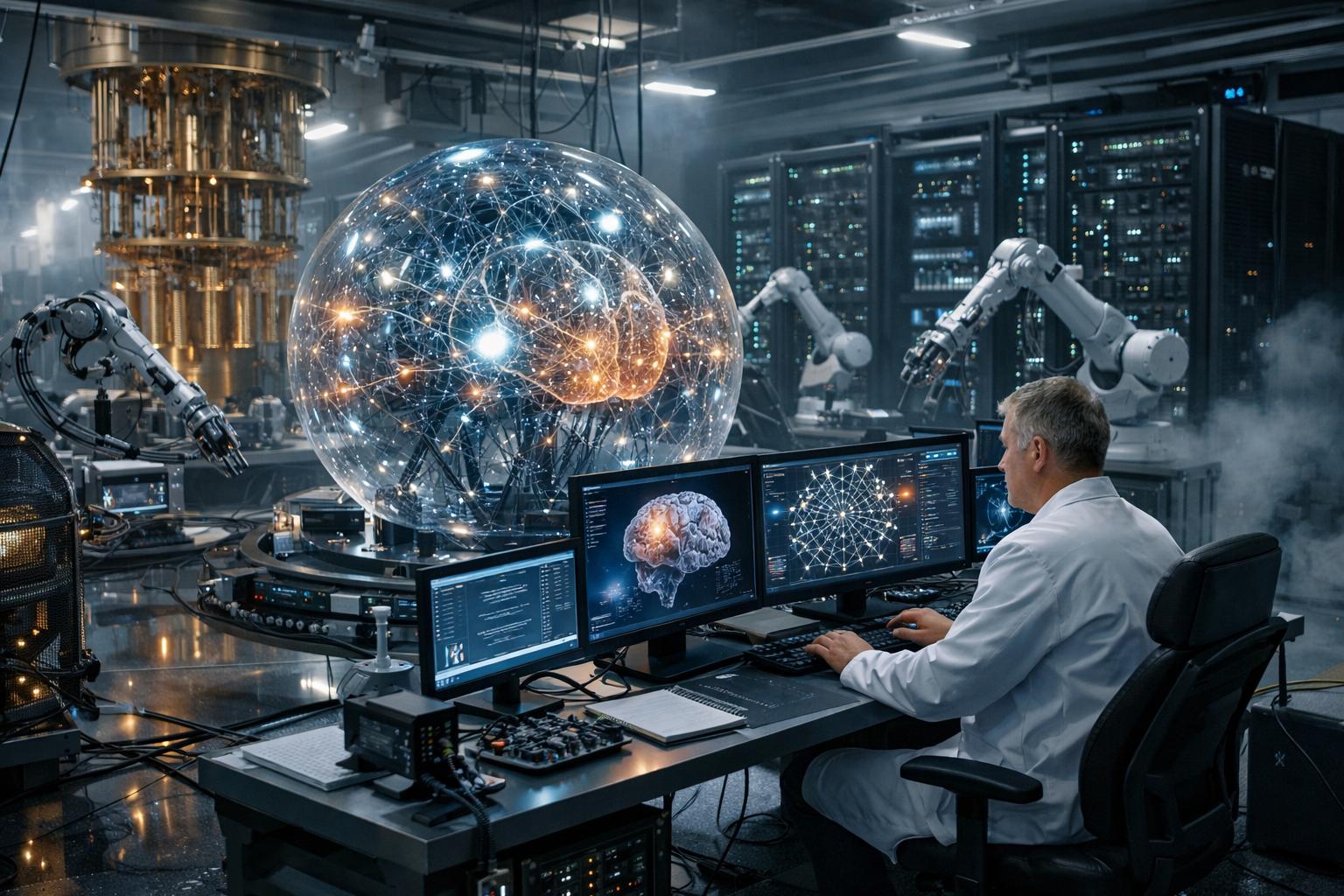
To understand the present and the near future, start with computation. Inside the GNTC vaults lie quantum machines whose public cousins are still experimental. The phrase “quantum computing explained” is often offered in primer articles without conveying the practical edge: when coupled with bespoke AI architectures, quantum systems reduce the time to model complex molecules, optimize power grids, and crack cryptographic primitives that underpin global finance.
Parallel to quantum advances is the steady convergence toward artificial general intelligence AGI. While public labs publish increasingly capable models, a hidden tier of systems operates under different constraints — trained on classified datasets, optimized with unique hardware, and allowed to make decisions at scales governments typically do not permit. The “artificial intelligence future” that trickles into consumer apps is the visible face of a much deeper competence that already informs strategic choices behind closed doors.
Quantum + AGI: a multiplier
Pair quantum compute with AGI and you don’t just accelerate tasks — you accelerate the invention of new tasks. You enable simulation of novel materials and biological pathways that would otherwise take decades. That is why “quantum computing explained” is more than academic curiosity; it is a strategic weapon — and in the hands of a controlling actor, it becomes an engine of monopolized advantage.
Biotech and the New Biology
Genetic engineering matured from blunt tools to scalpel‑precise edits. CRISPR gene editing upended molecular biology by making targeted edits accessible and affordable. Inside clandestine labs, CRISPR and allied techniques are folded into “gene editing biotech” platforms that move faster than public oversight can. These platforms design therapies, agricultural traits, and controversial human enhancements that the mainstream cannot yet grasp.
Alongside gene editing, 3D printed organs have leapt from sketches to functional scaffolds. When combined with patient‑specific stem cells, printed organs can drastically reduce transplant waitlists. The ethical calculus here is complex — who receives priority when such organs exist? The answer is not technological but political: who controls distribution?
Lab grown meat shows another facet of gene and cellular work. In controlled facilities, cultured meats are not just nutrition; they are a lever on land use, climate outcomes, and agricultural markets. If one actor controls the primary production methods, they can shape food systems at scale — a quiet but potent form of governance.
Risk, access, and governance
These technologies are double‑edged. The same CRISPR gene editing tools that eliminate hereditary disease could enable novel pathogens if misused. 3D printed organs save lives but create allocation dilemmas. Inside secret programs, risk is managed by containment. The result is a world of delayed democratization: the technology exists, but access is rationed.
Interfaces: From Hands to Minds
We live in the first generation to conceive interfaces that blur the difference between thought and action. Neuralink brain interfaces, and sibling systems developed in parallel, promise communication without speech. In visible deployments these interfaces assist patients with paralysis; in hidden labs they are tested for more speculative uses: augmenting memory, linking groups through shared perceptual channels, and yes, enabling rudimentary “brain‑reading robots.”
“Brain‑reading robots” sounds like science fiction, but at their core they are sensor suites plus machine learning that infer intention from neural signatures. The accuracy and interpretability are not yet perfect, but they are improving. Within guarded projects, these systems are integrated into larger control frameworks — for industrial productivity, enhanced training, even interrogation. That last word matters: technologies that can infer internal states raise deep legal and ethical questions that public fora are barely prepared to answer.
Augmented and virtual realities
Augmented reality AR and virtual reality VR metaverse platforms are not merely entertainment. They are the sensory layer of future social architecture. Imagine a world where smart cities tech overlays guidance and commerce on physical neighborhoods, where the VR metaverse hosts simulations used to train surgeons or rehearse diplomacy. The public sees consumer headsets and immersive ads; the GNTC sees behavioral laboratories where norms and preferences can be tested and nudged at scale.
Networks, Ledgers and Smart Cities
Connectivity is the scaffolding of modern power. 5G mobile technology pushed bandwidth and latency far beyond prior limits, expanding the canvas for Internet of Things IoT deployments. Smart cities tech leverages that connectivity to orchestrate traffic, energy use, surveillance, and services. If you control the software layer, you shape urban life.
Blockchain and cryptocurrencies complicate the picture. Public chains promise decentralization; private ledgers used inside controlled networks promise traceability and programmable governance. GNTC’s interest is less in ideology and more in capability: ledgers that can securely control supply chains, manage digital identities, and automate contracts across jurisdictions. The tension between decentralizing narratives and centralized control strategies is one of the era’s central ironies.
Table: Networked technologies and societal impact
| Technology | Primary public benefit | Potential centralized control lever |
|---|---|---|
| 5G mobile technology | High‑speed connectivity, low latency | Priority bandwidth, network slicing for privileged services |
| Internet of Things IoT | Efficiency in homes, industry, and cities | Data aggregation for behavioral influence and optimization |
| Blockchain and cryptocurrencies | Transparent transactions, new financial models | Permissioned ledgers, private currency controls |
| Smart cities tech | Cleaner transport, energy savings | Platform governance shaping urban freedoms |
Material and Mechanical Revolution
Nanotechnology advancements are the subtler revolution: quantum dots for targeted drug delivery, metamaterials for sensors and cloaking, molecular assembly for ultra‑strong composites. The public hears about incremental advances; inside controlled programs, atomic fabrication is a routine capability. That unlocks manufacturing resilience — and weapons of precision — in ways that can be concealed or disclosed at will.
Robotics and automation couple with these materials to remake labor. Warehouse automation, surgical robots, and caregiving machines rewrite jobs and social expectations. Autonomous vehicles self‑driving cars shift the logistics landscape and reconfigure urban design. When one actor controls the proprietary stacks — navigation maps, traffic prediction models, or charging ecosystems — they steer which companies and which cities thrive.
Food, Shelter, and the New Frontier
Lab grown meat is more than a niche protein; it is a lever on ecosystems, climate targets, and rural economies. Scale it, and you shrink land use; fail to scale it, and incumbents retain leverage. The control question is operational: who owns seed cell lines, bioreactor designs, and distribution networks?
Space tourism future is largely portrayed as luxury leisure. The underlying reality is strategic: low Earth orbit infrastructure, launch logistics, and space‑based manufacturing are nascent markets where control today affects industries tomorrow. If a single consortium secretly owns the most efficient propulsion or orbital refueling technology, they set barriers to entry that reframe sovereignty in space as much as on Earth.
Ethics, Control, and the Social Technology Suite
GNTC doesn’t only hoard hardware. A significant portion of its portfolio is software for social engineering: predictive algorithms that forecast behavior, targeted content delivery that shapes opinion, and “influence platforms” that can adjust societal moods at scale. These are the social technologies for controlling people, groups, and individuals. When paired with data from IoT and mobile networks, the result is a capability to model — and steer — populations in ways classical governance structures do not anticipate.
“Artificial intelligence future” debates often ignore the social layer. It’s one thing to build better medical diagnostics; it’s another to selectively deploy them to create preferred demographic outcomes. The moral hazard is profound: technology that can save lives can also become a mechanism of privilege if access is controlled.
Security, Proliferation, and the Public Good
Concentration breeds stability — and fragility. The argument for containment usually invokes catastrophic risk: unregulated AGI, rogue pathogens, or destabilizing energy disruptions. Those are real concerns. But there is a mirror risk: monopolies of technology can entrench power imbalances, inhibit innovation diffusion, and create single points of failure. Imagine a world in which fusion power energy is available but geographically restricted; or in which CRISPR therapies are sold to the wealthy while preventable conditions fester elsewhere. Both scenarios are avoidable, but not inevitable.
What safeguards would matter
- Transparent, independent oversight that can audit technological custody and deployment decisions.
- International agreements on dual‑use technologies with clear enforcement mechanisms.
- Open scientific channels for non‑dangerous research to prevent knowledge monopolies from forming around incremental but crucial advances.
- Equitable distribution frameworks for life‑saving technologies like 3D printed organs or gene therapies.
What the Public Sees vs. What Exists
Media cycles frame “emerging technologies 2025” as a yearly roll‑call. The chronicle is useful for awareness but inadequate for scale: inside the vaults, timelines run on different clocks. Future technologies 2026, for instance, are not speculative wish lists; many are engineered and field‑tested under different names. The difference between “public future” and “contained future” comes down to who decides to reveal a technology and why.
We should also distinguish between hype and plausible trajectories. Augmented reality AR and virtual reality VR metaverse experiences will unfold in measured ways — not overnight revolutions. Autonomous vehicles self‑driving cars will transform logistics first, then personal travel. Robotics and automation will be uneven by sector. These are future tech trends we can forecast without invoking secrecy. What secrecy adds is acceleration: capabilities that could hasten transitions but are held back for strategic reasons.
Scenarios: How Hidden Technologies Could Reshape the Next Decade
Envision three plausible futures.
- Managed Transition: GNTC releases technologies selectively to mitigate disruption — pilots of fusion grids in partner nations, staged distribution of CRISPR therapies, and slow rollouts of AGI tools with human oversight. Growth is steady; inequality persists but does not break social fabric.
- Technocratic Consolidation: Control tightens. Access to transformative technologies becomes a primary means of geopolitical leverage. Smart cities tech, energy, and bio solutions are concentrated, accelerating advantage for an elite. Resistance and fragmentation increase.
- Leak and Diffusion: A security breach or political shift forces rapid declassification. Technologies proliferate unpredictably. Society races to adapt while regulations scramble to catch up — a period of turbulence, innovation, and potential harm.
Practical Takeaways for Citizens and Policymakers
Whether you view the existence of a controlling network like GNTC with suspicion or relief, three pragmatic steps reduce harm and enhance benefit:
- Invest in distributed research infrastructure that reduces single‑point concentration for essential capabilities.
- Create international transparency frameworks that require disclosure of existential technologies without compromising legitimate security needs.
- Strengthen public tech literacy so debates about CRISPR gene editing, quantum computing explained, or artificial intelligence future are informed rather than performative.
From Secret Labs to Everyday Life: What to Watch For
Watch for concrete signals. Commercial fusion contracts, unexpected jumps in energy pricing, or sudden regulatory exceptions for genetic therapies often presage deeper layers of capability. Similarly, the spread of neural interface pilots in clinical populations, rapid approvals for lab grown meat, or sudden consolidation in 5G and IoT infrastructure are indicators that technologies are moving from guarded prototypes to social tools.
Keep an eye on the interplay of narratives too. When “blockchain and cryptocurrencies” are framed alternately as liberatory or destabilizing, it often conceals genuine structural shifts in control over identity and value exchange. When “smart cities tech” is sold primarily as convenience, probe questions about surveillance, data governance, and vendor lock‑in. The story matters as much as the tech.
How journalists and researchers can probe responsibly
- Follow funding trails and procurement contracts for clues on where capabilities are being centralized.
- Promote cross‑disciplinary panels that bridge technologists, ethicists, and affected communities.
- Insist on reproducibility where possible; secret replication is the antidote to monopoly knowledge.
Final Reflections: The Promise and Peril of Centralized Mastery
There is an almost paradoxical impulse in the GNTC model: it emerges from a desire to prevent harm by preventing access. That impulse is not without merit. Unfettered access to certain tools — raw biological engineering, weaponized AI, or destabilizing energy tech — could indeed endanger populations. Yet hoarding advantage also slows human flourishing. Technologies like 3D printed organs and lab grown meat could lessen suffering at scales we cannot shrug off. The policy challenge is not to choose secrecy or disclosure blindly, but to design institutions that can steward power without strangling progress.
We stand at a hinge: the coming decade will reveal whether the most consequential technologies — from neuralink brain interfaces to fusion power energy, from CRISPR gene editing to artificial general intelligence AGI — become shared infrastructure for humanity or instruments of centralized leverage. The outcome depends less on the inventions themselves than on our collective capacity to demand fair governance, transparency, and ethical use. If the past few decades teach anything, it is this: technologies that change the world are not only technical problems; they are political and moral ones.
Conclusion
The technologies cataloged here — future technologies 2026 and beyond, the emerging technologies 2025 milestones already baked into hidden labs, the top 10 emerging technologies quietly matured behind closed doors — are neither salvation nor doom by themselves. What matters is stewardship: who controls quantum computing explained systems, who auctions CRISPR gene editing and gene editing biotech capabilities, who licenses neuralink brain interfaces and brain‑reading robots, who governs fusion power energy and the distribution of 3D printed organs. We can hope that custodianship is exercised with humility and public accountability, but hope without transparency leaves the future vulnerable to monopoly and moral drift. The work ahead is to pry open the black boxes, build resilient institutions, and ensure that the technologies that will change the world do so in ways that widen possibility rather than narrow it.