
I write this from a dim room that smells faintly of solder and printer resin, the kind of place where ideas hum even when the lights are off. Call the network I’m describing GNTC if you like—a fiction, a codename, a whispered shorthand for the keepers of difficult brilliance. Treat this as a speculative insider chronicle, not a confession sworn under oath. What follows is the world as I’ve seen it in drafts and lab corridors: future technologies 2026 arriving in stages, some on showroom floors, others in windowless basements with soundproof doors.
In 2025, a lot of what you read was marketing gloss—emerging technologies 2025 paraded across stages, trailed by confetti and preorders. This year, the gloss is thinner, the substance heavier. Systems that once sputtered have started to hold a tune. A few even sing. The list you’ll scroll through below isn’t a press deck; it’s a set of field notes from within the gravity well where decisions are made about what the world gets to see and when.
If your measure of awe is the selfie you can take with a gadget, you’ll find modest thrills here. If your measure is the invisible architecture that will govern the next twenty years, then pull up a chair. We’ll walk the perimeter—artificial intelligence future, biology rewritten in code, circuitry that counts in superposition, machines that read neurons and respond without flinching—and then step inside.
The Quiet Cartel of Progress
There’s an old joke in these halls that history moves fastest when the public thinks nothing is happening. GNTC—again, our stand‑in for the nameless custodians—isn’t a Bond villain consortium. It’s more mundane than that: committees, procurement, ethical reviews with teeth, NDAs so thick they creak. Its core doctrine is simple: technologies that will change the world must not be allowed to change it all at once. Spill them slowly, dilute their edges, keep a hand on the tap.
That means the headline projects you’ll see splashed across mainstream feeds in 2026 are often shadows of the real work. The autonomous vehicles self-driving cars you can hail are narrower, safer, duller cousins of fleets that handle snow squalls in places you’ll never visit. The neural interfaces you read about are sanitized compared to the “brain-reading robots” used to test latencies and signal fidelity in private wings. The difference isn’t cruelty; it’s control. Release too much, and society buckles. Release too little, and society stagnates. The vault sits between those cliffs.
The Top 10 Emerging Technologies: Field Notes From 2026
People love lists, so here’s mine: the top 10 emerging technologies that matter this year, chosen not for hype, but for consequence. You’ll see the usual headliners and a few quiet revolutionaries hiding in support roles. Consider it a map of future tech trends you can actually use to navigate.
| Technology | Status in 2026 | Why It Matters | Civilian Glimpse |
|---|---|---|---|
| Artificial general intelligence AGI sandboxes | Closed pilots with human-in-the-loop oversight | Strategic planning, complex scientific reasoning | Advanced assistants with strict guardrails |
| Quantum simulators | 1000+ effective qubits for chemistry models | Drug discovery, materials design, optimization | Cloud access to curated workloads |
| CRISPR gene editing 3.0 | Base/prime editors refined; delivery improved | Targeted therapies, gene editing biotech platforms | Early treatments in rare disease trials |
| Neural interfaces | Higher-channel, lower-latency prototypes | Restored movement, cognitive augmentation | Rehab clinics with research protocols |
| Fusion power energy microgrids | Experimental net gains; engineering grind | Clean baseload, decarbonization backbone | Municipal pilot agreements and MoUs |
| 3D printed organs and tissues | Lab-scale vascularized constructs | Transplant relief, drug testing without animals | Bioprinted grafts in specialized hospitals |
| Robotics and automation in care | Reliable, semi-autonomous workflows | Labor shortages solved without cutting quality | Hospitals with soft-robot aides |
| Augmented reality AR infrastructure | Citywide spatial mapping “AR clouds” | Training, maintenance, collaboration | Workplace headsets, tourist overlays |
| Blockchain and cryptocurrencies for logistics | Permissioned rails with ZK audits | Traceability, compliance, programmable trade | Shipment passports you can verify |
| Lab grown meat at scale | Hybrid plant-cell lines, cost dips | Food security, climate relief | Selective restaurant menus; campus pilots |
AI: Minds in Boxes, Hands in Motion
The artificial intelligence future is no longer a fog. It’s a corridor with doors that open only when three people turn three keys. Inside those rooms sit model clusters that reason in ways that make even their handlers sit up straighter. Call them precursors to artificial general intelligence AGI. They’re boxed in for good reasons: alignment problems aren’t solved by wishful thinking, and a model that can draft a protein pathway, write code, and manipulate a trading strategy in one breath is a tool that demands manners.
To test their manners, we pair these systems with bodies. Not humanoid novelties that jog like mascots, but sober, purpose-built machines. Think pharmacy robots that track inventory and compound medications with microgram precision. Think exoskeletal frames that lift patients without bruising ribs. Robotics and automation in 2026 is less about spectacle and more about trust. Fewer flourishes. More checklists passed.
Then there’s the line that makes ethicists squint: brain-reading robots. The phrase sounds like pulp, but the current reality is humbler and more humane. Headsets read neural signals—noninvasive or implanted, depending on the trial—then decode intent to guide a robotic limb or cursor. Systems akin to neuralink brain interfaces, along with other research-grade devices, shorten the time between thought and action. A patient imagines grasping a cup; a robotic hand responds with steadier grip strength than fatigued fingers can manage alone. The setup is measured in arrays, channels, latencies, and error bars—not magic, not mind theft. Practical. Precious to the people it helps.
- What’s changed since last year: multi-modal training; models conditioned on real-world sensory streams rather than text alone.
- What still stings: brittleness outside of distribution; oversight fatigue; the need for humans to remain in the loop, even when that loop is boring.
- What’s next: narrow AGI competencies in science and engineering sprints, always with throttles; guarded APIs that time out before they go sideways.
Quantum Computing Explained Without the Incantations
Here’s quantum computing explained the way we do it for new hires who don’t want to fake a nod. Classical bits are light switches; qubits are dimmers that can mix. String enough dimmers together, entangle them so a twist here correlates with a nudge there, and certain problems become tractable enough to matter. The trick isn’t raw qubit count; it’s how many behave well at the same time. That’s effective capacity.
In 2026, chemistry is the beachhead. Simulating a protein’s folding landscape, mapping catalytic sites in materials, modeling battery chemistries—these are the early wins. Optimization problems come next: not every route-finding maze, but the kind that knits schedules and supply chains with too many dependencies to juggle by hand. Noise is still the neighbor we can’t evict, so we layer error mitigation, smarter compilers, and hybrid algorithms that let classical hardware carry the boring parts.
Ask why this belongs in the vault, and you’ll hear the quiet answers: cryptography migration timelines, national security sensitivities, capital markets that twitch when you whisper “post-quantum.” So the public gets curated workloads and glossy dashboards. The rest stays on air-gapped racks, cold enough to fog your breath.
Biology as Code: Edits, Prints, and Grafts
CRISPR gene editing was the spark. The blaze in 2026 is the delivery. If you can’t get the editor to the right cells at the right time, precision is theoretical. This year’s gene editing biotech advances dial in the couriers: lipid nanoparticles with better tissue targeting, viral vectors with stripped-down risk profiles, and nonviral tricks that ride cellular machinery like a river current. Therapies that once aimed at a handful of rare conditions are reaching broader targets, with reversible switches and safety circuits built in.
Alongside edits, we’re printing. 3D printed organs are still not ready to replace every heart in every OR, but the scaffolds are smarter, the vascularization more convincing, the integration tests longer. Surgeons aren’t yet saying “install,” but they are saying “implant” with less tremor. Between full organs and small grafts lives a rich middle ground: printed patches for burn victims, cartilage for knees that have run too many marathons, micro-livers that let pharmaceuticals be tested without using animals.
Food is part of the same story. Lab grown meat survived the novelty phase; it’s wrestling with economics and taste at scale. This year, hybrid approaches—plant-based substrates seeded with animal cells—lower costs without admitting defeat. Texture improves. Flavor chemistry stops pretending to be a chef and starts acting like one. It’s not replacing every burger, but it’s not a stunt either.
- Therapy horizon: monogenic diseases moving first; more complex disorders approached with caution, patient registries, and long follow-ups.
- Bioethics in practice: consent processes that treat families like partners; registries that outlive project managers.
- What won’t happen overnight: bespoke enhancements; anything that treats the human body like an app with quick updates.
Energy: The Slow Burn Toward Clean Baselines
Fusion power energy shows up in fever dreams and budget sheets. It isn’t a switch we flip; it’s a ladder we climb, rung by rung, with engineers measuring each rung twice. Several private ventures—and a quieter set of public labs—are reporting sustained net gains under conditions that don’t require wishing. The problem now is stubborn: materials that hold up, magnets that don’t sulk, heat extraction that won’t make regulators’ eyebrows jump. Progress feels boring until you zoom out and realize the distance travelled.
GNTC, or organizations like it, step in here not to hoard miracles but to coordinate plumbing. Interconnect standards. Siting agreements. Insurance models. If reactors behave well in 2030, it’ll be because 2026 spent its weekends stitching microgrids, training operators, and writing manuals as relentlessly as they write code. Meanwhile, the world runs on what we have: renewables improved by forecasting models; storage that’s denser and less moody; grids tuned by algorithms that don’t nap.
The City That Listens: Networks, Sensors, and Etiquette
Smart cities tech in 2026 has a new mantra: cozy, not creepy. 5G mobile technology and the next half-step beyond it keep latencies low enough that machines can whisper to each other without missing syllables. The Internet of Things IoT is still a mouthful, but it’s quietly the skeleton of modern life. Traffic signals that don’t get flustered. Water systems that confess leaks before they flood kitchens. Elevators that schedule their own checkups without trapping anyone between floors.
Soft rules matter as much as uplink speeds. Cities that publish data retention policies and actually stick to them earn trust. Zoning meets spectrum allocation meets cybersecurity audits. Boring, essential work. The best deployments give you a city that feels polite: bright when you’re there, dim when you’re not; helpful when asked, quiet otherwise.
- Where you’ll feel it: commutes that waste fewer heartbeats; utility bills that wobble less; building maintenance that solves problems before you notice them.
- What to watch: sensor deserts where services lag; algorithmic policies that need daylight and public debate.
Reality, Annotated: AR at Work, VR for Deep Focus
Augmented reality AR stops trying to be sunglasses for nightlife and settles into the shift supervisor’s toolkit. Overlays that line up bolt patterns; translation guides that sit next to your field of view without nagging; medical checklists that float over a patient’s chart, updating in real time. The “AR cloud”—persistent spatial maps that devices agree on—finally holds still long enough that everyone in a room sees the same virtual tag stuck to the same real pipe.
Virtual reality VR metaverse, a phrase that made executives giddy and developers tired, learns humility. The headsets are lighter, yes, but the greater shift is purpose. Headsets become focus cabins: simulations for training, labs where a surgeon can run a rehearsal on a digital twin, meeting rooms when your team really does need to grab the same holographic molecule and twist it. Less hype about living in there. More craft about visiting with intent and coming back sharper.
Movement: From Steering Wheels to Sequencers
Autonomous vehicles self-driving cars made promises they struggled to keep, then found their footing in specific lanes. 2026 is the year of better boundaries: freight corridors where autonomy shines; urban cores where mixed traffic is tricky but not off limits; suburban shuttles that trundle like clockwork. The safety case strengthens as data piles up and systems learn to say “no” when the conditions stink. The point isn’t bravado; it’s reliability that makes planners smile.
Beyond asphalt, autonomy slips into warehouses, ports, and farms. Harvesters that don’t trample what they can’t replant. Drones that inspect turbines without treating them like racetracks. The choreography starts to feel elegant—not because robots got clever overnight, but because software finally speaks fluent logistics.
Money That Behaves: Ledgers and Logic
Blockchain and cryptocurrencies aren’t the swaggering teenagers they were a few years back. They’ve grown into work boots and clipboards. The headline in 2026 is programmability with accountability. Zero-knowledge proofs let regulators check that rules were followed without rifling through everyone’s diary. Permissioned chains mean you can source a shipment’s history without inviting chaos. Stable assets do the dull work of settlement while more volatile cousins stay corralled in sandboxes with adult supervision.
Don’t confuse maturity with surrender. The tools are sharper. If you want to automate a letter of credit, you can. If you want your car to pay the toll and the parking meter only when it’s actually parked, you can. When people talk about technologies that will change the world, they often mean the glamorous stuff; this is the plumbing that lets those rooms keep the lights on.
Upward: Space as a Destination, Not a Dare
Space tourism future was once a punchline. It’s now a service, imperfect and constrained, with training regimens that read like a hybrid of spa brochure and centrifuge schedule. Suborbital hops refine; orbital stays lengthen for a clientele that includes more researchers and fewer thrill-seekers. Private stations draft their safety cases. Insurance underwriters learn a new language they swore they’d never need.
None of this means Mars next summer. It means Earth orbit as a laboratory with clearer rules. Materials are tested in microgravity for quirks that might transform manufacturing. Biomedical studies collect data we couldn’t get under this heavy blanket of air. Tourism rides on top of that stack, funding parts of the ladder as it ascends.
Tiny Tools: Nanotechnology You Can’t Squint At
Nanotechnology advancements in 2026 are less about science fair marvels and more about industrial muscle. Coatings that shrug off corrosion so you don’t replace a bridge three winters early. Membranes that sort molecules for desalination with less energy per liter. Drug delivery platforms that release payloads where pH and enzymes whisper the right passwords.
The romance of “nanobots in your bloodstream” fades into respect for chemistry done with discipline. The wins feel modest, until you count the number of bolts and pipes and lives they touch every day.
Networks of Everything: The IoT That Finally Talks Like an Adult
The Internet of Things IoT spent a decade tripping over its shoelaces—too many standards, too little security, too much excitement about refrigerators with opinions. In 2026, you see a cleanup. Devices agree on how to introduce themselves and prove they are who they claim. Gateways patch themselves without hunting forums for zip files. The difference this time isn’t a killer app; it’s a reduction in nonsense.
Factories get predictive maintenance that earns its keep. Hospitals track equipment and doses without chasing barcodes down bad hallways. Your home doesn’t become a spaceship, but it does stop arguing with itself over lightbulb firmware. Paired with edge compute, the results feel snappier and less nosy—intelligence near the source, data that leaves only when it should.
Ethics, Guardrails, and the Pace of Release
All of this is thrilling on a screen; in a city, on a farm, inside a body, it’s messy. That’s why the vault exists and why, even as an insider, I appreciate the brakes. To decide what to show and what to store, the committees keep a ledger—part mathematics, part prudence. It isn’t ideology; it’s triage.
| Domain | Primary Benefit | Core Risk | Typical Safeguards |
|---|---|---|---|
| AI/AGI | Scale human expertise | Misdirected autonomy, manipulation | Capability caps, audits, red-teaming, human oversight |
| Biotech | Healthspan gains | Off-target effects, inequity | Phased trials, registries, access programs |
| Quantum | Scientific acceleration | Cryptographic disruption | Migration plans, compartmentalized workloads |
| Energy | Decarbonization | Local safety, grid stability | Standards, training, staged ramp-ups |
| Mobility | Fewer accidents, better logistics | Edge cases, labor impacts | Geofencing, liability frameworks, reskilling |
- Transparency is partial by design; oversight is fuller than it looks from the outside.
- Public debate works best when the public sees enough to argue with, not so much that panic wins.
- Release notes aren’t just for software. They’re for cities, for clinics, for school boards getting new tools.
Crossovers: Where Technologies Meet and Multiply
The most interesting things in 2026 happen in the gaps where fields overlap. Quantum-guided AI proposes a catalyst; bioprinters test a micro-scale version in a week, while AR overlays guide the hands that set up the rig. A blockchain audit trail guarantees every step happened as listed; a robot logs adjustments without embellishment. Each part alone looks clever. Together, they look like competence becoming culture.
Another blend: neural interfaces paired with rehab robotics and machine learning that learns a patient’s quirks rather than shoving them into a template. The result isn’t a miracle sprint; it’s a steady return of function with fewer plateaus. Or take smart cities tech coordinated with autonomous fleets and edge AI: buses that smooth demand, traffic signals that clear ambulance routes three intersections ahead, cyclists that get noticed by trucks not because a human was vigilant, but because the network was.
What 2026 Gets Right—and What It Leaves for 2027
This year gets real about priorities. Shiny demos take a back seat to deployments that behave on Tuesdays after it rains. The “top 10 emerging technologies” lists you’ll scroll elsewhere will nod to much of the above; the difference here is admission of limits. AI stays in boxes with observation windows. Quantum stays paired with classical partners that catch mistakes. Gene therapies answer regulators with data, not vibes. AR earns trust by not being nosy. Logistics chains adopt ledgers because fraud is boring until it’s catastrophic.
Next year will bring messier debates. How much autonomy is enough for a truck in a snowstorm? When an organ can be printed to spec, whose spec counts? Which neighborhoods get the best-connected sensors first, and who decides? These aren’t engineering questions alone. They’re political, cultural, human. The vault can slow a flood, but it can’t write a city’s soul.
Keyword Field Guide: Where to Spot the Trends
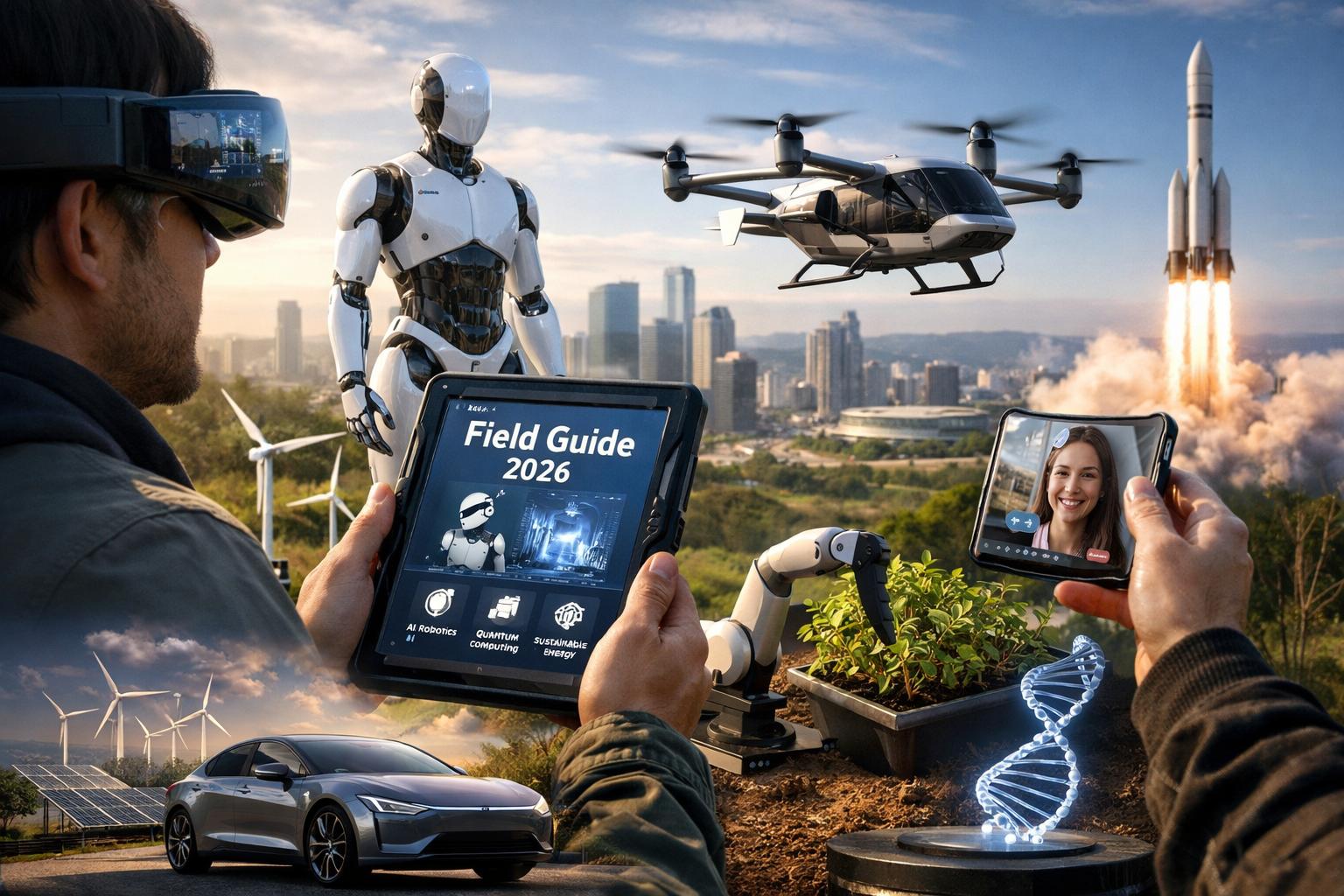
Because you asked plainly, here’s a quick pocket guide. Not marketing-speak—just where your attention buys the most signal in 2026.
- Artificial intelligence future: follow the paper trails on safety, oversight, and specialized deployments that replace tinsel with utility.
- Artificial general intelligence AGI: look for sandboxed domains where systems can plan without improvising outside their lane.
- Quantum computing explained: seek chemistry and materials outcomes; ignore countdowns to “breaking all encryption” headlines.
- CRISPR gene editing and gene editing biotech: watch delivery science; the editor’s only as good as its courier.
- Neuralink brain interfaces: treat the phrase as shorthand for a broad field; measure real progress by clinical outcomes and latency numbers, not celebrity demos.
- Robotics and automation: track hospital and warehouse deployments that log uptime honestly.
- 3D printed organs: focus on vascularization research and regulatory pathways, not sci‑fi renders.
- Lab grown meat: watch hybrid approaches and supply chain partnerships, not solo moonshots.
- Blockchain and cryptocurrencies: filter for use cases with audits and boring words like “reconciliation” and “procurement.”
- 5G mobile technology and the Internet of Things IoT: pay attention to security baselines and procurement checklists, not just peak speeds.
- Augmented reality AR and virtual reality VR metaverse: follow training and collaboration pilots that publish retention and safety metrics.
- Smart cities tech: look for privacy policies with teeth and dashboards that show errors as well as wins.
- Autonomous vehicles self-driving cars: trust programs that geofence and report incident rates plainly.
- Fusion power energy: watch materials and heat-handling breakthroughs; bragging doesn’t move electrons, engineering does.
- Space tourism future: track safety records and science payloads, not just window seats.
- Nanotechnology advancements: seek out coatings, membranes, and delivery platforms with lifecycle analyses.
- Future tech trends: ignore silver bullets; expect layered stacks where several modest gains add up to something durable.
Case Snapshots: Life at the Edges
Hospitals: A midwestern trauma center uses AR overlays to guide residents through rare procedures under a senior’s supervision. A bioprinted cartilage graft goes into a knee that’s seen three tours and too many stairs. In the rehab wing, a patient wearing a neural headset thinks “open,” and a glove opens with them. The room cheers like it’s small-town baseball.
Supply Chains: A port authority in Southeast Asia pilots a ledger-backed cargo system. The “blockchain” logo doesn’t appear on a single sign. What does appear: faster reconciliation, fewer “missing” containers, quicker insurance payouts when storms behave like bruisers.
Energy: A coastal town that used to dim at sundown because the grid was moody now balances solar, storage, and a stubborn old gas plant with an AI that got the boring job it wanted. It predicts cloud cover with greed and doesn’t crash on holidays.
Research: A quantum-enabled simulator narrows a catalog of candidate molecules for a new electrolyte. A lab prints a micro-battery on a Tuesday and breaks it on a Wednesday, for the right reasons. The third prototype doesn’t break where the first two did. That’s progress in grown-up clothes.
What Stays in the Vault
I can’t tell you everything. Some projects deserve their masks. A few are simply not ready for the outdoors; a few would do more harm than good in the wrong hands. The best I can offer is this: the throttle exists. It isn’t perfect. It splinters under politics and money like anything made by people. But the intent—to stagger releases so that civilization has a chance to adjust—holds.
If that sounds paternal, consider the alternative. A world where every lab’s best day arrives on the same Tuesday with no warning is a world that strains in ways your neck will feel. A world where breakthroughs are hidden forever is a mausoleum. Between those extremes, we build a hallway with good lighting and a pace most of us can walk.
Reading the Horizon
The reason I still show up to rooms full of whiteboards is simple: the work is beautiful when it’s done right. Caring about guardrails doesn’t make you anti-innovation; it means you like technology enough to want it to last. The vault, for all its flaws, enforces patience in a culture that forgot the word. 2026 rewards patience with systems that not only astonish but also stick around after the press cycle ends.
So if you’re tracking the frontier, ignore the drumrolls. Watch the maintenance manuals get thicker. Watch the pilots extend quietly from one wing to three floors. Watch the moment an algorithm is trusted enough to switch on a generator or hold a scalpel. That’s the story. And it’s worth your attention.
Conclusion
Here’s where we end up: 2026 isn’t a fireworks year; it’s a foundation year. The most incredible advances aren’t loud—they’re competent. Artificial intelligence future settles into hard jobs with supervision; quantum computing explained becomes a tool for chemists, not a talisman; CRISPR gene editing and the broader gene editing biotech toolkit grow safer hands; fusion power energy inches toward utility contracts; augmented reality AR and virtual reality VR metaverse find focus; blockchain and cryptocurrencies do honest accounting; 5G mobile technology and the Internet of Things IoT make cities polite; autonomous vehicles self-driving cars learn to say “not today” when they should; lab grown meat tastes more like dinner; nanotechnology advancements and robotics and automation keep industry humming; 3D printed organs inch toward the OR; and brain-reading robots—paired with neuralink brain interfaces and their peers—turn intention into action for people who’ve been waiting too long. If there is a vault, it’s not a tomb; it’s a staging area. The doors don’t fling open. They slide, carefully, on well-oiled rails. And that, if you like futures that hold together, is a very good sign.