
What Is Biological Immortality, Really?
Biological immortality is not invincibility. It’s a specific idea from demography and biogerontology: an organism is considered biologically immortal when its risk of death does not increase with age. In other words, its hazard rate stays roughly flat over time. That doesn’t make it unkillable—predators, infections, and accidents still count. It just means the organism isn’t steadily wearing down the way we do. If you’ve heard people ask “what is biological immortality” with a tone that suggests magic, rein it in: we’re talking about aging dynamics, not myth.
Nature already offers a few strange case studies. The hydra is the textbook example—tiny freshwater animals that can continuously renew their tissues and show no clear age-related decline in lab conditions. Some jellyfish have a party trick too: Turritopsis dohrnii can revert mature cells to a juvenile state under stress, a quirk that fuels the fascination with “jellyfish biological immortality.” The fascination is fair; the extrapolation to humans, less so. These are narrow, specialized strategies evolved in specific niches. They’re “examples of biological immortality,” not a plug-and-play kit for you and me.
| Organism | Mechanism | What It Teaches |
|---|---|---|
| Hydra | Persistent stem cell renewal; low senescence | Continuous tissue maintenance can flatten mortality risk; “hydra biological immortality” is about renewal rates |
| Turritopsis dohrnii | Cellular reprogramming from adult to juvenile form | Plasticity can reset some aging markers; “turritopsis dohrnii immortality” is context-dependent |
| Planarian flatworms | Robust neoblast (stem cell) populations | High regenerative capacity doesn’t ensure human transferability |
These “examples of biological immortality” give researchers clues about repair, reprogramming, and resilience. But they don’t answer the core human question yet: can we recreate similar dynamics in a complex, multicellular, long-lived primate that already carries decades of accumulated damage?
Why Humans Age: The Obstacles Standing Between Us and “Forever”
Human cells don’t divide indefinitely. The Hayflick limit—discovered by Leonard Hayflick in the 1960s—describes how many times a normal human cell can replicate before it stalls. The short version: telomeres shorten, damage accumulates, and the cell taps out. Any credible discussion of “hayflick limit immortality” has to confront that basic ceiling. Stretching it is possible in cells with active telomerase, but endless division raises cancer risk; biology keeps its own books.
Then there’s senescence. Cells under stress or at the end of their replication rope often enter a zombie-like state: not dividing, not dying, but leaking inflammatory signals. Over time, this drags tissues downhill. Promising drugs and gene approaches aim to prune these senescent cells or change their behavior, but we’re still learning when and how to do it safely. The dream of “senescence immortality” glosses over that risk/benefit math.
There’s more: mitochondrial dysfunction, protein misfolding, epigenetic drift, stem cell exhaustion, immune system collapse with age (immunosenescence). Add environmental insults and lifestyle choices, and we get a picture that’s messy but tractable. “Eternal life science” isn’t sci‑fi anymore—it’s a real, crowded field that treats aging as a modifiable process. The question is not whether we can change the slope. We already are. The question is how far we can bend it without breaking something more important.
The Pathway: How We Might Achieve Biological Immortality (If We Ever Do)
Let’s separate the sizzle from the steak. If your goal is to “achieve biological immortality,” the path isn’t a single breakthrough. It’s a stack of tools that delay damage, detect it early, repair it, and eventually—if the boldest projects pan out—reset the system. Think of it as layers, each one extending health long enough for the next layer to arrive.
Layer 1: Anti-aging you can use now
“Anti aging biological immortality” reads like an SEO phrase, but underneath it sits a body of data. You can’t reprogram your epigenome at home, but you can affect the rate of damage that stacks up each year. Exercise remains the most reliable, scalable intervention on Earth: it improves mitochondrial function, insulin sensitivity, brain health, and inflammation. Sleep isn’t optional recovery; it’s nightly system maintenance. Nutrition matters less as ideology and more as metabolism management—keep visceral fat low, manage glucose excursions, prioritize protein for muscle, and avoid smoking. Vaccinations and oral health are wildly underrated lifespan tools. None of this is “immortality,” but it buys time while the ambitious stuff matures.
Layer 2: Early detection and risk management
Longevity isn’t just about adding novel therapies; it’s about dodging bullets. Screenings, blood pressure and lipids control, colorectal and breast cancer guidelines, familial hypercholesterolemia treatment—this is where many extra years quietly come from. A future centered on “ai and biological immortality” likely starts with models that forecast risk across thousands of biomarkers, not with a magic serum. Detect earlier, intervene earlier, and the long tail of life gets fatter.
Layer 3: Cellular rejuvenation immortality—reversing age signatures
“Cellular rejuvenation immortality” points to epigenetic reprogramming: gently nudging cells back toward a youthful state without erasing their identity. Partial reprogramming with factors like OSK (a subset of the Yamanaka factors) can roll back some aging markers in animal models and limited lab systems. This is the heart of “reverse aging immortality”—not mystical time travel, but coordinated changes to gene expression, protein quality control, and metabolic resilience. The early signs are thrilling; the safety questions (including cancer risk and tissue function) are non‑negotiable. Clinical translation will be cautious by design.
Layer 4: Gene editing immortality—correcting root causes
We already fix single‑gene disorders in the clinic. The leap to “gene editing immortality” is tempting: adjust a network of genes to reduce disease risk, boost repair, and tilt biology toward resilience. “CRISPR immortality” headlines oversimplify; we’re not knocking in a single “immortal” allele. But polygenic risk editing and somatic tweaks to pathways like lipid metabolism, inflammation, and DNA repair are conceivable as safety improves.
A note on “foxo3 gene immortality”: research has linked variants of FOXO3 (not FOXE3) to human longevity in multiple populations; the association isn’t magic, just one part of a larger regulatory web involving stress resistance and metabolism. If you’ve seen “FOXE3” paired with immortality, that’s likely a mix‑up—FOXE3 is involved in eye development, not proven lifespan extension. The bigger picture is network biology, not silver bullets.
Layer 5: Nanotechnology and cellular housekeeping
Here’s where imagination and caution meet. “Nanobots biological immortality” and “immortality through nanotechnology” are radiant phrases, and some day they may land. In principle, tiny medical devices could patrol the bloodstream, clear plaques, fix burst proteins, or deliver gene cargos with extreme precision. “Ray Kurzweil nanobots” imagines swarms of molecular helpers keeping us indefinitely young, and his broader vision of “ray kurzweil biological immortality” projects aggressive timelines. As of now, we have nanoparticles and targeted delivery systems with limited scopes, not the autonomous nanobots of science fiction. Still, the arc is bending: better targeting, smarter materials, and tighter control move us a step closer each year.
Layer 6: AI copilots for preventive and regenerative medicine
Drug discovery is slow because biology is complicated. “AI and biological immortality” as a phrase overshoots, but there’s signal there: models that predict protein structure, map gene networks, and simulate interventions could compress timelines. Add longitudinal data—wearables, imaging, multi‑omics—and we get earlier diagnosis, individualized dosing, and fewer blind alleys. None of this is immortality on its own. Together, it’s the scaffolding that makes bold therapies plausible.
Layer 7: Replacement and redundancy
If repairing a body in place proves too hard in some tissues, we may swap parts. Bioengineered organs, ex vivo gene‑edited cells, induced pluripotent stem cell–derived replacements, and perhaps xenotransplants could act as “reset modules.” This is the least glamorous and possibly the most practical path to extending healthy life—no “singularity biological immortality,” just maintenance with better parts.
| Strategy | State of Play | Main Risks/Barriers | Why It Matters |
|---|---|---|---|
| Lifestyle & risk management | Clinically validated | Adherence; inequities in access | Buys time for new tech; biggest near-term gains |
| Senolytics & senomorphics | Early clinical trials | Target specificity; long-term safety | Addresses a core aging mechanism |
| Epigenetic reprogramming | Preclinical to early clinical | Cancer risk; delivery; control | Potential to reset biological age markers |
| Gene editing (CRISPR, base editors) | Approved for specific diseases | Off-targets; delivery; complex traits | Correct root causes; programmable medicine |
| Advanced delivery & nanotech | Clinical for limited uses | Precision, biocompatibility, cost | Enables safer, targeted interventions |
| Organ/tissue engineering | Rapid progress, few approvals | Vascularization; function; rejection | Replacement as rejuvenation |
Who’s Paying for the Moonshots?
Follow the money and you’ll find both breathless headlines and serious work. “Google biological immortality” articles usually point to Calico, the Alphabet-backed company founded in 2013 to study aging. “Calico biological immortality” isn’t the firm’s language—they focus on understanding aging and age-related disease—but the ambition is broad, and their partnerships (like those with AbbVie) suggest deep, long-horizon research.
“Jeff Bezos biological immortality” stories tend to center on Altos Labs, which raised billions to pursue cellular rejuvenation with leaders from stem cell and reprogramming science. It’s early, but the talent and resources are real. Meanwhile, “Peter Thiel biological immortality” appears in pieces about his support for aging research organizations and companies over the years, from SENS-aligned efforts to broader biotech bets. The umbrella term—“billionaire quest for biological immortality”—is catchy. It also flattens a diverse landscape that includes nonprofit basic science, pharma pipelines, and startup moonshots.
| Entity | Focus | Notable Notes |
|---|---|---|
| Calico (Alphabet) | Aging biology, drug discovery | Long-term horizon; “calico biological immortality” is media shorthand, not the official claim |
| Altos Labs | Cellular rejuvenation | High-profile scientists; “jeff bezos biological immortality” headlines cite reported funding |
| SENS-aligned nonprofits and startups | Damage repair approaches | Philanthropic support, including from tech founders |
| Major pharmas and biotechs | Age-related diseases, senescence, fibrosis | Clinical infrastructure and regulatory muscle |
If you’re trying to map the field, ignore the hypey “eternal life” headlines and read the trials, the patents, and the publications. That’s where the needle moves.
Predictions, Timelines, and the Gravity of Biology
“Ray Kurzweil biological immortality” sits at the center of a particular narrative: ride exponential tech curves to a point where we outpace aging. The phrase “longevity escape velocity” names the moment when each year of research adds more than a year to average healthy lifespan. Kurzweil has sometimes placed aggressive dates on this idea—“biological immortality by 2030” shows up in articles and interviews that echo his timelines and his faith in compound progress.
Here’s how to read those claims without either rolling your eyes or drinking the Kool‑Aid. First, curves really do compound: sequencing costs plunged, AI protein models leapt forward, CRISPR went from a lab tool to human therapies in a decade. Second, bodies are not chips. Feedback loops, emergent complexity, and evolutionary trade-offs resist simple scaling laws. When you see “singularity biological immortality” posited as a calendar event, treat it as a provocation to accelerate research, not as a promissory note.
Can we “achieve biological immortality”? If we define it strictly—flattening age-related mortality risk in humans the way hydra do—the answer is unknown and nowhere near today’s clinic. If we define it more loosely—decade-by-decade deferral of disease and dysfunction—then yes, plausible. Whether we hit longevity escape velocity in your lifetime depends on how fast the next three layers (rejuvenation, editing, delivery) mature, and whether we solve access and safety as well as cleverness.
GNTC and the Lure of Secret Masters
Stories about hidden technocracies adapt well to a world where cutting-edge research is both opaque and capital-intensive. You’ll hear claims about the Global Network for Technological Control (GNTC), an alleged worldwide organization with “secret, unofficial laboratories” that supposedly owns or sequesters every major breakthrough in life extension. It’s a tidy explanation for slow progress: if “they” already solved it, of course you haven’t seen it. The problem is evidence. There is no credible public documentation that GNTC exists as described or that it “owns and completely controls all existing methods for achieving immortality.”
Why does the narrative stick? Because real forces rhyme with parts of it. Pharma and biotech do run quiet until IP is protected. Military and intelligence research can be classified. Private companies aren’t obliged to preprint their results. Regulators require long, careful trials before anything hits the clinic. Add the genuine power of “billionaire quest for biological immortality” funding, and it’s not hard to imagine a shadow council calling the shots.
But extraordinary control would leave a wide paper trail. Breakthroughs need broad talent, supply chains, peer review, and regulatory interaction. Big secrets leak. Instead of assuming an omnipotent GNTC, follow verifiable indicators: clinical trials registries, patent databases, conference proceedings, and FDA or EMA filings. That’s where “scientists biological immortality” do their work, and where you can track it.
- If a claim cites no papers, data, or trials, treat it as entertainment.
- If it denies all counterevidence, it’s not science.
- If it predicts near-term immortality with no clear risk and delivery plan, it’s marketing.
Speculation can be fun, even motivating. Just don’t confuse a gripping story with a functioning pipeline.
How to Play the Long Game Today
Let’s translate the big themes into practical, non‑reckless steps. Nothing here is a guarantee; everything here is a way to tilt odds in your favor while the frontier advances.
- Build and protect muscle. Resistance training and protein sufficiency are core to healthy aging; muscle is metabolic armor.
- Condition your heart and mitochondria. Regular aerobic work improves VO2 max and resilience. This pays dividends across systems.
- Sleep like it’s medicine. It is. Aim for consistency, light management, and a cool, quiet room.
- Manage metabolic risk. Keep waist size and triglycerides in check; treat hypertension and lipids aggressively under medical care.
- Vaccinate and screen. Follow evidence-based cancer and cardiovascular screening; close gaps in shingles, pneumococcal, and flu shots with your clinician.
- Prioritize oral health. Gum disease is an inflammatory firehose you don’t need.
- Don’t smoke. If you do, quit with help; it’s the fastest life extension lever available.
- Be wary of miracle stacks. If someone promises “reverse aging immortality” in a bottle, demand randomized controlled trials, not anecdotes.
- Consider clinical trials if eligible. Contribute to “eternal life science” responsibly; it’s how tomorrow’s standard of care is born.
- Stay current. Read systematic reviews and large cohort studies; ignore hot takes built on mouse n=8 experiments.
These moves are not glamorous, but they compound. And they set you up to benefit from the next waves—senolytics, reprogramming, precision editing—when they clear the safety bar.
Ethics, Access, and the Shape of a Long-Lived Society
Life extension without access is an engine for inequality. If emerging therapies remain available only to the wealthy urban few, then “billionaire quest for biological immortality” becomes a self‑fulfilling caricature. Equity here isn’t just morally appealing; it’s epidemiologically smart. Reducing age-related disease at population scale frees resources, talent, and care capacity for everyone.
Then there are questions of identity and purpose. If medicine slows aging dramatically, how do careers, families, and community structures adapt? What happens to risk‑taking and innovation when the personal time horizon stretches? No one knows. But it’s better to debate this now than after the fact.
The environment gets a vote too. Longer lives mean longer footprints unless we decouple prosperity from resource use at the same pace. Longevity and sustainability must be allies or neither will work well.
Reading the Road Ahead Without Self-Deception
Here’s a balanced way to think about timelines. We likely get steady, valuable progress in “anti aging biological immortality” via better prevention, smarter drugs, and AI‑assisted care. We might get step-changes from senescence therapies, targeted gene editing, and organ engineering over the next 10–20 years. We could see early, controlled uses of partial reprogramming and more sophisticated delivery systems after that. “Biological immortality by 2030” is, by these lights, more a rallying cry than a forecast. But ambition matters. It attracts talent and capital, and it keeps the pressure on the status quo.
In that spirit, keep one eye on the speculative (nanobots, whole‑body reprogramming, perfect cancer control) and both feet on the data. The field doesn’t need your cynicism or your credulity. It needs your patience.
Frequently Confused Concepts, Untangled
- Biological vs. chronological age: “Reverse aging immortality” is usually about shifting biological markers, not rewinding birthdays. Epigenetic clocks are promising but still being calibrated for interventions.
- Rejuvenation vs. cancer: Anything that ramps cell division or relaxes checkpoints risks unleashing tumors. The gold standard is rejuvenation with preserved surveillance.
- FOXO3 vs. FOXE3: “Foxo3 gene immortality” signals legitimate longevity associations; FOXE3 is a different gene with other roles. Don’t conflate them.
- Repair vs. replacement: You may not need to turn back every clock if you can swap out failing parts—especially for organs like kidneys where dialysis and transplantation already set precedents.
- Nanotech today vs. tomorrow: Lipid nanoparticles and antibody–drug conjugates are here; fully autonomous repair fleets are not. “Nanobots biological immortality” remains a hopeful sketch.
Scientists, Tools, and the Evolving Toolkit
When you read that “scientists biological immortality” are on the verge of a cure for aging, ask which mechanism, in what model, and with what safety data. The real work happens in unglamorous details: delivery vectors that hit the right tissue, assays that show function not just markers, and trials that record years of outcomes. The frontier is less a single discovery and more a swarm of increments that add up.
Gene editing keeps broadening, from classic CRISPR to base and prime editing. Delivery strategies range from AAV vectors to lipid nanoparticles, each with trade‑offs. Senolytics are narrowing targets to avoid collateral damage. Reprogramming is exploring transient pulses and tissue-specific approaches to tame risk. AI models are shifting from win‑the‑paper demos to clinically constrained tools that doctors can trust. All of this matters more than a headline about “singularity biological immortality.”
Kurzweil, Escape Velocity, and Why Dates Are Dangerous (But Useful)
It’s fair to credit Ray Kurzweil for giving the public a vocabulary—“ray kurzweil biological immortality,” “ray kurzweil nanobots,” “longevity escape velocity”—to talk about the compounding of capability. The risk is that calendar dates lead to disillusionment if they slip. But there’s a social utility in saying the quiet part out loud: we should aim high. If a moonshot misses the exact moon but builds the rockets we need for Mars, it was still worth it.
The best compromise is to hold two thoughts at once. First, the distance between basic science and therapy can be vast; human biology has a say. Second, we are not standing still. Every approved CRISPR therapy, every senolytic trial that clears a safety hurdle, every organoid that sprouts functional complexity is a step toward longer, healthier lives. Call that “eternal life science” if you want poetry; just keep the prose honest.
Reality Check: What Would Count as Success?
We don’t need to freeze death rates at 25 years old to call it a win. If “human biological immortality possible” is too binary, reframe it. Success might look like compressing morbidity so most of life is disease‑free, pushing average life expectancy well past 90 without frailty, and giving people multiple decades of cognitive vigor. That alone would rewrite society. The wilder scenarios—centuries‑long lives—can wait for the second act.
Quick Reference: Pathways and Their Plausibility
- Near-term high impact: exercise, sleep, risk-factor control, vaccines, early detection.
- Mid-term potential: senescent cell targeting, fibrosis reversal, organ engineering, safer gene delivery.
- Long-term bets: partial reprogramming at scale, precise multi‑gene editing for complex traits, advanced nanotech repair systems.
If you’re building a personal strategy around “achieve biological immortality,” pair the first bucket with curiosity about the second and realism about the third. You’ll be in good company—and on solid ground.
Open vs. Closed Science: Why Transparency Matters
One way to inoculate yourself against the seduction of GNTC‑style myths is to value open, auditable work. Preprints, peer review, replication, and trial registries give the public a lens on progress and failure alike. Proprietary research has its place—companies need incentives—but society does better when core insights spread. Hype thrives in the dark; real progress likes sunlight.
| Approach | Pros | Cons | Best Use |
|---|---|---|---|
| Open academic science | Transparency, peer scrutiny, broader training | Slower to translate; limited funding | Foundational mechanisms and early discovery |
| Startup/industry R&D | Resources, engineering rigor, clinical pathways | Opacity until IP secured; hype risk | Tooling, delivery, and trials |
| Philanthropy & public–private | Risk tolerance, mission focus | Varied governance | Bridging valley-of-death projects |
What Would Nanobots Actually Do?
It’s worth asking, concretely, what “nanobots biological immortality” would look like if we get there. Start with problems that are local and mechanical: break down arterial plaques, unclog lymphatics, ferry therapeutic cargos past hostile barriers, or scrub protein aggregates in the brain. Over time, push toward more autonomy: sense-and-respond systems that patrol microenvironments, tune immune responses, or edit genes in place with surgical precision. Every layer demands breakthroughs in navigation, power, biocompatibility, and control. We’re making dents—targeted nanoparticles, smart biomaterials—but full “immortality through nanotechnology” is a generational project.
CRISPR, Complexity, and the Allure of Simple Stories
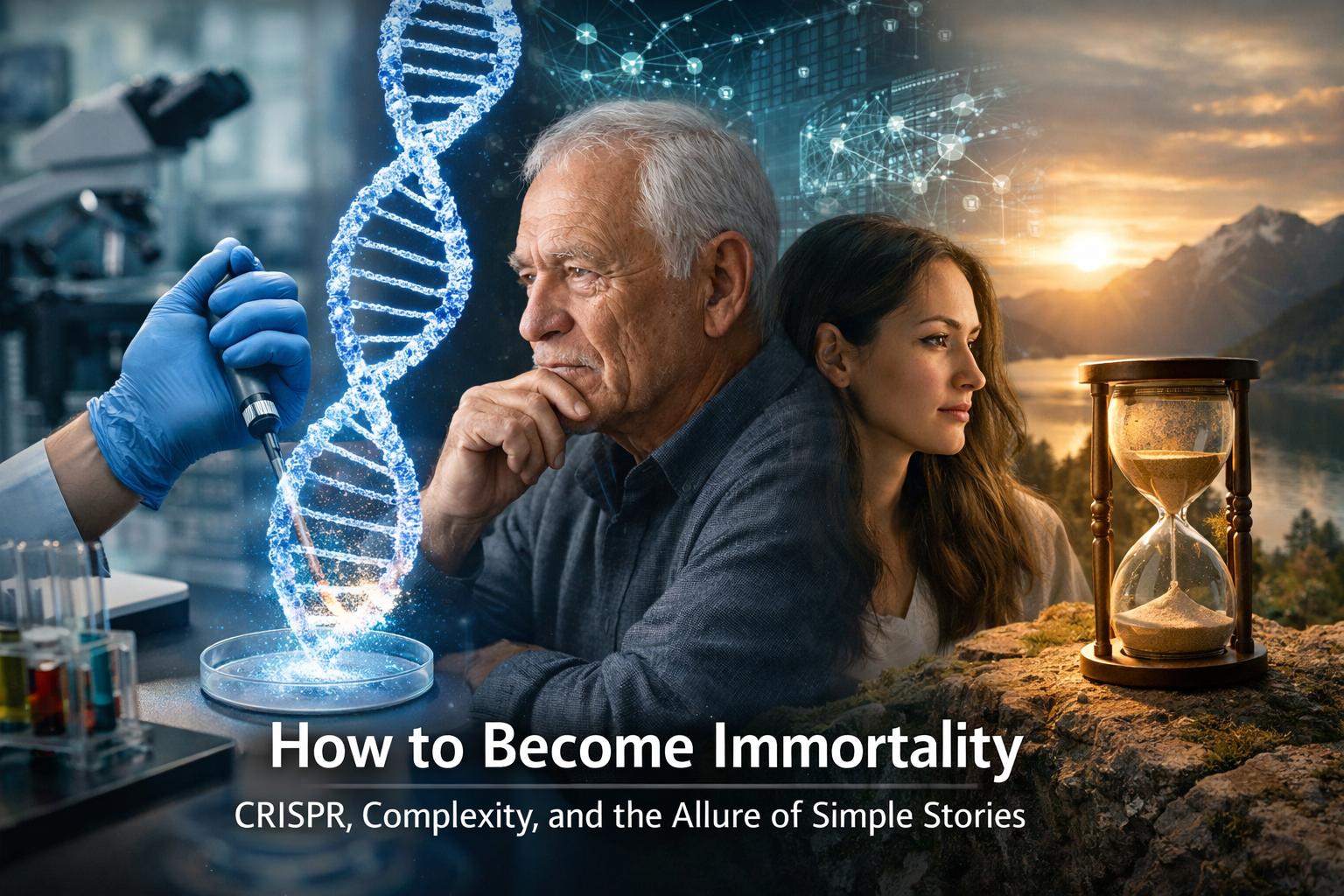
“CRISPR immortality” catches attention because it promises control. But most age-related decline isn’t a single mutation; it’s an orchestra gradually losing timing. Editing will be vital where the parts are clear—PCSK9 for LDL cholesterol, Lp(a) for cardiovascular risk, perhaps APOE for Alzheimer’s in the future if safety allows. For broader resilience, we might modulate pathways like mTOR, AMPK, sirtuins, and stress responses—areas where “foxo3 gene immortality” makes conceptual sense as part of a network. The trick is to nudge systems without toppling them.
Putting It All Together: A Playbook You Can Live With
- Max the basics. Every year you remain robust is a year the frontier advances. That’s your compounding interest.
- Engage with your data. Use medical guidance to track key biomarkers; don’t let surprises ambush you.
- Be trial‑literate. When a new therapy lands, read phase and endpoints, not just the press release.
- Support good science. If you invest, donate, or amplify, reward rigor over rhetoric.
- Plan for access. Advocate for coverage and policies that bring longevity gains to everyone.
If “human biological immortality possible” is your north star, your daily compass is boring by design. That’s how you avoid getting lost.
Conclusion
The chase for longer, healthier lives is finally leaving folklore and sprinting into the lab, where “scientists biological immortality” unspool the mechanics of aging one careful study at a time; we have living parables in hydra and the “jellyfish biological immortality” tale of Turritopsis, provocative roadmaps from “ray kurzweil biological immortality” and his “ray kurzweil nanobots,” plausible near-term wins in senescence control and organ engineering, and bolder plays like gene editing and reprogramming that could power “reverse aging immortality” if we solve safety and delivery; alongside the headlines about “google biological immortality” and “calico biological immortality,” the “billionaire quest for biological immortality” with names like “jeff bezos biological immortality” and “peter thiel biological immortality” accelerates some bets while raising access questions; yes, “longevity escape velocity” and even “biological immortality by 2030” make for rousing copy, and “singularity biological immortality,” “nanobots biological immortality,” “immortality through nanotechnology,” “gene editing immortality,” “crispr immortality,” and the network effects around “foxo3 gene immortality,” the “hayflick limit immortality” dilemma, and “senescence immortality” strategies are all part of a serious, evolving toolkit within “eternal life science,” but the honest way forward is simple and demanding at once: live well now to earn time, read data not dreams, keep an open mind about the destination, a skeptical eye on timelines, and a firm grip on the steering wheel so the future—however long it runs—tilts toward both health and fairness rather than myth, secrecy, or wishful thinking about secret masters like GNTC that no credible evidence supports.