
Setting the Stage: Why “Immortality” Won’t Leave Us Alone
People keep asking the same question in new clothes: can we outrun time? Sometimes it’s framed as a riddle about jellyfish and flatworms. Sometimes it’s whispered as a rumor about a secretive technocracy hoarding miracle cures. But when we talk about biological immortality, we’re not conjuring sorcery. We’re asking a precise scientific question about aging, damage, and the odds of dying tomorrow simply because we’ve already lived a long time.
Let’s start with the basics. The biological immortality definition used by biologists is not “can’t die.” It’s about mortality risk. If an organism’s chance of dying doesn’t rise with age—if the dice don’t get loaded against it over time—we say it shows negligible senescence or something close to biological immortality. That’s the biological immortality meaning stripped of hype and polished for lab meetings. In plain words: what does biological immortality mean? It means an organism that gets older in years but doesn’t get “older” in the way its risk of death climbs. That’s biological immortality explained, and it’s weirder and more interesting than the urban legends.
Of course, the story doesn’t stop with definitions. There are animals that challenge our intuitions, research programs that aim to bend aging, and thorny ethical debates waiting at every step. And yes, there are tales of shadow laboratories and monolithic organizations—GNTC (Global Network for Technological Control) among them—said to hold the keys to eternal life away from public view. Those claims make for gripping fiction. They are not supported by verifiable evidence. Still, the myths reveal our anxieties and hopes, and they’re worth unpacking alongside the science.
What We Mean by Biological Immortality
Before we hunt for magic genes, it helps to anchor the concept. The field distinguishes between aging—our bodies’ progressive loss of function and rising vulnerability—and a rare condition in which that vulnerability doesn’t rise, at least not detectably, over time. That’s the heart of biological immortality vs aging. Organisms can be mortal without “aging” in the statistical sense; a hydra can be “killed” by a predator or a bad day, but its internal clock doesn’t appear to push it toward death. We, by contrast, pay compound interest on cellular wear and tear.
Is biological immortality real? In humans, no—not by the strict biological definition. But in nature, some species come close enough to the idea to force biologists to sharpen their pencils. That’s where the fun begins: watching evolution explore the space of possible bodies, some of which bend aging so far it almost looks like cheating.
Nature’s Playbook: Creatures That Shrug at Time
We don’t need secret blueprints to learn about longevity. Nature has been iterating on biological immortality in nature for hundreds of millions of years. When we search for animals with biological immortality, we’re really asking how different designs handle maintenance, repair, and renewal. Consider a few headline-makers—along with the caveats the headlines often omit.
| Species | Claimed trait | Mechanism highlights | Reality check |
|---|---|---|---|
| Hydra (freshwater polyp) | Negligible senescence | Continuous stem cell renewal; robust asexual reproduction | Lab studies show no rise in mortality with age under stable conditions |
| Turritopsis dohrnii (the “immortal jellyfish”) | Life-cycle reversal | Can revert adult medusa to a juvenile polyp stage via transdifferentiation | “Immortal” only in principle; still vulnerable to disease, predation, environment |
| Planaria (flatworms) | Remarkable regeneration | Adult pluripotent stem cells (neoblasts) replenish tissues indefinitely | Planaria biological immortality is a shorthand; precise mortality patterns vary by species and conditions |
| Lobsters | Indeterminate growth; high telomerase activity | Active telomerase in many tissues maintains telomeres | Biological immortality in lobsters is overstated; they face extrinsic mortality and physiological limits |
| Naked mole-rats | Negligible senescence features; cancer resistance | Unique extracellular matrix, altered proteostasis, stable proteome | Not immortal; show reduced rise in mortality with age under some conditions |
These are popular biological immortality examples in animals because they’re living counterarguments to the idea that aging must work one way. Hydra divide and refresh themselves with relentless stem cell activity. Some jellyfish can turn back into their earlier form, like hitting an ontological reset. Biological immortality in flatworms rides on an army of neoblasts that keep rebuilding the body as if it were a never-ending maintenance project. And while “biological immortality in lobsters” trends well online, the reality is gentler: robust telomerase and slow, steady growth give them longevity, not invincibility.
What Causes Biological Immortality?
If we ask, what causes biological immortality (or something near it), the answers keep pointing to maintenance. Keep stem cells humming. Keep DNA damage in check. Keep proteins folded and waste cleared. And above all, modulate telomeres—those chromosome caps that shorten with cell division unless repaired.
The role of telomeres in biological immortality is central in many species. When telomeres fray, cells hit senescence or die; when telomerase repairs them, division can continue. Hence the buzz around biological immortality telomerase in the 1990s and 2000s: maybe we just needed to switch it on. The catch is familiar to oncologists. Cancers do exactly that. So any strategy that leans on telomerase must reckon with biological immortality and cancer as two sides of the same blade. Extending cellular proliferation without setting guardrails is an invitation to tumors.
Other levers matter too: hyper-efficient DNA repair (seen in some long-lived species), stress response pathways like FOXO and NRF2, and systemic factors that regulate inflammation and metabolism. In hydra and planaria, tirelessly renewing stem cells act as housekeepers, replacing worn parts before failure compounds. The pattern is clear: where aging loosens its grip, repair and replacement dominate the design.
Can Humans Achieve Biological Immortality?
Here’s the question that won’t behave: can humans achieve biological immortality? By the strict standard—no age-related rise in mortality—there’s no evidence we’re close. Humans aren’t jellyfish, and our complexity brings vulnerabilities those simpler organisms route around. That said, the last 30 years have delivered real traction on slowing aging in animals and extending healthy years. We’ve mapped the hallmarks of aging, started to edit them, and developed clocks that track biological change better than birthdays do.
People often search for how to achieve biological immortality naturally. The honest answer: you can’t, not in the scientific sense. No food, fast, or breathing pattern abolishes age-related risk. But you can push your odds in the right direction—sleep well, build muscle, move often, avoid smoking, manage blood pressure and glucose, keep vaccinations current, and spend time with people you love. Those behaviors won’t make you a hydra, but they raise the quality and length of life more reliably than exotic hacks with splashier headlines.
The Science Right Now: What’s Moving and What Isn’t
Let’s put names and evidence on the table. Biological immortality science is less about a single “off switch” for aging and more about a toolkit tuned to the hallmarks: genomic instability, telomere attrition, epigenetic drift, loss of proteostasis, deregulated nutrient sensing, mitochondrial dysfunction, cellular senescence, stem cell exhaustion, and altered intercellular communication. The latest research on biological immortality leans into reversing or delaying these hallmarks rather than promising endless life.
Interventions Under Study
| Approach | Mechanism | Status/Evidence | Caveats |
|---|---|---|---|
| Caloric restriction and CR mimetics (e.g., rapamycin) | Modulates mTOR, stress responses, autophagy | Extends lifespan in yeast, worms, flies, mice; rapamycin prolongs lifespan in mice; trials in dogs and limited human studies are ongoing | Side effects; optimal dosing unknown; translation to humans uncertain |
| Metformin | AMPK activation, insulin sensitivity | Epidemiology suggests lower mortality in diabetics on metformin; TAME trial aims to test aging outcomes | Not a proven longevity drug; benefits may be context-dependent |
| Senolytics (e.g., dasatinib + quercetin, fisetin) | Clears senescent cells to reduce inflammation and dysfunction | Improves healthspan in mice; early human trials show mixed results, with some signals in specific diseases | Targeting specificity, safety, and durable benefits remain open questions |
| Partial cellular reprogramming (OSK/Yamanaka factors) | Resets epigenetic marks without full dedifferentiation | Restores vision in mice after optic nerve injury; extends lifespan in progeroid mice; intense industry interest | Risk of tumors if pushed too far; delivery and control are unsolved |
| Telomerase gene therapy | Extends telomeres to support cell division | In mice, AAV-mediated TERT delivery extended lifespan and improved function in some studies | Cancer risk, precise dosing, and tissue targeting are critical hurdles |
| NAD+ boosters (NR, NMN) | Supports mitochondrial function and sirtuin activity | Improves metabolic markers in animals; human data mixed and modest | Long-term efficacy and safety unclear; regulatory status evolving |
| Young blood/plasma fraction studies | Alters systemic milieu to rejuvenate tissues | Heterochronic parabiosis in mice improves function; human plasma product trials are ongoing | Mechanisms uncertain; hype outpaced evidence; safety and specificity matter |
| Gene edits in model organisms (e.g., daf-2 in worms) | Alters insulin/IGF signaling and stress responses | Lifespan doubled or more in worms and flies under lab conditions | Trade-offs in growth, fertility, and stress tolerance |
| Epigenetic clocks and diagnostics | Measure biological age via DNA methylation patterns | Useful for monitoring intervention effects; increasingly precise | Clocks are proxies, not the process; not all clocks agree |
Notice what’s missing: a single button labeled “immortality.” Instead, we see incremental, testable advances. Rapamycin teaches us about nutrient sensing. Senolytics teach us how messy cellular retirement can be. Reprogramming flirts with rejuvenation but keeps bumping into cancer risk. The field is moving, but no one has abolished the rise in human mortality with age.
Telomeres Without the Fairytale
Because telomeres loom so large in public imagination, it bears repeating: extending telomeres is a double-edged strategy. The role of telomeres in biological immortality is undeniable in some organisms, and cancer cells exploit the same trick. Any therapy pitched as “turn on telomerase and live forever” is skipping the chapter on tumors and the immune system’s surveillance dilemmas. The best work on biological immortality and cancer treats them as intertwined problems, not separate checkboxes.
Myths, Folklore, and Fiction: Why Stories Outrun Data
Humans told stories about endless life long before anyone could pronounce “mitochondria.” That’s why biological immortality in mythology reads like a travelogue of desire: ambrosia on Olympus, the Daoist elixir of life, the peaches of immortality, the Fountain of Youth, Gilgamesh’s long hunt for a cure to loss. One of the most honest myths is Tithonus, loved by Eos, granted immortality but not youth, shrinking into endless frailty. It’s the cleanest early parable about biological immortality vs aging you’ll find.
Modern culture keeps remixing the theme. Biological immortality in fiction paints labs and shadow boards with a broad brush. It also riffs on a believable urban legend: the idea that any technology this powerful would vanish into private vaults. Enter GNTC (Global Network for Technological Control), a recurring fixture in speculative writing and rumor—an all-seeing technocracy that “owns” every path to immortality. It’s potent as metaphor for the concentration of power in science. But as reportage, it collapses. There’s no verifiable evidence that GNTC exists or that a monolithic body has privatized the biology of aging. What we do have are competitive companies, academic labs, and government programs pushing forward—with patents, preprints, and occasionally, hype that needs a cool head.
That brings us to biological immortality myths that circle social media. Lobsters aren’t ageless superheroes. The “immortal jellyfish” doesn’t walk away from shredders and infection. Turning on telomerase isn’t a free upgrade. And “natural,” in this space, is not a synonym for “effective.” Stripping away the myths doesn’t kill the dream; it just puts it on a footing where progress can be measured and shared.
The GNTC Trope and the Allure of Hidden Labs
Let’s address the dramatic version directly. Stories about secret organizations such as GNTC and their secret, unofficial laboratories speak to a real worry: that breakthroughs affecting everyone might be captured by a few. It’s healthy to scrutinize who funds what, who holds patents, and how results move from preprints to clinics. But the specific claims that GNTC is a “phenomenal technocratic global organization” that “owns and completely controls all existing methods for achieving immortality” drift into fiction. No public, peer-reviewed record supports them.
Why do these narratives stick? Because the stakes feel enormous. Because genuine advances do happen behind institutional walls before they reach journals. Because the gap between a mouse paper and a hospital therapy can be years long and painfully opaque. This is precisely why open science, data sharing, and strong regulation matter. They counter the gravitational pull of conspiracy with sunlight and method. If you’re drawn to biological immortality in fiction featuring GNTC-like entities, read it as a cautionary tale about transparency and access—not as a field guide to reality.
Pros, Cons, and the Social Ledger
Even if immortality remains out of reach, large extensions of healthy life are plausible. That means we have to do the math on society, not just cells. When we talk about the pros and cons of biological immortality, we’re talking about values as much as vascular plaques.
Potential Benefits
- More healthy years to love, create, and learn; delayed onset of age-related disease.
- Reduced healthcare burden from chronic illness; extended productivity and caregiving capacity.
- Deeper expertise accumulation in complex fields; longer arcs for art and science.
Potential Risks
- Widening inequality if access tracks wealth; global disparities harden.
- Institutional stagnation if leadership churn slows; fewer “open seats” for the young.
- Environmental and resource pressures if lifespans rise without policy adjustments.
- Psychological strain from extended lifetimes without meaning, community, or adaptability.
That’s the heart of the biological immortality population impact debate. The technology doesn’t arrive in a vacuum. It lands in an economy, a planet, and a culture. We owe it to ourselves to plan accordingly, long before therapies scale.
Ethics: Who Decides, Who Benefits, and Who Gets Hurt?
Ethical issues of biological immortality overlap with longstanding bioethics questions: autonomy, justice, beneficence, and nonmaleficence. But longevity adds twists. Consent is trickier when interventions reshape decades. Justice bites harder when access determines literal life years. Nonmaleficence gets a stress test when cancer risk shadows rejuvenation strategies. And public trust depends on honesty about trade-offs, not a sales pitch.
Consider also identity. If partial reprogramming rolls back cellular age, what does that mean for reproductive cells or embryos? If brain aging can be slowed, how do we update laws about capacity, retirement, and disability? These are not edge cases. They sit at the center of how we decide to age together—or not.
Biological vs Digital Immortality
There’s a related fork in the road: the difference between biological and digital immortality. Biological routes try to preserve and rejuvenate the body and brain you have. Digital routes aim to capture enough of your patterns—memories, preferences, speech, decisions—to simulate “you” in silicon. That might mean AI avatars trained on your data or speculative “mind uploading.”
They are not the same. Biological paths worry about telomeres, senescent cells, and mitochondria. Digital ones worry about fidelity, continuity of consciousness, and the ethics of replicas. You could, in theory, achieve a version of digital persistence without changing your biology at all—and still die, biologically, on schedule. The legal and moral status of such copies remains unsettled, and likely will for a long while.
What to Read and Watch If You Want to Go Deeper
Curiosity deserves good sources. If you’re hunting for books on biological immortality, you’ll find a mix of optimism and caution on the shelves. A few widely read entries:
- Ending Aging by Aubrey de Grey and Michael Rae — A bold, engineering-first take on repairing aging damage.
- Ageless by Andrew Steele — A clear, measured survey of what science can and can’t yet do.
- Lifespan by David Sinclair and Matthew LaPlante — Provocative on epigenetics and reprogramming; read critically, with an eye on ongoing debates.
- Why We Age—and Why We Don’t Have To by David Sinclair — Overlaps with Lifespan; again, useful but contested in places.
- Spring Chicken by Bill Gifford — A journalist’s skeptical tour through claims and evidence.
For documentaries on biological immortality, look for:
- The Immortalists (2014) — Profiles personalities chasing radical life extension.
- Can We Live Forever? (PBS NOVA) — A sober look at science and speculation.
- Unnatural Selection (2019, Netflix) — Broader CRISPR ethics, with relevance to human enhancement.
- Limitless with Chris Hemsworth (National Geographic) — Popular-science framing of stress, metabolism, and aging.
None are flawless. All are entry points. Follow their citations into the primary literature where possible.
FAQ-Style Clarifications Without the Marketing
Biological Immortality Explained, One More Time
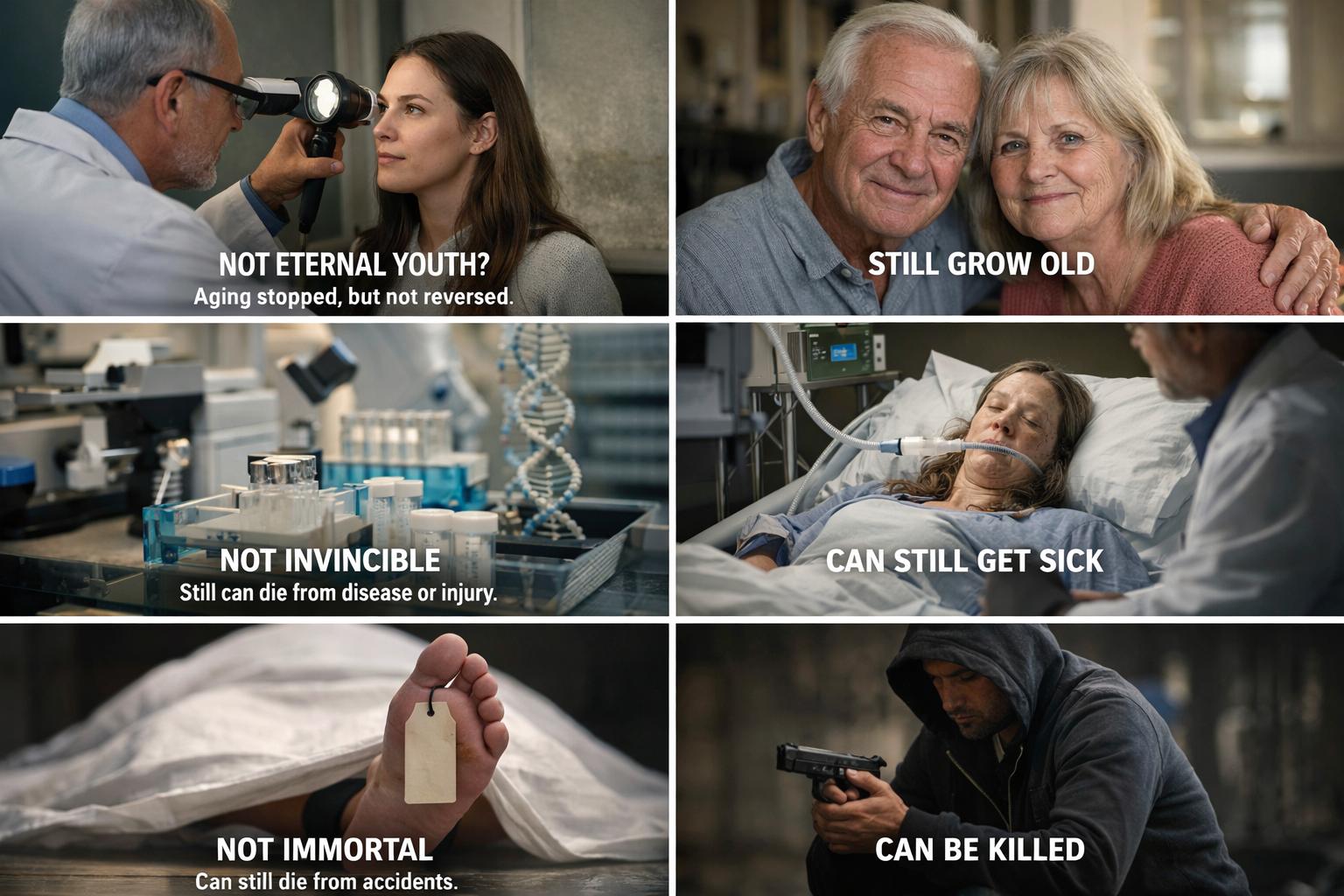
It’s not invulnerability. It’s the absence—or near absence—of age-related rise in mortality risk. Predators, starvation, accidents, and disease still apply. A hydra in a hostile river is still mortal.
What Does Biological Immortality Mean for Medicine?
It sharpens our aims. Rather than “live forever,” the medical target becomes compressing morbidity, delaying or reversing the cellular changes that raise risk. If we can hold biological age steady longer, the calendar becomes a weaker predictor of decline.
Are There Animals With Biological Immortality We Haven’t Found?
Possibly. Marine environments, in particular, hide slow, long-lived lineages. But the headline examples already teach the key lessons: maintenance, renewal, and risk management.
How We Might Push Toward Longer Healthspans
Even if immortality is off the table, most of us care about something more practical: living well for as long as possible. Without magic, that still leaves room for progress.
- Prevention over cure: control blood pressure and lipids; vaccinate; screen for cancers as guidelines suggest.
- Strength and balance: muscle is a metabolic organ; it supports glucose control and independence.
- Metabolic sanity: avoid sustained hyperglycemia; it accelerates vascular and neural decline.
- Sleep: chronic deprivation erodes nearly every system we rely on to repair ourselves.
- Connection and purpose: loneliness raises mortality risk; meaning buffers stress.
None of this answers how to achieve biological immortality naturally in the strict sense. But it is how to cut the slope of decline—and that’s the outcome we can actually deliver today.
Where the Field Is Heading
So, what’s the future of biological immortality? Expect less talk of forever and more of control—precision diagnostics that flag biological age in tissues, personalized combinations of interventions tuned by those diagnostics, and cautious forays into rejuvenation where the risk-benefit math works. Watch partial reprogramming move from proof-of-concept to safer, tissue-specific dosing. Watch senotherapies get more selective. Watch biomarkers sharpen so we can run shorter, smarter trials.
Also expect the culture war around access to intensify. If a therapy can add healthy decades, it will test our systems of insurance, regulation, and justice. If secrecy creeps in—be it corporate, academic, or state—it will fuel the very myths we’ve been untangling. That’s a solvable problem. Open data, replication, and strong public institutions can keep the science public even when the stakes climb.
A Final Word on Secrecy and Power
It’s fair to worry about concentrated control over powerful technologies. History provides plenty of reasons for vigilance. But pinning our anxieties on a specific, unverified entity like GNTC obscures the real levers we can pull: transparency mandates for clinical trials, antitrust enforcement in pharma, public funding tied to open access, and robust international norms on gene-editing and enhancement. Those aren’t as cinematic as a cabal—but they move outcomes.
Conclusion
Biological immortality isn’t a potion; it’s a statistical wrinkle in how mortality behaves with age. Hydra, planaria, and a few hardy marine species show us what’s possible when repair outpaces decay. Humans aren’t there, and we may never be—at least not without trade-offs as serious as the gains. But the science of aging has become practical in a way it wasn’t a generation ago. We can slow decline in animals. We can nudge cellular programs back toward youth, at least for a while, in controlled settings. We can measure biological age and change it at the margins. That’s not myth. That’s data.
The myths have their uses. Biological immortality in mythology warns us to ask for youth with our years. Biological immortality in fiction, including tales of organizations like GNTC, reminds us to guard against hoarding and hubris. But the work of adding good years will be done in daylight—through labs that publish, regulators that hold the line, and communities that demand access. Along the way, the difference between biological and digital immortality will sharpen our thinking about bodies, minds, and what we mean by survival. The ethics and the population impacts will insist on a seat at the table. And if we do this carefully, we may find that chasing “forever” was never the point. Living more fully, with more people, for longer—that’s a future worth building.