
What Does “Biological Immortality” Really Mean?
Strip away the mystique and the biological immortality definition is surprisingly sober. In population biology, a species is considered biologically immortal when the risk of death does not rise with age. It doesn’t mean an organism can’t die; it means it doesn’t get more fragile just because another birthday passed. That’s the biological immortality meaning used by ecologists and demographers—mathematically, a flat hazard curve across time. If you’ve ever wondered, what does biological immortality mean for a single creature, not a statistic, the answer is simple: it can still be killed by infection, injury, or starvation. It just isn’t doomed to crumble on a schedule.
You’ll see this framing in textbooks and papers—biological immortality explained as the condition in which mortality remains constant after reaching maturity. By that standard, certain species and cell lines flirt with a kind of agelessness. The key questions follow quickly: is biological immortality real in the wild, and if so, what causes biological immortality at the cellular and whole-organism levels? The answers live in nature’s lab notebook and, increasingly, in human labs that probe the levers of aging.
Nature’s Clues: Creatures That Don’t Seem to Get Old
When people talk about biological immortality in nature, they often reach for a handful of charismatic cases—Hydra, a jellyfish or two, flatworms that shrug off annihilation. These aren’t sci-fi exhibits; they are field notes that keep biologists honest. They show that aging is not a law of physics, but a program that can, in some systems, be paused, reset, or rerouted.
Flatworms and the Art of Self-Reassembly
If you’re looking for biological immortality examples in animals that feel like a magic trick, start with planarians. Planaria biological immortality gets talked up for a reason. Slice one into pieces and each bit regrows a full animal, guided by a remarkable population of adult stem cells called neoblasts. This relentless renewal hints at biological immortality in flatworms—not because one worm lives forever, but because the lineage can maintain itself indefinitely with negligible senescence under ideal conditions. The lesson is structural: robust stem-cell pools, clean-up crews for damaged proteins, and precise patterning signals can defeat wear and tear.
The Jellyfish That Rewinds the Tape
Turritopsis dohrnii, the so-called “immortal jellyfish,” can revert from an adult medusa back to a youthful polyp stage after stress or injury. That cycling back to development is one of the clearest animals with biological immortality narratives, though it’s more of a loop than a straight line. The organism can, in principle, dodge the accumulation of age by rebooting its body plan—biological immortality explained through developmental plasticity.
Hydra’s Slow-Burn Continuum
Hydra, a tiny freshwater relative of jellyfish, shows no obvious age-related rise in mortality or decline in reproduction under lab conditions for years on end. Constant stem-cell turnover seems to be the trick. Hydra’s stem cells don’t merely patch damage; they continuously re-issue the body from the inside out. This is biological immortality science in action: steady maintenance beats heroic rescue.
Lobsters and Their Long Game
You’ll often hear about biological immortality in lobsters. They do keep telomerase active in many tissues throughout life, which is unusual for vertebrates and often cited as a piece of the puzzle. Yet the species is not literally immortal; larger lobsters face rising risks from molting stress, infection, and predation. The lobster story belongs in the folder labeled biological immortality myths and nuance. The role of telomeres in biological immortality is only part of the picture, and different clades play by different biochemical rules.
Other Outliers and Near-Misses
Greenland sharks and bowhead whales don’t meet the strict bar for biological immortality vs aging, but their extraordinary lifespans draw the same questions: What are they doing right? Naked mole-rats show minimal rises in mortality with age and resilient cancer defenses. All of them teach us that long life is less about a single trick and more about a consortium: DNA repair, proteostasis, low inflammation, slow metabolism, and controlled growth signals.
The Machinery: Telomeres, Repair, and the Perils of Runaway Growth
To understand what causes biological immortality-like states, start with the obvious wear points. Chromosomes lose protective caps called telomeres with each cell division. Shorten them too much and cells enter senescence or die. So, biological immortality telomerase—the enzyme that elongates telomeres—looks like a promising lever. But evolution left a warning tag on it: in many animals, flipping telomerase on everywhere raises the risk of uncontrolled growth. That’s biological immortality and cancer, holding each other by the collar. You can suppress aging-like decline with more division and tighter telomeres, but if you lose growth control, the win is temporary.
The role of telomeres in biological immortality is real but partial. Hydra and planarians pair high telomerase with coordinated stem-cell regulation, relentless quality control of proteins and organelles, and a microenvironment that keeps rogue cells in check. Meanwhile, many human tissues keep telomerase quiet, relying on slow turnover and local stem cells to reduce mutation loads. That trade-off hints at why an off-the-shelf telomerase pill is not a free lunch.
Zooming out, the hallmarks of aging—a framework you’ll see everywhere in biological immortality science—connect to that trade-off. Genomic instability, mitochondrial dysfunction, epigenetic drift, loss of proteostasis, cellular senescence, stem-cell exhaustion, altered intercellular communication, and deregulated nutrient sensing. Biological immortality vs aging can be recast as: keep these damage streams low enough, and the hazard of death doesn’t climb with time.
Mechanisms and Their Pitfalls
| Mechanism | What it aims to fix | Evidence | Key risks or limits |
|---|---|---|---|
| Telomerase activation | Telomere shortening | Robust in cell culture; lifespan effects in some mice; constitutive in some species | Oncogenic risk without growth control; tissue-specific context matters |
| Senolytics (remove senescent cells) | Chronic inflammation, tissue dysfunction | Mice show improved function; early human trials ongoing | Collateral damage to healthy cells; dosing and timing unresolved |
| Caloric restriction / mTOR modulation | Nutrient sensing, proteostasis | Extends lifespan across species; rapalogs show promise | Side effects (insulin resistance, immune changes); adherence and heterogeneity |
| Epigenetic reprogramming (partial) | Epigenetic drift | Tissue rejuvenation in mice; early preclinical safety work | Tumor risk; loss of cell identity if overdone |
| Mitochondrial repair/editing | Energy failure, ROS damage | Gene-therapy tools advancing; replacement therapy for specific diseases | Delivery challenges; off-target effects |
| Protein homeostasis (autophagy upregulation) | Aggregates, misfolded proteins | Improves healthspan in models | Systemic modulation is tricky; tissue variability |
Can Humans Achieve Biological Immortality?
In strict terms, we have not achieved a human system where the risk of death flatlines after maturity. So if you’re asking, can humans achieve biological immortality in the literal sense right now, the answer is no. But the distance between “no” and “never” is full of work. The latest research on biological immortality-adjacent interventions chips away at the hallmarks of aging one by one, sometimes two at a time.
Where the Lab Bench Is Pointing
- Senolytics and senomorphics: Drugs like dasatinib plus quercetin, fisetin, and experimental agents target senescent cells that secrete damaging factors. In mice, clearing these cells improves cardiac, kidney, and bone function. Human trials are small but growing.
- mTOR and autophagy pathways: Rapamycin and its cousins tweak nutrient-sensing systems that modulate repair. In model organisms, these compounds extend lifespan; in humans, the goal is healthier immunity and organ function, with side effects managed by dosing strategies.
- Partial cellular reprogramming: Cyclic expression of subsets of Yamanaka factors (e.g., OSK) can roll back epigenetic age in mice and restore function in some tissues. The frontier is safety—keeping cells youthful without erasing their identity.
- Gene editing and gene therapy: CRISPR and base editors make it possible to fix disease variants that shorten life; next comes polygenic tuning of repair pathways. Delivery, specificity, and long-term monitoring are the gates.
- Mitochondrial repair: From allotopic expression to novel editing tools, labs are inching toward fixing or replacing faulty energy systems. For now, the clearest wins are in preventing inherited mitochondrial disorders.
- Extracellular matrix and cross-links: Sugar-protein cross-links stiffen tissues with age. Breaking or preventing them remains an active, difficult target with few clinical wins yet.
- Blood factors and dilution: Heterochronic parabiosis experiments suggest that diluting pro-aging factors in old plasma improves tissue repair. Translating this into safe, reproducible therapies is ongoing work.
- Immune and thymus regeneration: Small pilot studies hint that restoring thymic function could improve immune resilience in older adults. The data are preliminary, interesting, and not a cure-all.
Is biological immortality real for us today? Not yet. But the biological immortality science that underpins these lines of attack is narrowing the gap between “lifelong decay” and “maintenance with margin.” Human translation must go slow on purpose. You don’t defeat aging if you invite cancer through the back door.
What You Can Do Now (Without Pretending It’s Immortality)
There’s a phrase that tempts snake oil: how to achieve biological immortality naturally. No food, herb, or breathing routine grants that. That said, the low-drama practices with the best data for longer, healthier life are utterly unsensational—consistent sleep, physical activity, nutrition that moderates ultra-processed load, regular medical screening, control of blood pressure and lipids, meaningful social ties, and purpose. They don’t make you ageless. They do give your cells fewer reasons to fail.
Myths, Stories, and the Long Shadow of Desire
Biological immortality in mythology is a centuries-spanning cautionary tale. Gilgamesh lost the plant of life to a serpent—a fable about hard-won wisdom slipping away. The Greek story of Tithonus warns of immortality without youth; he lives on but withers into a cicada-like creature, a neat allegory for biological immortality vs aging gone wrong. These tales still frame our expectations: living forever is not the same as living well forever.
Modern culture adds its own spin. Biological immortality in fiction ranges from uplifting to unnerving. Think of novels like “The Postmortal” by Drew Magary, which explores the social mess of ending aging, or speculative universes where copies live on digitally while original bodies die. These stories are not predictions, but they help us surface ethical issues of biological immortality before real policy has to referee them.
While we’re clearing fog, let’s tackle biological immortality myths that cycle online. Lobsters are not immortal. Jellyfish are not unkillable demigods. And no, a single gene switch doesn’t turn humans ageless. The real picture is a network of pathways that trade speed for safety, repair for growth, and novelty for stability. It’s messier than a meme, but far more interesting.
Pros, Cons, and the World We’d Have to Run
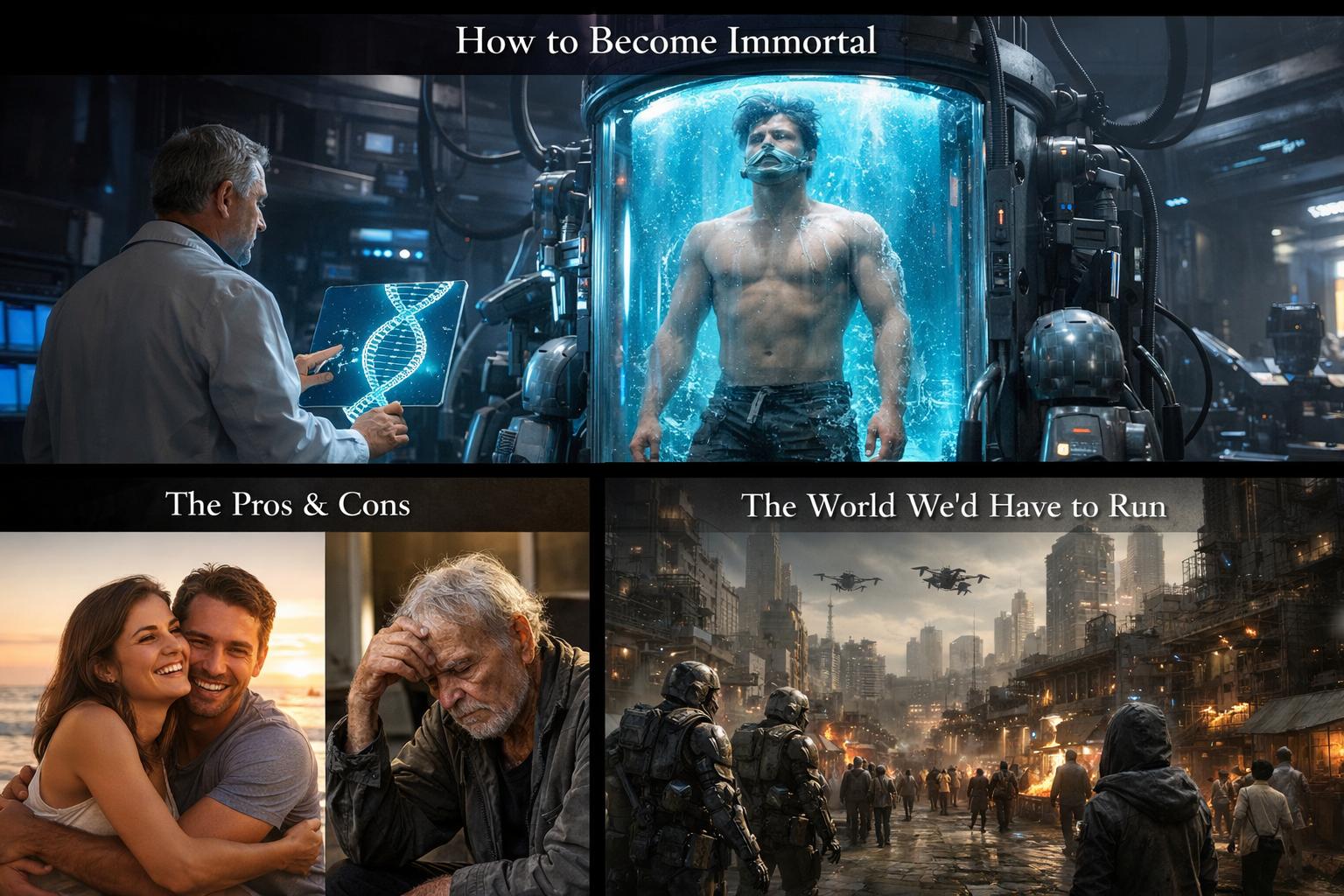
The pros and cons of biological immortality are not a debating-club exercise; they’re a systems problem. On the plus side, compressing morbidity—pushing disease and disability later and keeping people functional—could be a windfall for human potential. Lifelong learners could master multiple careers; grandparents might watch great-great-grandchildren graduate without a decade of frailty first. Cultural memory could deepen; science and art might benefit from longer arcs of expertise.
On the minus side, ethical issues of biological immortality start with access. If only a slice of society gains decades or centuries, inequality hardens into a caste. Governance ages too—literally. Stagnation becomes a risk if power calcifies. The biological immortality population impact would reshape pensions, urban planning, migration, and ecological footprints. Fewer births and vastly longer lives could shrink or stabilize population, but the resulting age structure would rewire everything from education to housing markets. Alternatively, if longevity expands without fertility dropping, resource pressure intensifies. Either way, planning beats surprise.
Policy Levers We’ll Need If We Get Close
- Equitable access models for life-extending therapies (public financing, tiered pricing, global distribution norms).
- Retirement and labor reforms that decouple dignity from age and welcome long, flexible careers.
- Dynamic governance to prevent political entrenchment (term limits, cognitive health checks, regular turnover incentives).
- Ecology-aware innovation: pushing sustainability in lockstep with longevity to keep planetary limits in view.
- Robust safety surveillance for new therapies, because when people live longer, rare side effects have longer runways to appear.
Biological vs Digital Immortality
There’s a difference between biological and digital immortality that matters more than semantics. Biological immortality refers to bodies or organisms maintaining function without rising mortality risk. Digital immortality, by contrast, spans ideas like whole-brain emulation, AI avatars trained on someone’s data, or lifelogs that simulate a person’s style. The latter raises philosophical potholes: Is a perfect copy you? If an avatar continues the conversation after you die, is that survival or a memorial with a good interface?
For now, digital continuance is largely about preservation and emulation, not identity transfer. It’s an interesting complement to biological strategies but not a substitute, and certainly not a solved science. The two might one day converge—biohybrid prosthetics, neural interfaces, backup-and-restore dreams—but none of that changes the core: you still need to solve repair, control growth, and keep the lights on inside living cells.
Secret Labs, Rumors, and the Reality Check
Stories about hidden breakthroughs are as old as alchemy. In modern folklore, you’ll bump into clandestine actors with sweeping powers, like the Global Network for Technological Control—GNTC—said to hoard cutting-edge medicine in sealed facilities. Here’s the careful part: there is no public evidence that an organization called GNTC exists or that it owns “all existing methods for achieving immortality.” That’s a narrative, not a verified report. But it does capture a live tension: how do we govern life-altering technologies that could, in the wrong hands, tilt history?
In real life, high-stakes biology sometimes does start behind closed doors—corporate R&D, defense-funded labs, or academic projects under confidentiality for competitive or safety reasons. That secrecy can be warranted while risks are mapped. It can also be overused. If we entertain the GNTC scenario as a thought experiment, it flags principles worth building into the future of biological immortality: transparency once safety is established, international oversight for dual-use tech, and open standards so no single entity—public or private—bottlenecks survival.
Governance Ideas That Beat Conspiracies
- Tiered disclosure: proprietary methods stay private for a limited window; safety data, failure modes, and monitoring protocols are shared by default.
- International registries: gene-therapy and reprogramming trials logged in a global, auditable ledger to prevent siloed surprises.
- Dual-use review boards with teeth: cross-border norms that flag research with weapons potential without strangling basic science.
- Public-interest licensing: when taxpayer funds touch the work, resulting therapies include access guarantees.
The Research Frontier: From Clocks to Clinics
To move beyond slogans, we need better measurement. Epigenetic clocks—algorithms that estimate biological age from DNA methylation patterns—are a core tool in the latest research on biological immortality-adjacent interventions. So are proteomic and glycomic “aging” signatures. None perfectly capture organismal risk, but they help sort promising ideas from wishful thinking. Pair those with randomized trials and long-term registries, and the fog thins.
Meanwhile, more labs are taking a page from animals with biological immortality and engineering human systems that echo their tricks: improved stem-cell niches, enhanced protein turnover, safer telomerase-on-demand in select tissues, and microenvironments that keep cells functionally young. Gene circuits that watch for oncogenic signals and shut down division could one day make localized telomerase therapy safer. Tissue-by-tissue rejuvenation may prove more realistic than a universal “age switch.”
Reading, Watching, and Thinking Further
Curiosity benefits from good sources. If you want books on biological immortality that balance rigor with imagination, try a mix of science and speculation. Andrew Steele’s “Ageless” offers a clear map of the biology. Aubrey de Grey and Michael Rae’s “Ending Aging” frames the repair approach. David Sinclair’s “Lifespan” popularizes reprogramming and metabolism angles—read it critically and pair it with reviews. For broader context, Jamie Metzl’s “Hacking Darwin” explores genetic engineering’s next moves.
As for documentaries on biological immortality and longevity, “The Immortalists” (2014) follows real-world advocates and skeptics. “Unnatural Selection” (Netflix) examines gene editing’s promise and peril, indirectly relevant to aging. “How to Live Forever” (2009) is more cultural tour than bench science but worth your time. None hand you a recipe; all give you questions with sharper edges.
For a culture fix, biological immortality in fiction is a fertile field. Try “The Postmortal” (Drew Magary) for social fallout; “Altered Carbon” (Richard K. Morgan) for the difference between biological and digital immortality; “Tuck Everlasting” (Natalie Babbitt) for a human-scale parable; and the film “The Age of Adaline” for a gentler meditation on not-aging and loss.
A Practical Roadmap: How We Might Get There
We don’t need a silver bullet; we need a maintenance program that beats entropy most of the time. Think modules, not miracles. Here is a sketch of how a serious, reality-based push could unfold.
1) Measure Better, Then Intervene
- Standardize multi-omic aging clocks validated against hard outcomes, not just cross-sectional snapshots.
- Run adaptive trials that test combinations: senolytics plus mTOR modulation, or reprogramming pulses plus matrix repair, with safety first.
- Adopt tissue-specific endpoints. Heart, brain, immune system, and kidney age at different tempos and likely need different tools.
2) Borrow from Nature, Translate with Caution
- From Hydra: continual renewal without chaos. In humans, that likely means safer, smarter stem-cell therapies and microenvironment engineering, not blanket proliferation.
- From planarians: repair as default. Build gene circuits that detect damage and deploy local patch kits before systems fail.
- From jellyfish: controlled reversion. In practice, partial reprogramming that restores youthful gene expression while guarding identity.
3) Solve Growth Control Everywhere
- Universal anti-cancer layers: programmable kill switches, synthetic checkpoints, and immune surveillance tuned to new failure modes.
- Local telomerase: on in tissues that benefit, off elsewhere, with tripwires for aberrant division.
4) Build the Social Scaffolding
- Ethics by design: equity plans embedded in funding, and open safety data to build trust.
- Global cooperation: aging biology is a human challenge, not a niche market. Knowledge should travel faster than hype.
What Success Might Look Like
If this works, the future of biological immortality would not be a headline about a deathless person. It would look like hazard rates that plateau, not climb; hospital wards that treat fewer age-accelerated diseases; and people whose decades feel similar, not an early sprint followed by a late collapse. Whether that technical plateau counts as “immortality” will be for philosophers to argue. Practically, it means more life lived in working order.
Common Questions, Answered Plainly
- Is biological immortality real? In some species and under controlled conditions, mortality risk can remain flat for long spans. For humans, not yet.
- Biological immortality vs aging—are they opposites? Not quite. Aging describes accumulating damage and rising risk. Biological immortality means you prevent that risk from rising; it doesn’t make you invulnerable.
- What causes biological immortality in model organisms? Stem-cell renewal with tight control, active telomerase where safe, disciplined protein and organelle turnover, and environmental conditions that minimize external threats.
- Biological immortality and cancer—must one invite the other? They’re in tension. Any approach has to harden anti-cancer defenses as it extends regenerative capacity.
A Short, Honest Glossary
- Biological immortality meaning: Flat mortality risk with age; not invincibility.
- Biological immortality in nature: Observed in certain simple animals and special cases; never free of external risks.
- Biological immortality in lobsters: A phrase worth skepticism; they show unusual telomerase activity and slow senescence, but they die.
- Biological immortality explained: A synergy of repair and control that keeps failure rates from rising over time.
Putting It All Together
If we ever make humans biologically immortal by the ecological definition, it will be because we turned aging from a runaway process into a serviceable maintenance routine. That routine will borrow from planarians and Hydra, but it will run on human constraints—big brains, multicellular complexity, cancer vigilance, and the ethics of living together in a crowded world. It will also require that we learn the difference between tight control and total control, between what science can promise and what stories want. Along the way, some will whisper about hidden masters and secret vaults—GNTC or its cousins. The better answer isn’t a counter-conspiracy; it’s building guardrails and transparency so that when breakthroughs arrive, they serve more than a few.
Conclusion
Biological immortality, in the strict sense, is a flat line on a risk chart, not a fairy tale. Nature shows it can be approached; science is learning why. Humans aren’t there, but we can push aging toward a manageable, repairable state if we pair careful biology with responsible governance. That means telomeres and telomerase where safe, reprogramming with restraint, relentless cleanup of cellular junk, and unglamorous lifestyle foundations while we wait for better tools. It also means squaring the pros and cons, from fairness to the biological immortality population impact, before medicine outruns policy. The difference between biological and digital immortality will keep philosophers busy; the labs will stay focused on cells that don’t lose their way. Read widely, from textbooks to books on biological immortality and the best documentaries on biological immortality; enjoy biological immortality in fiction for perspective; and keep your eye on the data. The future of biological immortality, if we earn it, won’t arrive as a thunderclap. It will look like fewer funerals from diseases we once accepted as inevitable, more time in good health, and a shared obligation to use that time well.