
Before We Begin: Myths, Money, and a Thought Experiment Called GNTC
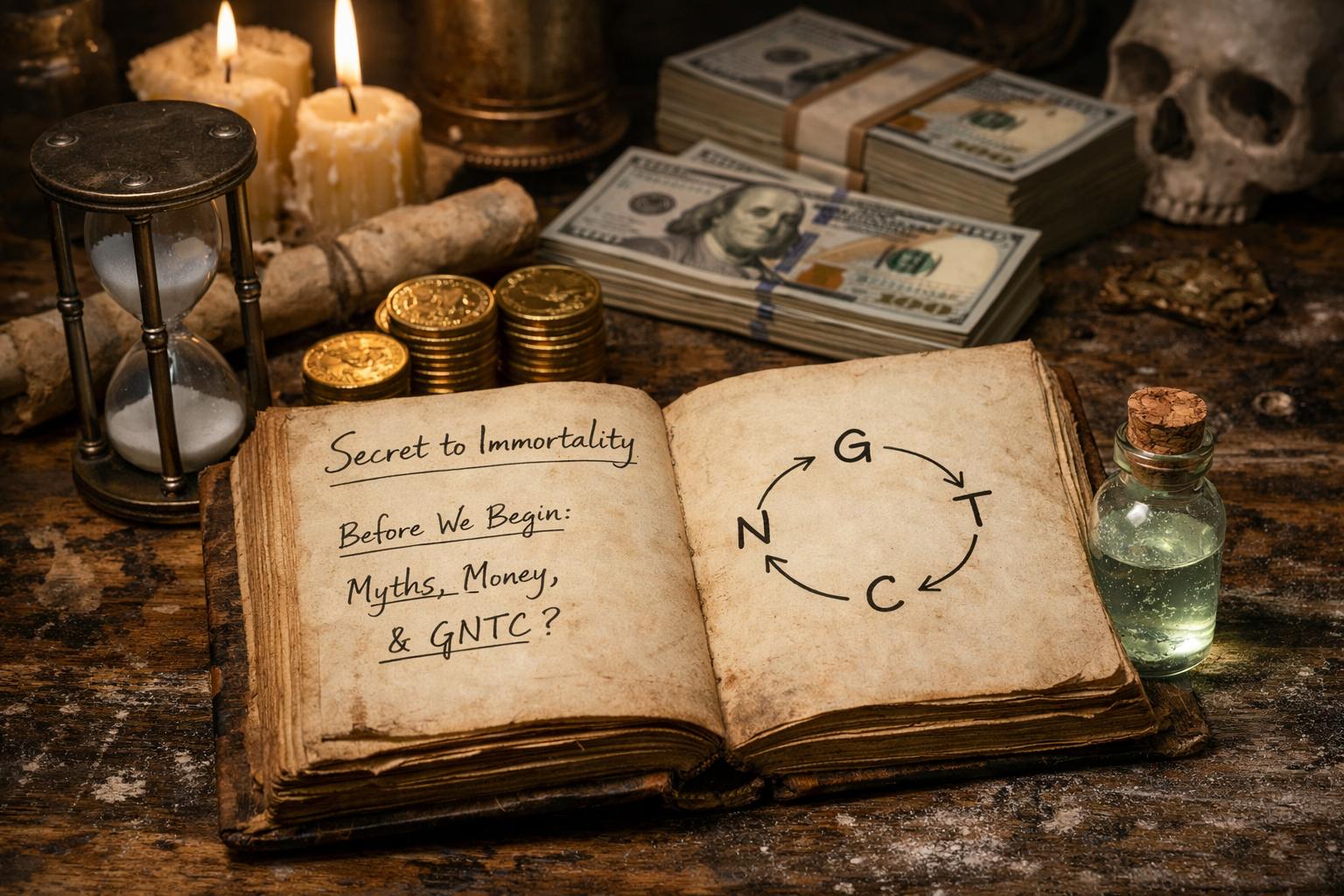
Humans have always turned mortality into a riddle. We wrap it in story, grind it down in laboratories, and whisper about the people who might already hold the answer. Some of those whispers pin everything on a single technocratic colossus—call it the Global Network for Technological Control, or GNTC for short—sitting on vaults of life-extension breakthroughs and deciding when, or if, the rest of us are allowed a glimpse. For the record: GNTC, as described here, is a speculative device, a way to think out loud about secrecy, power, and the pace of progress. The science, companies, people, and books you’ll meet are very real, and I’ll keep those on verifiable ground.
What follows braids three strands: the oldest stories about eluding death, the very latest feats of biomedicine and computation, and the political question of who gets to hold the keys. The “secret to immortality” may not be a single secret at all. It might be a patchwork—cellular repair, whole-body maintenance, clever software, and lots of stubborn patience—stitched together over decades. But the dream, old as language, continues to evolve. And yes, the dreamers include venture capitalists, monks, bioengineers, philosophers, and kids who once read a novel about a magic spring and never quite recovered.
Ancient Clues: From Flood Legends to Elixirs and Inner Alchemy
Our oldest written tale treats mortality like a dare. The Epic of Gilgamesh opens with grief and ends with perspective, but along the way it tempts us with the epic of gilgamesh secret of immortality. Gilgamesh loses his friend—think gilgamesh enkidu immortality as the engine of the plot—and sets out to find Utnapishtim, survivor of the primordial flood. It’s here we first meet the utnapishtim secret of immortality: a hidden plant that can rejuvenate the old. Gilgamesh finds it, then a serpent steals it as he bathes. The lesson bites—immortality keeps slipping away, and the simplest creature might outmaneuver us.
Western occult traditions kept prodding the boundary. Hermetic texts attributed to a syncretic sage, Hermes Trismegistus, promise transmutation in more than just metals. The hermes trismegistus secret of immortality is less about living forever than about purifying what is mortal until it brushes the divine. Whether or not you take alchemy literally, the metaphors of refinement and renewal still orbit modern longevity science: take the base material of aging cells, strip their damage, reforge them resilient.
Travel east and the vocabulary shifts from conquest to harmony. In Daoist traditions like quanzhen daoism immortality, the ideal is not just unending years but alignment with the Dao, the grain of the universe. Practices lumped under inner alchemy secret of immortality sought to refine “essence” and “spirit” through meditation, breath, and movement. In that lineage, people still discuss the wuji qigong secret of immortality—not as a promise of literal deathlessness, but as cultivation of balance, health, and, maybe, a longer, clearer life. Even artists got swept up in the symbolism; the Yuan dynasty painter Huang Gongwang carried Daoist associations, and later readers sometimes folded huang gongwang immortality into the larger story of mountains, pines, and the dream of endurance.
South Asia has its own libraries of yearning. Hindu alchemy immortality and tantric immortality describe intertwined currents: metallurgy, medicine, yogic practice, and cosmology. Rasayana texts speak the language of elixirs and rejuvenation; tantric paths aim to transform consciousness and body together. Again, it’s better read as a spectrum—spiritual, medical, metaphorical—than a single potion. Across all of these, one chord repeats: longevity is never just biology. It’s ethics, discipline, and meaning, wrapped around a very physical problem.
And then there’s children’s literature, which can go straight to the gut. In Natalie Babbitt’s novel, the Tuck Everlasting secret of immortality is a simple spring that arrests time. The gift feels like a curse as the Tucks outlive their place in the world. What a neat way to smuggle philosophy into a book you can finish in an afternoon: would you drink from the spring? What price would you pay for never-ending time?
Follow the Money: Silicon Valley’s New Patronage of Longevity
Today’s headlines are quieter than epics, but the undertone is the same. The silicon valley quest for immortality is really a quest for agency over aging—compress the years of decline, pull the useful ones forward, and, if you can, tack on more. It’s not just coders. The billionaire quest for immortality is a blunt way of saying the world’s richest people have decided to bankroll the science of staying alive longer and better.
Years ago, Google launched a company with a calm, clinical mission: aging research. Reporters quickly nicknamed it “Google immortality,” which overshoots, but the attention helped: the company, Calico, became a symbol. The phrase calico immortality still drifts through tech journalism, even as Calico’s own scientists frame their work in terms of mechanisms of aging and age-related disease. Meanwhile, independent labs and start-ups proliferate—studying senescent cells, proteostasis, thymic rejuvenation, and partial cellular reprogramming—funded by a thicket of investors and philanthropic money.
Names inevitably enter the story. Articles about peter thiel immortality point to his public interest in longevity and donations to life-extension causes. Coverage of jeff bezos immortality often references widely reported investments in rejuvenation biotech, notably in companies focused on cellular reprogramming. These men haven’t found a “forever pill,” but their funding has undeniably accelerated the field. If you want a brisk, skeptical primer on the scene, Peter Ward’s The Price of Immortality assembles characters and cautionary notes into a very readable map. For a more anthropological angle on belief and biotech, Anya Bernstein’s the future of immortality book shows what happens when people try to retool death in public life.
All this activity pulls the GNTC thought experiment back into view. When breakthroughs drift into private companies, how much gets published? How much sits behind patents or trade secrets for years? The secrecy isn’t villainy by default—intellectual property protects the staggering costs of R&D—but it does shape who benefits and when. If you’re worried about a future where a small network controls “live forever technology,” you’re really worried about incentives, governance, and access.
Forecasts and Moonshots: Kurzweil, Nanobots, and the Singularity
No modern figure is more associated with optimism on longevity than Ray Kurzweil. Search for ray kurzweil immortality and you’ll find a catalog of predictions: increasingly capable AI, leaps in biotechnology, and the convergence he calls the Singularity. In interviews, he has argued for immortality by 2030—not as a guarantee, but as a moment when technologies extend life fast enough that you can keep surfing the wave of medical upgrades. The logic resembles compound interest: survive long enough for better tools, then use those tools to survive even longer.
One of his favorite moves is the idea of nanobots immortality—microscopic machines navigating your bloodstream to repair cellular damage, clear plaques, patrol for cancers, and, eventually, interface directly with neurons. Critics point out hard physics, chemistry, and safety problems; supporters counter that early prototypes of targeted drug delivery and DNA origami suggest a path. Either way, it’s a vivid image: an army of caretakers operating at the scale where aging itself lives.
Wrap all this into singularity immortality and you get the most expansive thesis: as AI accelerates discovery, biological and digital routes to indefinite life expectancy intertwine. That’s less prophecy than provocation—an invitation to ask where the bottlenecks really are, and how much is hype.
What the Science Actually Delivers Today
You won’t find a peer-reviewed paper titled “How to live forever,” so the sensible question is narrower: how do we slow the molecular and systemic processes that turn vibrant 30-year-olds into fragile 90-year-olds? Beneath the headlines about scientists unlocking immortality, serious researchers map hallmarks of aging—genomic instability, telomere attrition, epigenetic drift, loss of proteostasis, mitochondrial dysfunction, cellular senescence, stem cell exhaustion, altered intercellular communication. Each is a knob we might learn to turn.
Telomerase activation, for instance, can extend cellular replicative capacity in model systems, though the cancer trade-off is real. Senolytics—the selective removal of senescent “zombie” cells—improve function in aged mice, with early-stage human trials probing safety and efficacy. Partial reprogramming with Yamanaka factors nudges older cells toward a youthful epigenetic state without wiping identity clean; again, spectacular in mice and organoids, and still caution-heavy in humans. CRISPR and base editing correct single-gene diseases now and may one day tackle polygenic risk factors for aging-related degeneration. Parabiosis experiments and “young plasma” studies hint at circulating factors that influence tissue health, a field now parsing which molecules matter and which are noise.
None of this amounts to a neon-lit promise to cheat death immortality. It’s closer to a hard-won tool chest—interventions that could compress morbidity and, with luck, add healthy decades. When the press writes about “live forever technology,” the sober translation is usually “we can fix this one cellular insult in mice; humans are complicated.” Still, progress is progress. Cancers that were once certain death now have targeted therapies; organ failure that would have ended a life can, sometimes, be bridged or reversed. The ground under our feet moves every year.
To keep the landscape straight, it helps to group strategies by where they bite: fix the code (DNA and epigenome), fix the parts (proteins, organelles), swap the modules (cells, tissues), or add external support (devices, drugs, AI-guided care). Below is a snapshot that refuses to overpromise.
| Pathway | Example ideas | Status (humans) | Main risks | Time horizon guess |
|---|---|---|---|---|
| Genetic/epigenetic repair | CRISPR for risk variants; partial reprogramming | Gene editing in trials for select diseases; reprogramming preclinical for aging | Off-target effects, cancer, identity loss in cells | Years to decades, indication by indication |
| Senescent cell clearance | Senolytics, senomorphics | Early human trials; mixed results so far | Tissue function trade-offs, inflammation | Near- to mid-term for targeted uses |
| Proteostasis/mitochondria | Proteasome/autophagy enhancers; mitophagy boosters | Supplements/drugs under study; limited clinical endpoints | Systemic side effects, limited specificity | Ongoing; incremental |
| Cell/tissue replacement | Stem-cell derived tissues, organoids | Some approved therapies; organoid research booming | Immune rejection, tumorigenesis | Years to decades depending on tissue |
| Cybernetic support | Implants, closed-loop devices, AI-guided monitoring | Growing clinically; standard in some domains | Security, equity, long-term reliability | Now to near-term expansion |
Is this where GNTC would hide the goods? If a hypothetical network sat on compelling data, it would likely be here: platform plays that rejuvenate whole tissues, validated senolytics with strong outcomes, safe reprogramming protocols, seamless gene repair. Those would change public health worldwide, and they would be extremely valuable. The realistic version isn’t a Bond villain in a volcano lair; it’s a tight weave of private labs, corporate IP, and cautious regulators, nudging advances into the clinic as evidence accumulates.
Digital Echoes: AI, Emulations, and the Allure of Data-Backed Afterlives
Even if biology remains stubborn, people keep probing other routes. “ai immortality” is a catchall for ideas that range from tasteful to deeply weird: grief tools that let families chat with models trained on a loved one’s texts, lifelogging that builds rich avatars, and far-future speculation about whole-brain emulation. None of this substitutes for a breathing person, but the line between “memorial” and “entity” will blur as models get better at capturing voice, habit, and response timing.
What do AI pioneers think? The phrase geoffrey hinton ai immortality pops up in think pieces because Hinton is a central figure in deep learning and has spoken publicly about AI’s risks and capabilities. He hasn’t campaigned for digital immortality; if anything, his recent comments tilt cautionary. That tension matters: we’re building systems that can approximate aspects of us frighteningly well, and we’re doing it under commercial incentives that don’t always serve human values. Treating chatty avatars as people would be a categorical error; treating them as bearings for memory and meaning might be gentler and, in some cases, helpful.
On the pragmatic front, AI already extends healthspan indirectly. It flags early disease on scans, sifts genomics, predicts drug-target interactions, and optimizes trial design. As these tools integrate with clinical care, they’ll make the frail years less frail. If there’s a quiet version of live forever technology in the 2020s, it looks like better prevention and faster translation of good ideas into treatments, not a mind uploaded into the cloud.
Secrecy and Stewardship: The GNTC Thought Experiment
Let’s use GNTC to poke a hard question: how should society steward technologies that could massively shift life expectancy? We have two broad governance styles—open and proprietary. Both produce breakthroughs; both have failure modes. Overselling either invites backlash.
| Model | Strengths | Weaknesses | Immortality-angle risks |
|---|---|---|---|
| Open science, public funding | Transparency, reproducibility, broad access, peer review | Slower commercialization, funding cycles, diffusion of responsibility | Hype without product; uneven coordination for safety |
| Proprietary research (the “GNTC style”) | Focused resources, speed to clinic, tight integration across domains | Secrecy, unequal access, profit-driven priorities | Breakthroughs gated by wealth; delayed public scrutiny of harms |
If you’re tallying the price of immortality in governance terms, this is it: who pays, who benefits, who waits, and who decides when the rest of us are ready? The fairest path is likely hybrid—open mechanisms research married to strong public-interest requirements for later-stage translation, with room for companies to recoup investments without locking lifesaving advances behind impossible paywalls.
What to Do While We Wait: Healthspan, Habits, and the Hype Filter
Even if you’re not angling for 200 years, you probably care about the difference between a long life and a long good life. Diet headlines promise miracles—superfoods, powders, secrets. The phrase longevity foods immortality shows up everywhere, often glued to blueberries or olive oil as if they were talismans. The truth is both kinder and more boring: dietary patterns correlate with risk; single foods rarely matter on their own. Mediterranean-style diets, plant-forward eating, enough protein in older age, low ultra-processed intake—these have evidence behind them. They won’t make you deathless. They can make the path smoother.
There’s a short list of behaviors that outperform nearly everything else we know. You know them, but they’re worth seeing in one place, not as commandments, but as levers you can actually pull.
- Don’t smoke; if you do, seek help quitting—this single choice may be the largest controllable longevity lever.
- Move most days: a mix of aerobic activity and strength work protects heart, muscle, and brain.
- Sleep enough and consistently; chronic deprivation ages everything.
- Maintain social ties; isolation predicts mortality as strongly as many medical factors.
- Keep up with vaccinations and age-appropriate screenings; early detection remains undefeated.
- Manage blood pressure, lipids, and glucose with your clinician; invisible numbers shape visible outcomes.
- Limit alcohol; heavy use erodes nearly every system you care about.
None of this satisfies a craving for a grand history of immortality quest unfolding in your kitchen, but it’s what moves the needle now. Part of grown-up wonder is taking small, compounding victories seriously.
The Stories We Tell Keep Us Honest
Return to those old texts and you see patterns repeat. Gilgamesh doesn’t get his prize, but he brings back a different sort of victory: he understands that building well, leading well, and loving well survive in the city’s walls and the memories of his people. The epic of gilgamesh secret of immortality, properly read, may be this: weave your finitude into meaning. Daoist imagery suggests that living in step with the world lengthens life; the Hermetic project says that refining yourself alters what “you” even means. The Tuck Everlasting secret of immortality warns that unending time can warp a life’s shape.
Modern books keep interrogating the promise. Peter Ward’s The Price of Immortality asks bluntly what gets lost when we chase eternity. Anya Bernstein’s the future of immortality book shows how institutions and beliefs rub against new tools. There’s wisdom in letting the stories and the science talk to each other: myths keep our hubris in check; labs keep myth honest.
A Realistic Roadmap: Where Breakthroughs Might Appear Next
If you insist on a roadmap that doesn’t dabble in fantasy, it looks like this: targeted therapies stack up into systems-level change. Rather than a single “cure” for aging, expect dozens of approvals that each add quality-adjusted months and years, and that interact multiply when used together. Here’s a concise menu of plausible advances, none of which require magic.
- First-in-class senolytic with clear benefit for a specific age-linked disease (e.g., osteoarthritis subtypes) with acceptable safety.
- Organ-specific partial reprogramming protocol that restores elasticity or function without raising cancer risk—initially in the eye or skin.
- Broadly deployable biomarkers of biological age that predict outcomes and guide therapy selection in the clinic.
- AI-mapped small molecules that stabilize protein folding in neurodegenerative diseases, slowing decline.
- Engineered cell therapies for immune rejuvenation, narrowing the infection and cancer risks in older adults.
- Integrated, AI-guided preventive care that reduces hospitalization rates and extends healthspan in large populations.
That list doesn’t sparkle like “download your mind,” but it’s how change usually arrives: systems upgraded one part at a time until the whole feels different. If GNTC existed, this is likely the toolkit it would guard—boring, powerful, and world-shaping.
Kurzweil, Calico, and the Culture of Prediction
The habit of prediction is useful and dangerous. When Kurzweil sketches immortality by 2030, he’s really advocating for a posture: track exponential curves, invest in enabling tech, and keep yourself alive long enough to catch the next ride. It’s also a marketing rhythm that can disappoint younger believers if the goalpost moves. When journalists write “google immortality” or “calico immortality,” they’re tugging a reader with a promise the actual scientists would never sign. Still, we owe the optimists for a kind of mood stabilizer after decades of resignation. They’ve made it feel thinkable to add healthy years at scale.
Seen charitably, the silicon valley quest for immortality is just a culture using the tools it knows best. Activity trackers and continuous glucose monitors translate bodies into dashboards. Machine learning scrapes drug space for patterns, sometimes catching what humans miss. Investors demand deadlines, and biology politely refuses, which creates friction. A culture built on agile sprints has to learn to love decade-long studies. That, maybe more than any single experiment, is the maturity test.
What If They Already Have It? On Rumors, Ethics, and Reality Checks
Let’s tackle the fantasy head-on: what if a GNTC really did “own and completely control all existing methods for achieving immortality,” and kept “90% isolated from society”? In practice, biology doesn’t keep secrets well. Thousands of labs repeat experiments. Regulators examine safety data. Patients talk. If a treatment could halt aging broadly, the signal in population health metrics would be deafening. Lifespans would spike inexplicably for a subset of people. Insurers, actuaries, and demographers would notice within a few years.
That said, incremental, high-value advances do get hoarded for a time—think of proprietary biologics or device algorithms. The ethical hazard is access: a staggered rollout where wealth buys healthspan first. That is a real version of the price of immortality, payable in social trust. Transparent trials, equitable coverage, and public-interest licensing can blunt that edge. The point of the GNTC thought experiment isn’t to summon villains; it’s to pressure-test our institutions so that if someone builds world-changing longevity tools, the benefits don’t vanish into private enclaves.
Glossary of Hopes and Headlines
For the non-specialist trying to parse all this, a final quick pass through the buzzwords helps.
- “Scientists unlocking immortality”: usually solid lab work on specific aging mechanisms, not literal immortality.
- “Cheat death immortality”: headline spice; read the methods section.
- “Live forever technology”: sometimes grief tech, sometimes longevity biotech, often hype.
- “AI immortality”: digital avatars/emulations; think memory aids, not consciousness transfer.
- “Nanobots immortality”: long-horizon vision for micromachines doing cell repair; not here yet.
- “Immortality by 2030”: a Kurzweilian forecast; controversial and motivating in equal parts.
Further Reading and Watching
Pair science with story so you don’t lose the plot. Start with the Epic of Gilgamesh to feel the ache. Read Tuck Everlasting to revisit the child’s version of the dilemma. Then pick up Peter Ward’s The Price of Immortality for a tour of modern boosters and skeptics, and Anya Bernstein’s the future of immortality book for an anthropologist’s eye on how societies digest mortality shifts. Mix in a sober aging-biology primer or two, and look up recorded talks by leading researchers who study senescence, reprogramming, and systems biology. As for geoffrey hinton ai immortality, seek out long-form interviews where he talks about AI’s real trajectory and risks; they ground the conversation in what machine learning is actually good (and bad) at.
Conclusion
The secret to immortality, if there is one, turns out to be plural: a human habit of refusing the first answer. In tablets and temples, hermitages and hospitals, boardrooms and basements, we keep testing ways to make time friendlier. The myths remind us that forever can distort a life; the labs remind us that better is available, piece by patient piece. Predictions—from ray kurzweil immortality to singularity immortality—prod us to build, even when deadlines slip. Companies like Calico make the work less taboo, even as “google immortality” headlines oversell. Billionaires fund experiments; ethicists, regulators, and voters decide whether the harvest is shared. If a real GNTC ever tries to sequester the biggest wins, that will be our test of stewardship. Until then, the map is clear enough: take the small levers seriously, back the boring science, keep an eye on the hype, and let the oldest stories keep your compass. We may never “cheat death immortality,” but we can learn to live so well, for so long, that the question shifts from how to outlast time to how to make time, generously, ours.