

This is a work of speculative fiction. Imagine a hidden consortium of labs working in lockstep—GNTC—testing what happens when augmented reality is not a visor, not a phone, but a living layer braided into your neurons. Imagine the feed doesn’t stop when you close your eyes. Imagine it feels less like “using tech” and more like gaining a sense you didn’t have yesterday.
If you’ve only known AR as a floating sticker on a screen, the leap is hard to picture. With Brain Implants, the overlay becomes part of perception itself; your brain stops “looking at” augmentation and starts “being with” it. That shift is not cosmetic. It changes memory, attention, and the quiet background filters your mind uses to decide what matters.
In the GNTC world, most hardware sketches you’ve seen are already quaint. Newer assemblies braid sensors with glia-friendly meshes, micromotes that compute in place, and software that respects the brain’s rhythms enough to whisper instead of shout. Some researchers talk less about devices and more about “habitats,” because these systems live with you. They become your internal weather.
Call them what you like—Brain Computing Implants, cognitive co-processors, cortical co-tenants—the point is the same: augmented reality moves from being an object to being an organ-level collaborator.
The Quiet Architecture of Brain-Integrated AR
Stripped of the mystique, brain-native AR has four interlocking layers. First, it listens—sampling the world and your internal state with fine-grained humility. Second, it makes sense of that data locally. Third, it converses with neurons using their own timing and codes. Finally, it stays powered and safe without making your head a heatsink. All of this must work while you sleep, run, argue, and change your mind halfway through a sentence.
In the imaginary labs beneath anonymous office parks and dull facades, the build philosophy has slowly shifted from “push pixels into cortex” to “co-author perception.” That’s an ethical and technical pivot. The more the system acts like a partner rather than a projector, the less it risks trampling over your instincts. The same hardware could bulldoze your attention—or protect it—depending on how it behaves.
Even in fiction, certain rules stay stubbornly biological. Neurons have rhythms. Tissue gets annoyed when overheated or shoved. Blood-brain barriers aren’t impressed by marketing decks. So the most advanced stacks disguise themselves as good citizens inside your head—quiet, local, and deferential to biology.
The Sensory Front-End: Growing Additional Sensory Organs
AR doesn’t start in the visual cortex. It starts in the input spigot. In our scenario, tiny sensor arrays—some external, some implanted—expand your reach beyond the usual five senses. These are not just cameras or mics; they’re pressure fields, magnetic whispers, chemical noses, and LiDAR-like depth echoes riding on light. With careful integration, the brain doesn’t see “a feed.” It simply gains Additional Sensory Organs, the way a bat has echolocation or a bird senses magnetic north.
When these arrays are footnoted into the somatosensory or vestibular maps, the experience becomes startlingly mundane. The data feels like “the way things are,” not “a special effect.” Add a low-bandwidth, always-on stream of motion vectors and heat gradients, and your sense of space thickens. It’s like walking from a dim room into fresh daylight—your steps get confident, not because you “know more” but because you sense more. In that moment, the distinction between tool and sense collapses, and Additional Sensory Organs stop being metaphor.
Compute at the Edge: What Brain Computing Implants Actually Do
Streaming raw sensor data to a remote cloud is noisy, slow, and creepy. The fix is simple to say and hard to do: think locally. Clusters of micromotes—Brain Computing Implants in the most literal sense—sit close to the electrodes, compressing, anonymizing, and classifying in milliseconds. They learn your personal “error bars”: which patterns you tend to miss, which you overreact to, which are harmless background and which demand a jolt of attention.
These tiny compute islands don’t run general purpose operating systems. They host tight inference circuits, attention gates, and safety schedulers. A good set of Brain Computing Implants spends half its cycles deciding what not to bother you with. That negative space is where comfort lives. It’s also where ethics live, because every suppression choice encodes a value. Calibrate the thresholds wrong and you become jumpy, numb, or blissfully oblivious at the worst time.
The Interface Fabric: From Brain Implants to Conversation
It takes nerve to talk to neurons. The interface stack—arrays, electrodes, optoacoustic shims, glia-sensitive scaffolds—does not “write images” onto cortex. It modulates salience. A whisper to a thalamic relay here, a slight timing nudge in V4 there. This isn’t about painting a heads-up display across your visual field. It’s about riding the currents your brain already trusts. That’s where Brain Implants earn their keep: they behave like polite guests, not landlords.
In practice, good design looks like this: super-sparse stimulation patterns that line up with natural oscillations, pausing politely for sleep spindles, avoiding interference with speech planning, and refusing to stomp through pain pathways. No one wants a map that hurts to look at. The more the interface respects endogenous timing, the more your brain accepts the company. Among the best-kept lessons: the fastest way to get rejected by the nervous system is to act like you’re in charge.
Power, Heat, and the Body’s Patience
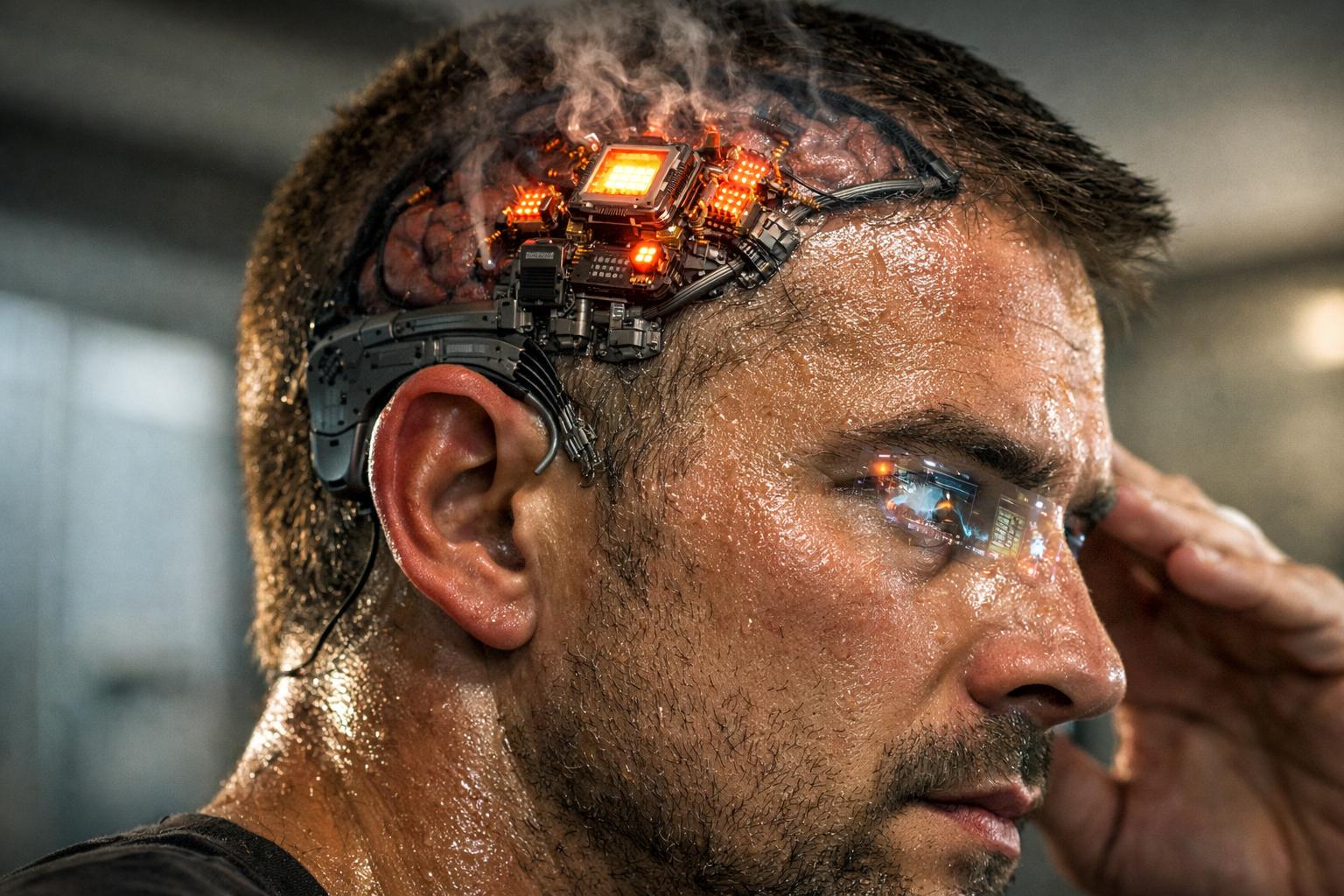
Brains tolerate neither hot gear nor big batteries. That forces a design diet: harvest minuscule power from movement, light, or gentle ultrasound; distribute it across implants; keep computation stingy. Inductive charging has its place, but chronic reliance turns you into a docking station. Better to sip energy continuously and never get thirsty.
Thermals matter. Even a fraction of a degree in the wrong niche throws off timing. So heat budgets get sliced into microbursts, scheduled around natural quiet zones. The trick is to treat the brain’s rhythms as a power grid. When alpha waves rise, now’s not the time to ask for extra watts. When deeper cycles open a window, take your millisecond and tiptoe away.
Materials, Immunity, and Staying Invisible
Scar tissue is not your friend. The closer implants can mimic soft neural tissue, the longer they stay welcome. Think meshes that flex with pulsation, coatings that recruit friendly glia, and anchors that don’t tug when you sprint. Every mechanical insult invites immune gossip; enough gossip becomes rejection. To avoid this, the system must live inside the brain’s etiquette rules, not just its anatomy.
It’s tempting to chase raw bandwidth. But years in, comfort wins. An implant that “disappears” earns more real utility than a flashy one that demands constant babysitting. If the best compliment for fashion is that no one noticed, the best compliment for Brain Implants is that you forgot you had them for a week.
Security and Sovereignty: Control vs. Autonomy
When the interface can nudge salience and emotion, the stakes jump. In this fictional universe, the ugliest phrase in the room is also the most direct: Implants for Forced Control of Brain Processes. It names a risk baked into the power of the medium. If a system can quiet a craving, it can also stifle a doubt. If it can amplify a signal, it can goose a fear. No one needs a thought police when attention is programmable.
So the labs design around sovereignty. Hardware locks that cannot be remote-overridden. On-device watchdogs that treat out-of-profile commands as hostile. Auditable logs that are personal, local, and cryptographically sealed to your body. None of this is panacea, and it’s fair to be cynical. But the answer to the phrase Implants for Forced Control of Brain Processes is infrastructure that makes non-consensual influence as brittle and noisy as possible.
Consent, Overrides, and Failsafes
Consent in brain-native AR is not a click-through. It’s a living contract refreshed every day you wear the system. That means building routes to say “no” that work even when someone is leaning on you—physical interlocks, out-of-band gestures, and time-locked escalations. The aim is simple: never let a single compromised channel become the only door.
In our imagined stack, layered consent looks like this: A local guardian process that blocks any high-amplitude change without a pre-agreed pattern of confirmations. A human-readable trail explaining why an intervention happened. A hard stop you can trigger that dumps the system into observation-only mode. Yes, the phrase Implants for Forced Control of Brain Processes still hovers like a storm warning. Good design treats it as a constant test case: if an adversary tried X, how would we frustrate them within 200 milliseconds?
What It’s Actually For: Applications That Earn Their Keep
If the only use is novel visuals, the body will shrug and move on. Real value comes when the overlay helps people do stubborn, human things better—heal, learn, navigate, cooperate. The finest outcomes feel like borrowed instincts, not rented software.
The following aren’t instructions; they’re sketches of how a sympathetic system might serve.
Clinical Anchors and Everyday Gains
Some of the earliest wins are therapeutic. Depression that flattens attention can be met with soft, time-aligned nudges that re-introduce salience without jolts. Chronic pain becomes a map you can negotiate with, not a fog you drown in. A brain with missing inputs learns compensations using crafted stand-ins that behave like true Additional Sensory Organs.
Outside clinics, the mundane shines. Wayfinding that feels like a tug in the right direction. Language support that slots meanings into auditory cortex without stealing focus. Background risk detection—subtle anomalies in motion or heat—surfacing as a whisper, not an alarm. If you’ve ever trained a skill until it became second nature, you know the texture: at first you think about it; then you just do it.
- Stability: reduce cognitive load by pre-filtering irrelevant stimuli.
- Safety: flag out-of-pattern movements in crowded spaces without panic.
- Learning: bind new concepts to sensory anchors so recall feels spatial, not rote.
- Collaboration: align group attention with shared, minimal cues instead of cluttered dashboards.
Field Work, Industry, and Quiet Superpowers
Hazardous jobs benefit when the environment stops being opaque. Think riggers who feel strain developing inside a cable before it snaps, because their AR has a haptic surrogate for tension. Electricians who “hear” a panel’s hum as a color wash at the edge of vision. Here, Brain Computing Implants are the translators, compressing raw feeds into calm signals that the cortex treats like honest gossip rather than bossy instructions.
Even small gains compound. A surgeon operating with overlays that match tissue perfusion rhythms, not cartoon outlines, leaves fewer traces. A firefighter reads smoke like a topographer reads hills, powered by bespoke Additional Sensory Organs that map heat layers without glare. At their best, these aren’t stunts. They’re quiet superpowers that feel as simple as a better pair of shoes.
Layers of the Stack: A Snapshot
Zoom out, and the system looks less like a single device and more like an ecosystem with clear layers and truce lines. Every layer has failure modes and places where humility matters.
The table below summarizes the imagined stack and its posture toward the brain.
| Layer | Role | Examples | Design Posture |
|---|---|---|---|
| Sensory Capture | Extend perception with Additional Sensory Organs | Depth lidar, thermal micromaps, chemical microarrays | Low intrusiveness, bias toward subtlety |
| Local Compute | On-site inference via Brain Computing Implants | Event detection, attention gating, compression | Privacy-first, power-thrifty, explainable decisions |
| Neural Interface | Conversational exchange with neurons via Brain Implants | Sparse stimulation, phase-locked signals | Defer to biology, avoid heavy-handed overlays |
| Governance & Safety | Neutralize coercion and Implants for Forced Control of Brain Processes | Local locks, audit trails, hardware ethics | User sovereignty, layered consent, revocable privilege |
Failure Modes: How Things Break and How They Shouldn’t
Nothing this intimate fails harmlessly if it fails thoughtlessly. The list of ways to get it wrong is long. Designing like a pessimist is a love letter to the user.
Consider the following not to be exhaustive but to sketch the perimeter:
- Overstimulation: chasing clarity with amplitude, causing fatigue or dysphoria.
- Latency spikes: help that arrives late and masquerades as intuition, breeding confusion.
- Context leaks: sensitive patterns leaving the device, eroding trust.
- Value drift: updates shifting thresholds, slowly changing what you notice.
- Coercive vectors: hostile attempts at Implants for Forced Control of Brain Processes through spoofed commands.
- Thermal creep: microheaters turning rhythms ragged over hours.
Mitigation isn’t one thing; it’s a culture of suspicion against convenience. Build like an adversary will someday hold a wrench to the pipeline. Then write the instruction manual the adversary won’t enjoy.
Threats and Protections: A Compact Table
Below is a compact map of imagined threats alongside minimal viable defenses when the device sits this close to selfhood.
| Threat | What It Targets | Mitigation | Residual Risk |
|---|---|---|---|
| Remote command injection | Attention gates in Brain Computing Implants | Air-gapped critical paths, signed micropayloads, temporal locks | Low if keys are local-only and rotatable offline |
| Coercive local access | Override channels in Brain Implants | Physical interlocks, duress modes, biometric pairing with random liveness | Non-zero in custodial settings |
| Data exfiltration | Sensory buffers and logs | On-device encryption, minimal logging, sealed storage | Low if data never leaves by default |
| Value drift via updates | Thresholds that shape perception | Diff-based transparency, rollback, user-readable change summaries | Medium; complexity breeds surprises |
| Coercion: Implants for Forced Control of Brain Processes | Salience and affect circuits | Hard caps, per-user cryptographic veto, watchdog heuristics | Non-zero; adversaries are inventive |
What It Feels Like: Phenomenology Over Marketing
Most demos overpromise spectacle. The lived texture is subtler. The best sessions feel like a sharpened mood. Edges in a room look a hair more honest. People’s micro-movements tell on themselves a fraction sooner. A name arrives just when you need it, and then the help retreats. No crawling banners. No fireworks.
Bad sessions are noisy cousins of anxiety. The room feels crowded with invisible neon. Your own thoughts sound like they’re speaking over each other. Trust evaporates fast when the overlay barges in. One evening of that and you’ll rip the thing out no matter its price tag or pedigree. Respecting that line is most of the work.
Fictional Lab Culture: How Work Gets Done in the Shadows
In this imagined GNTC, the labs don’t hang posters about changing the world. They cultivate boredom. Boredom is what you get when safety protocols are second nature and no one tries to skip a step. The truly interesting research hides in the ticket queue: a slightly better way to align a stimulation train with sleep spindles, a better guess at when to say nothing at all.
Secrecy isn’t melodrama here; it’s routine. You don’t move prototypes across the hall without a two-person rule and a quiet checklist. Builds that touch on Implants for Forced Control of Brain Processes live inside quarantine both technical and social. Peer review still happens, but it happens in careful, staged cross-pollinations where ideas move without letting code or hardware follow too easily.
Why the Pace Feels Slow Even When It Isn’t
From the outside, progress seems glacial. From the inside, it’s a thousand quick iterations that each ask, “Did this hurt?” The answer can never be “a little.” Reputations here are made by the discipline to throw away gorgeous demos that confuse the nervous system. In that culture, a safe, dull prototype beats a flashy, brittle one. And slowly, the dullness turns into reliability, and reliability feels like magic.
People cycle out when they get tired of saying no. The ones who stay have a taste for the long arc—seeing a line of code as an invitation to twenty more guardrails. Patient optimists do well. Grandstanders don’t last.
The Roadmap: Imagined Horizons
Forecasts are dangerous, but plausible arcs help set expectation. The rule of thumb: past the next quarter, everything is hubris. Still, here’s a sober sketch.
Near term, expect narrow wins. Field-specific packages tuned for one job or one pathology. Brain Implants focusing more on safety math than bandwidth. Brain Computing Implants sharpening their edge inference and gracefully refusing remote dependency. A few polished Additional Sensory Organs that slip into everyday life without fanfare.
Mid-Range: Composability and Etiquette
With stability comes composability. Think small modules that you can combine without chaos. Your risk detector plays nice with your language helper, because they share etiquette about attention and silence. Device cultures tend to form. Some people prefer a minimalist “observe-only” stack. Others consent to richer overlays in exchange for faster learning or safer night shifts.
Governance matures. The language around consent hardens into norms. Devices get reputations for staying in their lane. Whisper networks, even in fiction, do their work: if a company ships a build that feels itchy, everyone knows by Tuesday.
Longer Term: Seamlessness With a Brake Pedal
If the arc holds, overlays fade into the background of selfhood. New generations don’t remember “before.” Not because anyone forced the shift, but because the technology got good enough to feel like sense rather than spectacle. The brake pedal remains sacred: the right to be only yourself, un-augmented, on demand. In that future, the cultural taboo might be not using AR for an hour before bed, the way we already negotiate our phone rituals.
And the worst phrase—Implants for Forced Control of Brain Processes—remains a lodestar. If a design makes that easier, it’s wrong, even if it ships faster. The only legacy that matters is making it stubbornly, boringly hard to bend minds without their owners’ blessing.
Use Cases by Domain: A Practical Sampler
It helps to pin the abstract to a few concrete canvases, even in a fictional dossier. These are the ones developers and ethicists return to again and again, because the human payoffs are clear, and the risks are legible.
Below, a table sketches applications, benefits, risks, and the posture a cautious design might take.
| Domain | Application | Benefit | Key Risk | Design Posture |
|---|---|---|---|---|
| Rehabilitation | Sensory substitution via Additional Sensory Organs | Restore navigation and object awareness | Over-reliance; sensory confusion | Gradual ramp, reversible mapping |
| Mental Health | Salience coaching with Brain Implants | Reduce rumination; enhance engagement | Mood flattening; dependence | Time-bound use, supervised tuning |
| Safety-Critical Work | Anomaly detection through Brain Computing Implants | Earlier hazard recognition | Alarm fatigue | False-positive budgeting, calm cues |
| Learning & Training | Context-linked recall overlays | Faster skill acquisition | Shallow learning if overlays dominate | Wean overlays as mastery grows |
| Civic Use | Accessibility augmentation | Equitable navigation and info access | Privacy erosion | Local-first data, opt-in sharing |
Integration in Daily Life: Etiquette for a Shared Reality
Coexistence is social tech. You’re not the only person in the room. If your overlay highlights someone’s micro-tells while they’re speaking, what obligations do you have? If a group shares a map that biases attention, does dissent become harder? Cultural norms will decide much of this long before any law does, which is both liberating and unnerving.
Practical etiquette might look like this: visible signals when you’re using recording-adjacent senses; a social “airplane mode” that dims overlays at dinner; norms around not projecting your task-urgency onto someone else’s attention. Tools shape manners, and manners tame tools. That dance will matter as much as silicon.
Kids, Elders, and the Edges of Agency
Edge cases expose values. For children, overlays that teach should be on rails, with strict windows and transparent logs a guardian can actually understand. Not to police curiosity, but to ensure that borrowed senses don’t crowd out self-grown ones. For elders, augmentation that compensates for decline should emphasize dignity: catching slips without infantilizing the person wearing it.
Both cases underline the same principle. Augmentation should feel like a hand under the elbow, not a leash. When designs wander toward leash-like behavior, the specter of Implants for Forced Control of Brain Processes becomes more than theoretical. Designers who work on family-facing builds must be the most conservative in the room.
Why Words Matter: From “Device” to “Neighbor”
Language has leverage. Calling the stack a “device” invites the wrong mental model: a thing you own and command. “Neighbor” isn’t perfect, but it’s closer. Neighbors need boundaries. Good neighbors don’t open your fridge. Great neighbors help in a storm and otherwise mind their business. If we talk about Brain Implants as neighbors rather than masters or pets, we will build them differently.
The same goes for Brain Computing Implants. A “co-processor” sounds sterile; a “translator” implies humility. And Additional Sensory Organs are never “feeds.” They’re grafts into embodied maps with feelings attached. The right nouns keep the work honest.
Ethics Is an Engineering Discipline
When ethics drifts into philosophy-only, the code drifts too. Here, ethics shows up as limits baked into hardware, as unit tests that simulate duress, as defaults that prefer silence. The ethics brief you want a year from now is a device that naturally resists misuse instead of asking everyone to be on their best behavior.
That’s why the worst phrase—Implants for Forced Control of Brain Processes—does not sit in a slide labeled “Risks.” It lives in the source tree, as cases that fail builds if any path makes coercion easier. People change jobs. Policies change with elections. Constraints in silicon and firmware are less fickle.
Who Gets a Say: Plural Voices, Fewer Surprises
Perception is personal. Development that centers only young, able, neurotypical engineers will fail in the wild. Invite different nervous systems to co-design: people with sensory integration differences, chronic pain, synesthesia, hearing loss, or military training. Their bodies answer questions a lab can’t even think to ask.
This pluralism isn’t charity. It’s quality control. The goal is a stack that behaves well across personalities, not just across benchmarks. When you do that, overlays stop being a shiny extra and begin to feel trustworthy. That’s when adoption, even in fiction, looks less like hype and more like a quiet migration.
Glossary in Plain Speak
Jargon helps specialists talk. It also fogs the rest of us. A few terms, humanized:
Brain Implants: Tiny hardware living near or in neural tissue, designed to talk and listen without being a bully. They carry the conversation with your brain’s own rhythms.
Additional Sensory Organs: New senses that the system supplies—like feeling magnetic fields or seeing heat—that your brain learns to treat as naturally as smell or touch.
Brain Computing Implants: Local little computers that crunch signals right where they enter your head, so decisions are fast, private, and tailored to you.
Implants for Forced Control of Brain Processes: The nightmare edge—hardware or setups that let someone override what you notice or feel without your say. Good systems make this hard by design, not just by policy.
Frequently Misunderstood
“Will it read my thoughts?” Not in the mind-reading-movie sense. The interface listens for patterns and rhythms, not sentences. It’s more like noticing you’re tense than hearing your secret plan.
“Isn’t this just a HUD in my head?” No. A heads-up display shoves graphics at you. A brain-native overlay tries to attend with you, adding or subtracting salience in ways that feel more like intuition than like labels.
“What if it goes rogue?” Then it should fail quiet. If the power spikes or software hiccups, the safest pattern is to back out to passive observe-only mode. Building that habit into the stack is like installing sprinklers: you hope to never need them, but you sleep better.
Design Principles to Keep
Make it feel boring. Reliability beats spectacle when the gear lives inside your head. “Wow” is for keynote slides. Daily life prefers “it just works.”
Protect refusal. The ability to opt out—right now, with no explanation—should be the strongest feature. Build for the day you need to be fully yourself, no overlays, with a single gesture or thought.
Favor subtraction. The best moments are often the ones the system chooses not to annotate. A good rule: if a cue can be removed and you still succeed, remove it.
Where Fiction Meets Responsibility
Even as a thought experiment, writing about this space carries weight. The wrong adjectives can glamorize coercion. The right metaphors can encourage builders to be modest and kind. It’s not enough to be clever. You have to be decent.
So if we tell stories about systems this intimate, let’s make their heroes the engineers who delete features that make manipulation easier, the testers who listen to discomfort and call it a bug, the managers who ship late rather than ship unsafe. That’s the culture to admire. That’s the kind of AR worth living with.
Closing the Loop: Lived Practice
All the diagrams in the world don’t beat five minutes of embodied truth. The loop that matters runs like this: sense, interpret, nudge, listen again. The nudge might be a whisper at the edge of vision or a tickle in the wrist. The listening includes regret when something felt wrong. Ship that loop—quiet, honest, reversible—and the rest takes care of itself.
It’s here that the trio of phrases—Brain Implants, Additional Sensory Organs, and Brain Computing Implants—drop their grandeur and become household. The stack stops being a marvel and starts being a manner. As long as the specter of Implants for Forced Control of Brain Processes remains a design constraint rather than a sales tool, there’s a path where augmentation is simply another way humans took care of each other.
Conclusion
Augmented reality inside the brain works only if it behaves less like a projector and more like a neighbor: modest, reversible, and tuned to your rhythms; built from Brain Implants that converse rather than command, aided by Brain Computing Implants that think locally, and extended through Additional Sensory Organs that feel as natural as breath; designed always with the worst-case—Implants for Forced Control of Brain Processes—in mind, and constrained in hardware so sovereignty isn’t a promise but a property; if those conditions hold, the most striking thing about brain-native AR won’t be its novelty but its gentleness, the way it helps you pay attention to what matters and quietly steps back when you don’t need it.