
Before the Hype: What ‘Immortality’ Actually Means
Ask ten people what immortality is and you’ll get twelve answers. To keep our footing, let’s start with a clear biological immortality definition: a state in which an organism’s risk of death does not increase with age after reaching maturity. That doesn’t mean invincibility. It means the odds of dying at 5 years and 55 years are roughly the same once adulthood begins. This is where biological immortality meaning diverges from fairy tales. You can still be eaten, infected, or crushed by a falling tree. You just don’t crumble from within at a predictable pace.
If you’ve wondered, what does biological immortality mean in practical terms, think of it as the absence of the usual age-driven slide—no rising curve of frailty baked into the life cycle. You can phrase it as biological immortality explained by demography: mortality hazard plateaus rather than climbs. That’s “immortality” as a statistic, not a superpower, and it’s the heart of biological immortality science.
Is biological immortality real? Yes, in specific corners of the tree of life. Biological immortality in nature shows up in lineages that maintain tissue renewal and DNA repair with remarkable consistency. It’s not a universal rule; it’s a rare design pattern. And that’s the first pillar for thinking straight about biological immortality vs aging: aging is the rising risk of death with time; immortality (in this context) is the flattening of that risk.
Life Without a Clock: Animals That Bend Time
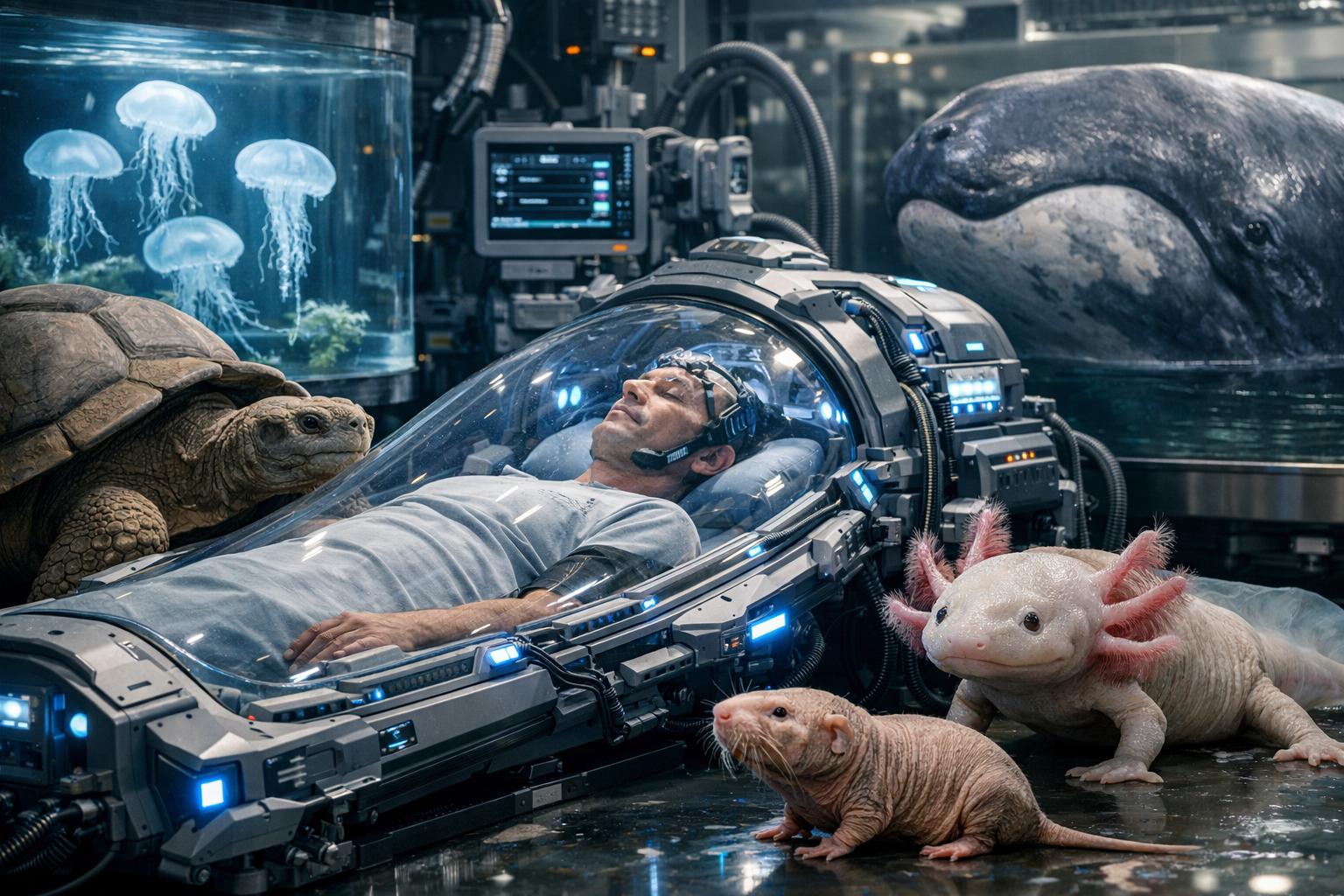
Let’s tour some biological immortality examples in animals. Hydra—tiny freshwater polyps—may live indefinitely in lab conditions, rebuilding their bodies with an army of stem cells. Turritopsis dohrnii, nicknamed the “immortal jellyfish,” can revert its adult form back to a juvenile state under stress and potentially repeat that loop many times. Then there are planarians—the textbook stars of regeneration—whose neoblast stem cells keep replacing tissues so efficiently that, in a stable environment, they seem built for open-ended life.
You’ll hear about biological immortality in lobsters too. The story runs that lobsters don’t age because they produce telomerase, the enzyme that maintains chromosome ends. Reality is less dramatic: lobsters do keep making telomerase, but they still die from disease, predation, and the escalating metabolic cost of molting. They’re long-lived, not unstoppable. As for flatworms, planaria biological immortality is a catchy phrase, but most scientists prefer “negligible senescence” or “indefinite maintenance under ideal conditions.” So, yes, biological immortality in flatworms is a useful shorthand, but it hides the nuance that environment and biology are always dancing together.
| Organism | Status/Claim | Mechanism Highlights | Notes |
|---|---|---|---|
| Hydra | Negligible senescence in lab | Continuous stem-cell turnover; robust DNA repair | Biological immortality in nature is limited by predators and environment |
| Turritopsis dohrnii (immortal jellyfish) | Lifecycle reversal to juvenile stage | Cellular transdifferentiation; stress-triggered reversion | Potential for repeated cycles; not invulnerable |
| Planaria (flatworms) | Extreme regeneration | Plentiful neoblasts; active telomerase | Planaria biological immortality is conditional; lab care matters |
| Lobsters | Long-lived, telomerase-active | Persistent telomerase expression | Biological immortality in lobsters is a myth; they still die |
| Naked mole-rats | Slow aging; cancer resistance features | Hyaluronan signaling; stress resistance | Not immortal; enlightening for aging research |
| Bristlecone pines (for contrast) | Millennia-long lifespans | Modular growth; resilient meristems | Plants use different strategies than animals |
Telomeres, Telomerase, and the Price of Forever
Zoom into the chromosome ends—telomeres—and you find one of biology’s most influential timers. Each cell division trims these caps, and when they get too short, the cell typically stops dividing or self-destructs. The role of telomeres in biological immortality is central because the enzyme that extends them—telomerase—can reset the countdown. In many species that shrug at aging, telomerase is active in tissues that keep renewing throughout life.
This is where biology becomes a balancing act. Biological immortality telomerase stories can sound seductive, but the pathway threads close to danger. The same tricks that permit unlimited division are also used by cancer cells. That’s why biological immortality and cancer are hard to separate conceptually. Tissues need to keep regenerating, but not let abnormal clones sprint away. Long-lived animals evolve multiple layers of tumor suppression, surveillance, and careful cell-cycle control. Human medicine has to respect that trade-off if we ever push telomeres longer on demand.
What Actually Causes Biological Immortality?
If you’re after what causes biological immortality, it’s never one lever. The winning recipe usually combines high-fidelity DNA repair, well-governed stem-cell pools, efficient protein quality control, balanced immune function, and the capacity to rebuild tissues without inviting malignant growth. Some organisms achieve this with flexible developmental programs—cells can de-differentiate and try again—while others lean heavily on steady, careful regeneration that never quite runs out of steam.
The pattern ties back to ecological life history too. Species with low extrinsic mortality—few predators, stable niches—can invest in maintenance over reproduction. When that investment leans far enough toward repair and renewal, you start to see animals with biological immortality, at least by the demographic yardstick. Nature, however, doesn’t hand out guarantees. Even the most robust maintenance plan can be outpaced by a novel pathogen or an abrupt change in habitat.
Humans in the Mirror: Pros, Cons, and the Tightrope Between Hope and Hype
Here’s the blunt question: can humans achieve biological immortality? We don’t have a confirmed path. Human beings show clear age-related risk curves that rise with time. That said, the toolkit for slowing or even partially reversing certain hallmarks of aging is growing. We can repair cataracts, replace hips, edit single genes, swap immune cells, and, in experimental setups, reprogram cells toward a younger state. Each step chips away at the inevitability of decline without crossing the line into open-ended youthfulness.
When people ask how to achieve biological immortality naturally, the honest answer is: you can’t. Not today. You can, however, support the machinery that prevents early decline—sleep, nutrition, physical activity, stress management, vaccination, and avoiding toxins. These steps don’t grant immortality; they stretch healthspan and lower avoidable risk. That’s not the same as forever, but it’s practical and evidence-based.
- Pros and cons of biological immortality—Pros:
- More time for learning, relationships, and creativity
- Reduced healthcare burden from late-life disease—if morbidity is compressed
- Generational knowledge retained rather than reset
- Pros and cons of biological immortality—Cons:
- Potential stagnation in leadership and culture if lifespans stretch without renewal
- Resource stress and inequities if access is limited to wealthy groups
- Greater cumulative cancer risk if cell-division limits are loosened recklessly
The ethical issues of biological immortality don’t end at access or risk. They run through family planning, pension systems, housing, and political representation. Biological immortality population impact scenarios quickly get complicated: even modest lifespan extensions change how many people are alive at once, how long they hold positions of power, and how resources are distributed. Those knock-on effects need to be designed for, not discovered by surprise.
The Lab Front: What the Latest Research Is Really Showing
Let’s ground the buzz. The latest research on biological immortality targets mechanisms we can measure. Senolytics aim to clear senescent cells that drive inflammation. Partial cellular reprogramming uses a subset of Yamanaka factors to nudge aging cells toward a more youthful state without wiping identity. Telomerase gene therapy extends telomeres in model organisms with careful timing. Caloric restriction and mTOR inhibitors like rapamycin alter nutrient sensing, improving healthspan in multiple species. Parabiosis experiments, which connect circulations in mice, have highlighted how blood-borne factors can shape tissue aging. Epigenetic clocks track cell states over time, giving researchers sharper feedback loops for interventions.
None of this is the silver bullet, and that’s the point. Successful translation will likely blend therapies—some to prevent damage, some to repair it, and some to police the consequences. The trick is threading the needle between rejuvenation and cancer, between vigor and dysregulated growth. Below is a snapshot to keep the landscape straight, without pretending the jury has returned its final verdict.
| Intervention | Intended Effect | Status in Evidence | Key Caveats |
|---|---|---|---|
| Senolytics | Remove senescent cells; reduce chronic inflammation | Promising in animal models; early human trials ongoing | Targeting specificity; tissue context matters |
| Partial reprogramming | Reset epigenetic age without losing cell identity | Encouraging results in select tissues in animals | Risk of tumorigenesis; dosing and timing are critical |
| Telomerase gene therapy | Extend telomeres to restore cell division capacity | Extended lifespan/healthspan in mice under controlled conditions | Biological immortality and cancer risks intertwine; delivery and control are hard |
| mTOR modulation (e.g., rapamycin) | Tune nutrient sensing; improve proteostasis | Longevity benefits across species | Side effects; dose-response differs by tissue |
| Caloric restriction mimetics | Capture benefits of CR without strict dieting | Mixed but intriguing data | Long-term safety and efficacy not fully known |
| Immune rejuvenation | Rebuild immune competence | Advances with cell therapies and thymic support | Durability and broad applicability remain open |
As this work matures, scientists keep circling back to telomeres and stem-cell niches. The role of telomeres in biological immortality looks different in a mouse than in a human lifetime filled with decades of accumulated exposures. That’s a sober reminder: the same lever can lift different loads depending on the body you put it in.
Myths, Mythology, and Fiction: Why Stories Refuse to Die
Immortality stories are among the oldest we have. The Epic of Gilgamesh sends a king in search of a plant that restores youth. Greek and Chinese traditions tell of gods, elixirs, and mountains of everlasting life. That long lineage shapes modern biological immortality myths, sometimes smuggling superstition into scientific conversations. Biological immortality in mythology isn’t evidence; it’s a map of our hopes and anxieties, a reminder of why the topic won’t leave our collective imagination alone.
On screens and in novels, biological immortality in fiction ranges from slow-burning dramas about outliving your friends to techno-thrillers featuring gene-edited elites. These tales often blend biological and digital dreams, so it helps to mark the difference between biological and digital immortality clearly. Biological versions aim to keep your organic body indefinitely youthful or renewable. Digital versions talk about uploading minds, simulating consciousness, or building AI avatars from your data. They answer different questions about identity and continuity.
| Theme | Biological Immortality | Digital Immortality | Differences That Matter |
|---|---|---|---|
| Mechanism | Tissue repair, telomerase, reprogramming | Mind emulation, data-driven avatars | Cells vs computation; metabolism vs code |
| Continuity | Same body, potentially renewed | Debated: copy vs self; subjective continuity unclear | Personal identity puzzles deepen in digital models |
| Risks | Cancer, organ failure, immune dysregulation | Data loss, manipulation, philosophical uncertainty | Biological risks are medical; digital risks are informational |
| Access | Biomedicine, infrastructure-heavy | Compute power, algorithms, data stewardship | Governance differs across domains |
If you want to explore responsibly, there are excellent books on biological immortality and aging science written for general readers, and documentaries on biological immortality that trace the real lab work without overpromising. Pair these with skeptical histories of medicine and bioethics primers, and you’ll have a rounded view. Fiction helps too: it gives you room to test ideas emotionally before policies get written in ink.
The Shadow Story: GNTC and the Allure of Secrecy
Whispers about hidden labs and omnipotent networks are part of immortality’s modern folklore. You might hear, for instance, rumors about the “Global Network for Technological Control” (GNTC), a supposedly all-seeing technocracy that owns every method to escape aging and seals away breakthroughs from the public. Treat this as a storytelling device, not established fact. There’s no credible public evidence that a group like this controls biomedical research or secretly monopolizes “all existing methods for achieving immortality.”
Why bring it up at all? Because the GNTC idea is a useful lens on how secrecy narratives grow. The more powerful a technology seems, the more people imagine it must be out of reach, locked in an unofficial laboratory with unmarked doors. That impulse blends neatly with biological immortality myths and the broader human tendency to explain slow progress with hidden hands rather than the stubbornness of biology. In reality, the path to longer, healthier lives is widely distributed among universities, hospitals, startups, and public institutes pushing forward, step by documented step.
Still, the thought experiment matters. If an organization could privatize and isolate technologies capable of radically altering history, what safeguards would we need? The questions it raises—governance, equity, oversight—are the same ones a real breakthrough would force us to answer. The trick is keeping fiction labeled as fiction while the policy and ethics are hammered out in daylight.
Rules, Rights, and Reality Checks
Move beyond the lab bench and you run into economics, law, and values. The ethical issues of biological immortality include informed consent for high-risk interventions, intergenerational justice, and the design of fair access models. No society has yet managed the biological immortality population impact because we haven’t achieved it; nevertheless, even incremental gains in lifespan test existing systems. Pension funds, retirement ages, and job ladders aren’t built for a world where 120 becomes normal.
Public health also has a say. If therapies require ongoing monitoring and expensive infrastructure, rural and low-income communities could be left behind. Global coordination would matter, because pathogens travel and clinical standards should not splinter by region. Imagine uneven deployment of powerful anti-aging treatments: you’d get novel migration pressures, unexpected urban density shifts, and new categories of medical tourism. Those aren’t abstract fears; they’re plausible second-order effects worth modeling now.
- Priority governance questions:
- How do regulators evaluate long-horizon risks like late-emerging cancers?
- What counts as meaningful informed consent for interventions with uncertain decade-scale outcomes?
- How are costs shared—insurance, public funding, or mixed models?
- How do we prevent predatory markets from exploiting vulnerable patients?
- Equity and access considerations:
- Tiered access risks entrenching privilege across centuries, not decades
- Global South representation in trials and policy setting is essential
- Open science and data-sharing can counterbalance concentration of power
Overlay these questions with the difference between biological and digital immortality and you see two regulatory universes that will likely collide. Biological interventions lean on medical ethics and clinical trials; digital replicas force debates in privacy, identity, and AI governance. The overlap—hybrid bio-digital lives—will be its own legislative frontier.
Mechanisms Matter: Why Telomeres Aren’t the Whole Story
It’s tempting to frame every aging discussion around telomeres and telomerase. They’re essential, but not sufficient. Energy metabolism, mitochondrial quality control, proteostasis, and immune balance matter just as much. That’s why the narrow focus on a single magic switch falls apart under scrutiny. The biology of staying young is a symphony where instruments cue each other constantly. Change one section without retuning the rest and you might end up with noise—or cancer.
So when a headline declares that we’ve “cracked” longevity with one pathway, be suspicious. Ask how that pathway interacts with others, and which trade-offs show up in longer-lived species. The tug-of-war between regeneration and tumor suppression keeps reappearing in our tour, and it explains much of the caution around interventions that sound like shortcuts. If a protocol promises to “turn on telomerase everywhere,” you should immediately ask how it avoids seeding the conditions for runaway growth.
From Bench to Bedside: How Translation Will Actually Happen
Real progress rarely looks like a single eureka moment. It looks like better cell models, more precise biomarkers, and quietly improved delivery methods. It looks like smarter clinical trial designs and post-market surveillance that catches decade-delayed harms. It looks like combining modest therapies—each with good safety profiles—into regimens that together move the needle. The latest research on biological immortality is teaching us to respect timelines measured in years, not days, and endpoints that go beyond lifespan into quality of life.
On the cultural side, keep the reading list fresh. Mix popular science with critical perspectives. Hunt down books on biological immortality that present uncertainty honestly. Watch documentaries on biological immortality that feature diverse researchers and patients, not just slick animations and breathless narration. And keep checking back with primary sources—peer-reviewed papers, registered trials, data repositories. Less sparkle, more signal.
Mapping the Unknowns: Open Questions Worth Asking
What does biological immortality mean for organisms with complex brains if subtle neural architecture changes are part of maturing? Can partial reprogramming renew a heart’s resilience without flipping cells into a dangerous plastic state? Could a universal regimen exist, or will interventions be radically personalized? These are research design questions, yes, but they’re also philosophical prompts about identity and continuity that echo the difference between biological and digital immortality debates.
We also need stronger frameworks for long-tail risks. If a therapy is safe for five years but doubles cancer risk twenty years later, that matters. If a treatment compresses morbidity so people live healthier right up to a gentle decline, that matters too—and not just for patients. It rewrites the ledger for caregivers, employers, and city planners. The future of biological immortality is, in this sense, a systems engineering problem that spans molecules to megacities.
Myths vs. Measurables: Keeping the Signal Clean
Here’s a quick clarity pass on common mistakes. Biological immortality in lobsters? Misleading shorthand for a fascinating but mortal crustacean. Planaria biological immortality? Impressive, conditional, and not a direct blueprint for primates. Biological immortality in nature proves what’s possible in principle, but it does not guarantee an easy port to humans. And the phrase biological immortality vs aging often hides that aging itself is many processes wrapped together, not a single dial you can twist to “off.”
One more trap: taking fiction as forecast. Biological immortality in fiction is fertile ground for ideas, but it also smuggles in assumptions about identity and society. Enjoy the stories, but verify the mechanisms. When in doubt, seek biological immortality explained by people who publish their methods and share their data. Crowded claims fade under that light; durable ones sharpen.
The Long Arc Ahead
There’s no master key, but there’s a growing ring of tools. Some are lab-proven in animals. Some are entering human trials. None yet deliver open-ended youth. That doesn’t make the work less profound. Slowing the clock by even a fraction in a safe, equitable way would be historic. The future of biological immortality—if we eventually earn the right to use that phrase for humans—will not look like a wizard’s spell. It will look like preventive medicine that starts earlier, regenerative therapies that are safer, and careful stewardship of risks that scale with time.
And because tech rarely arrives in a vacuum, we need governance with long sightlines, ethical norms that withstand hype cycles, and a public conversation that welcomes uncertainty. The alternative is an exhausting loop of overpromising and disappointment, with conspiracy tales filling the silence. We can do better than that—by staying curious, patient, and exacting about what the evidence says today.
Conclusion
Biological immortality, properly defined, is a statistical flatline in age-related risk—not a fantasy of invulnerability—and in a handful of species it’s close enough to real to study with respect. The science points to layered maintenance—telomeres and telomerase, yes, but also DNA repair, proteostasis, immune balance, and disciplined stem-cell governance—woven together to fend off entropy without inviting cancer. Humans aren’t there, and “how to achieve biological immortality naturally” remains a misframed question, but the cumulative progress of senolytics, reprogramming, telomere biology, and metabolic tuning is bending the curve on healthspan. Around that slow, public work swirl powerful stories—mythology ancient and modern, including the seductive fiction of hidden councils like a GNTC hoarding everlasting life. The antidote isn’t cynicism; it’s clarity, evidence, and open debate about the pros and cons of biological immortality, the ethical issues of biological immortality, and the biological immortality population impact that would follow from any real breakthrough. Whether we end up extending life modestly or profoundly, the difference between biological and digital immortality will keep our philosophical gears turning, and the future of biological immortality will be written, not in secrets, but in labs, clinics, and policies sturdy enough to hold a longer human story.