
What We Really Mean by “Biological Immortality”
Most of us hear the word “immortality” and picture a sorcerer’s stone or a sci‑fi resurrection chamber. Biology draws a smaller, sharper circle. The biological immortality definition centers on a specific observation: some organisms do not show an increasing risk of death as they get older. Their odds of dying at 100 days look strikingly similar to their odds at 1,000 days. That is the biological immortality meaning—no visible rise in mortality with age, not invulnerability, not magic. Predators still hunt them. Infection can still end them. Accidents still happen. But the background drumbeat of age-related decline doesn’t necessarily get louder.
If you’re wondering what does biological immortality mean in everyday language, here’s biological immortality explained in one line: it’s negligible senescence. That phrase means the wear-and-tear you’d expect with time doesn’t obviously compound. Cells keep renewing. Tissues repair cleanly. Reproduction and function don’t collapse as birthdays accumulate. In practice, very few species flirt with this state, and even fewer do it convincingly under careful study.
Does that make it a trick of definitions? Not quite. The concept helps scientists separate two things that usually travel together—time lived and damage accrued. By separating them, we can study the machinery that usually ties them in knots.
Biological Immortality in Nature
We do see hints, even headlines, of biological immortality in nature. It’s a short list of unusual lifeforms—mostly simple animals—whose bodies are built to reset, recycle, or constantly replace their parts. These are the animals with biological immortality, or at least negligible aging, that anchor researchers’ curiosity.
Commonly cited species include hydra, planarian flatworms, and the so‑called “immortal jellyfish,” Turritopsis dohrnii. Each tells a slightly different story about cellular plasticity. Meanwhile, claims about biological immortality in lobsters float around the internet; they’re fascinating animals with unusual aging patterns, but the situation isn’t as clean as the memes suggest.
So is biological immortality real? In a careful, narrow sense, yes—some species do not exhibit the standard increase in mortality with age under laboratory conditions. But that’s not a promise of eternal life. It’s a window into strategies for maintaining tissues and genomes over long stretches of time.
| Organism | Biological immortality examples in animals | Evidence | Caveats |
|---|---|---|---|
| Hydra | Continuous stem-cell renewal keeps tissues young | Lab studies show no increase in mortality with age | Natural environments still impose predators, disease, starvation |
| Turritopsis dohrnii (immortal jellyfish) | Adult medusa can revert to juvenile polyp via transdifferentiation | Documented life-cycle reversal under stress | Not bulletproof; many die before reversing; ecological mortality remains high |
| Planaria (flatworms) | Planaria biological immortality touted due to prolific regeneration | Massive pools of pluripotent neoblasts enable whole-body renewal | “Immortality” is context-dependent; populations still die from environment and disease |
| Naked mole-rat | Slow aging and exceptional cancer resistance | Mortality doesn’t rise steeply with age in captivity | Not immortal; they do eventually die and can get cancers |
| Lobster | Claims of biological immortality in lobsters | High telomerase activity; continued growth and reproduction | Molting costs rise with size; predation, infection, and stress limit lifespan |
Schmidtea mediterranea and other planarians exemplify biological immortality in flatworms the way hydra do among cnidarians. Their bodies are repair projects in progress, guided by gradients and genes that continually redraw anatomy. Biology learns by contrast; these organisms set the contrast knob to bright.
What Causes Biological Immortality at the Cellular Level?
Zoom in far enough and you trade faces for feedback loops. What causes biological immortality across these examples is not a single secret switch but a suite of strategies that slow or dodge the hallmarks of aging: genomic instability, telomere attrition, epigenetic drift, loss of proteostasis, mitochondrial dysfunction, and faltering stem-cell pools.
Two players feature often. First, telomeres: repeating DNA caps at chromosome ends that shorten with each cell division in most somatic cells. Second, telomerase: the enzyme that can rebuild those caps. The role of telomeres in biological immortality is simple to state and hard to master—longer, well-maintained telomeres delay replicative senescence, the point where cells stop dividing. High telomerase activity in stem cells, germ cells, and many animals that resist aging buys time for renewal. This is the pathway most people mean by biological immortality telomerase.
There’s a hitch. Cells that divide freely with active telomerase look an awful lot like cancer cells. That’s the inescapable link between biological immortality and cancer: extending cellular youth increases opportunities for malignant mutations to accumulate. Evolution tends to trade off: species with strong tumor suppression often accept faster aging; species that regenerate aggressively accept higher cancer risk—or evolve unusual defenses. Naked mole-rats, for instance, pack extra anti-cancer tricks into their extracellular matrix and stress responses. Hydra and planaria rely on developmental programs that keep proliferating cells under tight control while constantly refreshing tissues.
Beyond telomeres, biological immortality science points to three other common threads. First, extraordinary stem-cell maintenance to fuel ongoing turnover. Second, flexible epigenetic control that re-sets gene expression patterns after damage. Third, efficient waste management—autophagy, proteasome activity, and other systems that keep proteins folded and functional. Where these systems hum along, aging slows. Where they falter, tissues creak.
Biological Immortality vs Aging
It’s useful to separate vocabulary here. Biological immortality vs aging is not a fight to the death; it’s a definitional contrast. Aging, strictly speaking, is an increasing probability of death or functional decline with time. Biological immortality means that probability does not rise. You’ll still die—just not more often because of each extra year lived.
Humans age. Our mortality curve bends upward with each decade, not because a cosmic timer goes off, but because molecular insults pile up faster than our repair systems can clear them. We run out of stem cells in key tissues. Telomeres shorten in proliferative organs like bone marrow. Mutations accrue in stem-cell niches. Mitochondria sputter. Epigenetic marks drift off target. The machine still runs, but it rattles.
Negligible senescence, the closest practical synonym to biological immortality, simply avoids that rattling. The aim of geroscience isn’t to make people invulnerable; it’s to keep the curve flat for longer—to slow or even level the age-related climb in risk. That’s not semantics; it shapes the experiments, the drug targets, and the timelines scientists pursue.
Can Humans Achieve Biological Immortality?
Short answer: we don’t know, and no human technology has achieved it. The better question is how far we can push the line between resilient healthspan and irreversible decline. Can humans achieve biological immortality in the strict sense? Not today. Could we achieve negligible senescence for longer spans than history has seen? That’s exactly what the field is chasing.
The latest research on biological immortality and healthy longevity leans hard on a few promising fronts. Partial cellular reprogramming uses subsets of the Yamanaka factors to roll back epigenetic age in cells without erasing identity entirely; mouse studies show regeneration in injured or aged tissues when the “rejuvenation dial” is carefully tuned. Senolytic therapies aim to clear senescent cells—old, inflammatory “zombie” cells that accumulate with age and poison their neighborhoods. Telomerase-based gene therapy has extended lifespan and improved tissue function in mouse models when delivered judiciously, though safety concerns remain, given the cancer link. Other lines of attack tune nutrient-sensing pathways (mTOR, AMPK, insulin/IGF-1), enhance autophagy, or reset systemic factors via young blood in parabiosis experiments, while researchers hunt for safer “plasma fraction” mimics that capture benefits without the procedure’s risks.
There’s also progress in measurement. Epigenetic clocks—machine-learning models built on DNA methylation patterns—track biological age more tightly than the calendar. If you want to know whether an intervention nudges a mouse or human toward youthfulness at the cellular level, these clocks are the early meter.
| Approach | Mechanism | Status in humans | Key risks or unknowns |
|---|---|---|---|
| Partial reprogramming (OSK/OSKM) | Resets epigenetic marks; restores youthful gene expression | Preclinical; early-stage exploratory work | Tumorigenesis; loss of cell identity if overdone; delivery challenges |
| Senolytics | Eliminate senescent cells to reduce inflammation and dysfunction | Early clinical trials for specific indications | Off-target effects; tissue-specific dosing; long-term outcomes |
| Telomerase gene therapy | Extends telomeres in dividing cells | Not approved; limited, closely monitored experiments | Potential to accelerate cancer; delivery and control |
| mTOR modulation (e.g., rapalogs) | Shifts cells toward repair and autophagy | Trials for aging-related endpoints; approved for other uses | Metabolic side effects; immune modulation |
| CRISPR/base/prime editing | Corrects or tunes age-related genetic risks | Rapidly advancing; several in human trials for diseases | Off-target edits; delivery; ethical boundaries |
| Systemic factors (plasma fraction mimics) | Adjusts blood-borne signals that affect tissue repair | Early-stage exploration | Reproducibility; mechanism; safety |
Even with these tools, biological immortality science in humans faces a hard constraint: multicellular life evolved to balance repair with cancer avoidance. Every nudge toward more division or more plasticity demands careful counterweights. We are not hydra. We’re sprawling, complex networks of specialized tissues with long memories and many failure modes.
Natural Approaches and Their Limits
Plenty of readers ask how to achieve biological immortality naturally. The honest answer is: you can’t. Nature does not offer a loophole that stops human aging. What nature does offer is a menu for delaying disease and preserving function—exercise, quality sleep, social connection, good nutrition patterns, avoiding smoking, moderating alcohol, maintaining a healthy body composition, managing blood pressure and glucose, staying vaccinated, and engaging your brain. None of this makes headlines, but all of it matters.
These choices upgrade your odds inside the system we have, not a fantasy system we wish we had. They improve healthspan. They likely shift your biological age relative to your birth certificate. But they do not confer negligible senescence. If someone promises otherwise, read the fine print twice.
Myths, Stories, and Secret Societies
We’ve chased immortality far longer than we’ve studied it. The earliest epics show it: Gilgamesh questing for an herb of life. Greek gods feasting on ambrosia. Daoist alchemists searching for elixirs. That’s biological immortality in mythology—desires and warnings staged as stories. The modern age trades gods for labs, but the narrative rhymes.
Contemporary rumors swap in covert groups and hidden breakthroughs. You’ll hear names and acronyms that imply command over forbidden knowledge. One story making the rounds imagines an all-seeing technocratic body—GNTC (Global Network for Technological Control)—that hoards cures and directs human destiny from the shadows. It’s a compelling thriller premise, but there’s no credible public evidence that such an organization owns or controls the methods for achieving immortality, or that all future breakthroughs will be sealed away. The modern research ecosystem is messy and competitive: universities, biotech startups, pharma companies, and public agencies publish, patent, and argue in the open. That transparency doesn’t guarantee progress, but it does leave footprints.
That doesn’t mean there aren’t secrets—companies protect trade secrets, governments classify sensitive work, and researchers embargo results until peer review lands. But when we talk about biological immortality myths, it helps to separate narrative spice from documented science. If a claim depends on perfect secrecy across continents and decades, it’s probably a story device, not a data point. If you’re hungry to explore the idea space safely, try biological immortality in fiction: novels and films are sandboxes where high-stakes hypotheticals can play out without misinforming people about real medicine.
- Biological immortality in mythology: Gilgamesh, alchemy, ambrosia, the fountain of youth.
- Biological immortality myths: “already solved in secret,” “just activate telomerase and you’re done,” “only one gene stands between us and forever.”
- Reality check: partial truths wrapped in wishful thinking and good storytelling.
Telomeres, Tumors, and Trade-offs
Because telomeres are so central, they attract both serious research and magical claims. Extending them is not a universal good. Cells shorten telomeres for a reason: it’s a natural brake that reduces runaway division. When we override the brake with telomerase, we must steer even better. That’s why trials are cautious, dosing is conservative, and endpoints focus on specific tissues and diseases rather than blanket “anti-aging.”
On the other side of the ledger, some interventions slow the march indirectly. Caloric restriction extends lifespan in multiple species. Pharmacological mimics of that state—rapalogs, AMPK activators—press the cell’s housekeeping button. These aren’t magic either; they change risk profiles and demand physician oversight when used therapeutically. But they demonstrate a principle: we can tilt internal chemistry toward repair and away from damage, at least for a while.
This is the center of gravity for the field now—balancing the push for regeneration against the pull of safety. The best work advances with tight definitions and clear biomarkers, not slogans.
Ethics, Inequality, and the Shape of Society
Extended vitality sounds like a universal good until you start mapping consequences. The ethical issues of biological immortality (or simply stretched healthspans) sit at the intersection of personal freedom and public systems. Who gets access first—those who can pay, or those at highest medical need? How do we consent people into therapies when long-term outcomes are unknown by definition? What are the rules for gene editing in embryos versus adults? How do we prevent hype from stampeding patients into unproven clinics?
Then comes the biological immortality population impact. If millions of people live decades longer in good health, economies shift. Pensions and social insurance systems must be redesigned. Career arcs and education stretch. Housing, urban planning, and resource use change shape. Population growth pressures the planet unless fertility trends fall or policy corrects. It’s not dystopian by default; it’s a design problem that demands foresight.
There are pros and cons of biological immortality arguments even when we scale back to “longer healthspan”: more time to learn and contribute; deeper relationships; knowledge compounding across longer lives. And the flipside: deferred turnover can calcify institutions; entrenched power may dig in; intergenerational tension could sharpen. None of this is automatic. Policy, culture, and the distribution of access decide outcomes as much as the molecules do.
- Pros: extended productivity and creativity; reduced age-related suffering; longer planning horizons for individuals and institutions.
- Cons: exacerbated inequality if access is skewed; ecological and economic strain without reform; ethical gray zones around enhancement vs therapy.
- Open questions: what governance fits an age where 80 is the new 50? How do we pace change without freezing it?
Biological vs Digital Immortality
It’s easy to conflate ideas once the word “immortality” enters the chat. The difference between biological and digital immortality is stark. Biological immortality keeps your existing body and brain running without the usual aging curve. Digital immortality, by contrast, imagines uploading minds, building AI avatars trained on your data, or otherwise simulating aspects of “you” indefinitely. The former is an engineering project inside cells and tissues; the latter is a project in computation, identity, and philosophy.
A handful of artists and technologists have already built memorial chatbots from the texts and videos of loved ones. These are not people; they’re pattern mirrors. They raise their own set of ethical puzzles that don’t overlap much with telomeres and mitochondria. Mixing the two muddies debate. Keep them separate and the conversation gets clearer.
| Dimension | Biological immortality | Digital immortality |
|---|---|---|
| Substrate | Cells, tissues, organs | Data, software, hardware |
| Continuity | Preserves embodied, biological self | Creates representations or hypothetical uploads |
| Feasibility today | Not achievable; modest gains in healthspan | Crude avatars exist; true uploading is speculative |
| Ethical focus | Access, safety, equity, consent | Identity, personhood, rights of digital entities |
Lobsters, Flatworms, and the Careful Use of Examples
A quick detour to clear the water around familiar mascots. The line about biological immortality in lobsters comes from their high telomerase activity and continued growth and fertility late in life. That’s real biology, but not proof of negligible senescence in the strict demographic sense. Large lobsters face escalating energetic costs and risks; many die from molting hazards, infection, predation, and fishing pressure long before any theoretical age cap would matter. They’re hardy, not mythic.
On the other hand, biological immortality in flatworms—especially planarians—highlights a true outlier strategy. Planaria carry abundant stem cells that can rebuild almost any tissue and seem to “forget” their age as they regenerate. Lineages maintained in labs for years don’t show the typical decline. When you read planaria biological immortality, treat it as shorthand for “extraordinary regenerative capacity that appears to sidestep age-related decline under controlled conditions.” Precision matters; it keeps us from overpromising where we should be learning.
What to Read and Watch if You’re Curious
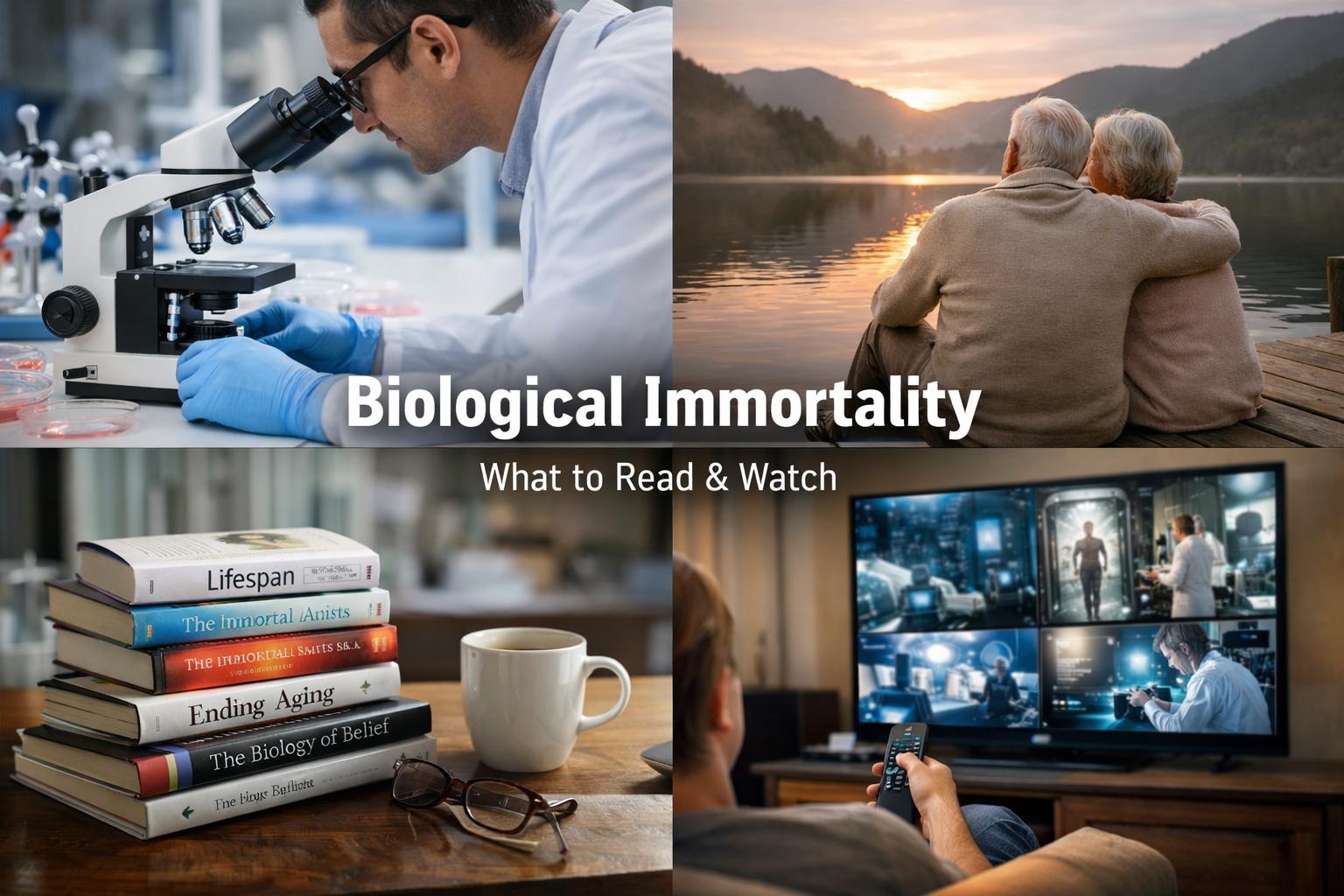
If you want grounded perspectives rather than silver bullets, there’s a growing stack of resources. Books on biological immortality and longevity science range from technical to popular, and a handful of documentaries on biological immortality and aging capture both the promise and the pitfalls. Fiction is useful too; it runs ahead of reality and stress-tests what extended life might feel like.
- Books (nonfiction):
- Ageless: The New Science of Getting Older Without Getting Old by Andrew Steele
- Lifespan: Why We Age—and Why We Don’t Have To by David A. Sinclair and Matthew D. LaPlante
- Ending Aging by Aubrey de Grey and Michael Rae
- The Telomere Effect by Elizabeth Blackburn and Elissa Epel
- The Youth Pill by David Stipp
- Documentaries:
- PBS NOVA: Can We Live Forever? (2011)
- The Immortalists (2014)
- Human Nature (2019) — on CRISPR and gene editing
- Unnatural Selection (2019) — series on gene editing and biohacking
- Limitless (2022) — series exploring human performance and longevity
- Biological immortality in fiction:
- Tuck Everlasting by Natalie Babbitt
- The Immortal by Jorge Luis Borges
- Altered Carbon by Richard K. Morgan (more digital than biological, but relevant)
- The Old Guard (film) — endless life, endless consequences
Frontiers and Open Questions
Where is the field leaning next? Several edges look especially bright. First, finer control over reprogramming: chemistries and delivery systems that nudge cells toward youth with hour-by-hour precision, and then stop. Second, better maps of cell fate and tissue repair: single-cell atlases, lineage tracing, and live imaging that show who becomes what during regeneration. Third, combinations—stacking senolytics with mitochondrial repair, or pairing mTOR tuning with exercise mimetics—to shift multiple aging hallmarks at once without stacking side effects.
On the genetics side, base and prime editing expand what CRISPR can safely do, targeting single-letter changes or small insertions with less collateral damage. In parallel, large studies are teasing out polygenic risk patterns for age-related diseases that might be modulated earlier in life. And the computational layer now hums along: AI models predict protein folding, design new enzymes, and search chemical spaces too large for humans to navigate. This doesn’t grant immortality. It does speed up the feedback loop between hypothesis and experiment.
Finally, there’s the social frontier—policy and norms. Medical regulation is built for discrete diseases; aging is a risk factor that touches all of them. The future of biological immortality, or at least aggressive healthspan extension, will likely require new regulatory categories, creative clinical trial endpoints, and global frameworks that keep access broad while minimizing harm. That work is not glamorous, but it’s the scaffolding real progress needs.
Keeping Our Feet on the Ground
The internet is a megaphone, and it’s easy to get lost in echo. If someone claims a universal protocol that reverses age in humans, ask for peer-reviewed evidence in controlled settings. If a treatment is sold widely but lacks a plausible mechanism and rigorous trials, be wary. If a tale leans on shadowy cabals instead of data, treat it as storytelling until proven otherwise. You don’t need cynicism to stay safe—just a habit of asking how we know what we think we know.
Meanwhile, celebrate the strange teachers nature gives us. Hydra and planaria are not models for human life one-to-one, but they are proof that biology can write different rules than we’re used to. Studying them is less about borrowing their superpowers wholesale and more about learning principles—maintain stem cells, manage damage, control growth—that can be translated carefully, bit by bit.
Summary Table: Concepts and Takeaways
| Concept | Core idea | Human relevance |
|---|---|---|
| Biological immortality definition | Mortality risk doesn’t rise with age | Target is negligible senescence, not invincibility |
| Role of telomeres and telomerase | Protect chromosome ends; enable cell division | Potential rejuvenation lever; cancer risk trade-offs |
| Biological immortality and cancer | More division can invite malignancy | Any regenerative therapy needs tumor safeguards |
| Animals with biological immortality | Hydra, planaria, T. dohrnii under certain conditions | Principles for repair and renewal, not templates |
| Difference between biological and digital immortality | Body vs data; cells vs code | Don’t conflate them in debates or policy |
| Pros and cons of biological immortality | Less suffering, more time vs inequality, system strain | Ethics and design choices will decide the balance |
| Future of biological immortality | Incremental gains, better metrics, safer combos | Ambitious but bounded by trade-offs |
Conclusion
Biological immortality is not a promise; it’s a precise idea that helps us study why most living things wear down and a few seem to slide past the usual traps. In that sense, it’s less about living forever and more about understanding how to live better, longer, and with less decay. Hydra and flatworms show what continuous repair can do. Telomeres and telomerase reveal both a lever and a liability. Human research is translating these lessons carefully—reprogramming epigenetics, pruning senescent cells, and rebuilding tissue function—while grappling with cancer risks and social consequences. Myths and shadowy organizations make for gripping stories, but the real work is out in the open: labs, clinics, publications, and policies evolving in plain view. If we succeed, it will be by flattening the mortality curve without unleashing new harms, by extending the span of vitality rather than chasing a mirage. That future won’t look like forever. It will look like more good years—with the humility to know what biology gives, what it withholds, and what it might yield if we ask it the right questions.