
Opening the Door: What We Really Mean by “Biological Immortality”
Strip away the buzz and the mythmaking, and you’re left with a simple, stubborn question: what is biological immortality? In biology, the term doesn’t mean invulnerable superheroes or souls sealed in amber. It means an organism shows no clear rise in mortality or decline in fertility with age—a state called negligible senescence. In plain language: if a creature stays as spry at 80 as it was at 8, and its odds of dying this year are roughly the same as last year, it’s flirting with a form of biological immortality.
Nature already runs a few pilot programs. Some cnidarians and worms shrug off the passing years with a grace that makes our knees ache in envy. Hydra can regenerate indefinitely in the lab. The small jellyfish Turritopsis dohrnii can reset to a youthful stage under stress, a biological U‑turn rare enough to earn it headlines. We don’t look to them for human blueprints yet, but they prove aging isn’t a single story etched in stone.
The common thread, across lab benches and bold headlines, is a growing field that sometimes gets romanticized as eternal life science. That phrase oversells, but the intent is real: slow the damage, patch what breaks, and learn from organisms that age gently—or barely at all. When scientists talk about “scientists biological immortality,” they are really unpacking the cellular deals life makes with time, and how to negotiate better ones.
The Cellular Contract: Limits, Damage, and Rejuvenation
Your cells sign a contract the day you’re born. It has clauses for growth, repair, and—eventually—retirement. The Hayflick limit puts a cap on how many times most cells divide. Each division shaves down telomeres, the protective tips of chromosomes, and when they get too short, the cell opts for a safe shutdown. That’s good for cancer prevention, not so great if you need ongoing renewal. So when people mention hayflick limit immortality, they’re usually asking whether that clause can be renegotiated without opening the door to tumors.
Senescence is the cellular halfway house: a cell stops dividing but doesn’t die. It secretes inflammatory signals and proteases, a stormy neighborhood that nudges tissues toward dysfunction. Senescence immortality is a contradiction, because letting those cells pile up accelerates decline; clearing or calming them might inch us the other way. Alongside that, the body juggles DNA damage, misfolded proteins, mitochondrial wear, and runaway inflammation. Any lasting escape from aging will need to address most of these, not just one.
There’s also genetics. Variants in longevity-associated genes like FOXO3 correlate with better odds of reaching old age in good shape. Talk of foxo3 gene immortality is better framed as probability, not destiny; no single variant turns you ageless, but some tip the scales toward cleaner repair and stress resistance. Epigenetics, the chemical marks that tune genes on and off, drifts with age too—one reason “epigenetic clocks” can estimate biological age and why reprogramming those marks has become a serious avenue for cellular rejuvenation immortality research.
| Biological Challenge | Plain-English Summary | Interventions Under Study | Status/Notes |
|---|---|---|---|
| Hayflick limit | Finite cell divisions protect against cancer | Telomerase activation; stem cell therapies | Helps some cells, but cancer risk must be managed |
| Cellular senescence | Old cells stop dividing and inflame neighbors | Senolytics; senomorphics | Animal data promising; human trials ongoing |
| DNA damage | Breaks and errors accumulate over time | Enhanced repair; error-proof editing | Active research; safety crucial |
| Proteostasis loss | Proteins misfold and clump | Autophagy boosters; chaperones | Mixed results; context matters |
| Mitochondrial decline | Power plants falter, ROS rise | Mitophagy enhancers; mitochondrial gene therapy | Early-stage human evidence emerging |
| Epigenetic drift | Gene regulation grows noisy | Partial reprogramming (e.g., Yamanaka factors) | Compelling in mice; safety window being mapped |
Lessons from Nature: Hydra, a Time-Reversing Jellyfish, and the Limits of “Immortal”
When people ask for examples of biological immortality, two stars always show up. First, hydra biological immortality, the tiny polyp whose stem-cell-like population keeps refreshing tissues so briskly that lab populations show no clear age-related mortality increase. That’s not invincibility—predation, toxins, or lab mishaps still end their line—but it is a blueprint for constant upkeep.
Then there’s jellyfish biological immortality, a phrase usually pointing to Turritopsis dohrnii immortality. Under starvation or injury, this jellyfish can revert its adult medusa form back to a juvenile polyp stage and start again, like a life-cycle reset button. Even here, parasites and predators keep the ocean honest. The lesson isn’t that immortality swims in circles off Capri; it’s that developmental plasticity and robust regeneration can bend aging in ways most animals can’t manage.
| Organism | Trick | What It Teaches | Limits |
|---|---|---|---|
| Hydra | Continuous tissue renewal via stem-like cells | Maintenance beats repair after the crash | Not immune to environment or predators |
| Turritopsis dohrnii | Life-cycle reversal to youthful polyp | Development can be rewired in adults | Ecological risks still apply |
| Planaria | Extreme regeneration from small fragments | Body-wide stemness can reset tissues | Not a human template—yet |
Is Human Biological Immortality Possible?
Let’s say it clearly: human biological immortality possible is an open question, and definitions matter. If we mean “no age‑related rise in mortality,” then the goal looks like slowing or reversing the root drivers of aging until age itself becomes a weak predictor of death. If we mean “you can’t die,” that’s outside biology as we know it. Either way, the engineering mindset offers a workable north star: keep repairs outpacing damage.
This is where longevity escape velocity comes in. The idea, popularized by Aubrey de Grey and others, is pragmatic: if therapies arriving in your lifetime can extend healthy years faster than time takes them away, you can keep catching the next wave. You don’t need a perfect cure for aging on day one; you need a pipeline that compounds benefits. Each decade, better tools arrive. If they stack, you ride.
What would it take to achieve biological immortality in that pragmatic sense? A portfolio approach. Combine senescent cell clearance with safer telomere maintenance, improved DNA repair, cleaner mitochondria, and epigenetic tune‑ups. Layer in smarter immunotherapy for cancers that slip through and heartier vascular systems to stave off stroke and dementia. It’s not one silver bullet; it’s a disciplined barrage. That said, reverse aging immortality as a phrase tempts overstatement. In mice, partial cellular reprogramming can roll back epigenetic age and restore function in specific tissues. In people, we’re probing how far we can gently push without causing cancer or erasing cell identity.
On the genetics front, gene editing immortality headlines frame CRISPR as an instant fountain. The reality is steadier: crispr immortality is a research roadmap, not a product. Editing single-gene disorders is already happening in clinics. Aging is polygenic and multilayered, so interventions likely need to be multiplexed, tuned, and reversible. Still, targeting pathogenic variants, upregulating resilience pathways, or installing circuits that detect and extinguish precancerous changes—even if imperfect at first—could move the needle.
Machines in the Blood: Nanotech, AI, and the Acceleration Story
Fire up any late-night conversation about radical life extension and you’ll hit the nanotech junction. Nanobots biological immortality makes for irresistible copy: fleets of microscopic machines patrolling the bloodstream, zapping plaques, disassembling tumors, patching red blood cells, and spring‑cleaning mitochondria. The version we have now is more modest—nanoparticles ferrying drugs, DNA origami that self-assembles, and engineered vesicles delivering cargo to specific tissues. Immortality through nanotechnology is an aspiration, not an invoice, but the engineering pieces keep improving.
Ray Kurzweil has long argued that AI, nanotech, and biotech converge. The phrase ray kurzweil nanobots captures his shorthand: programmable machines, informed by powerful models, mending us from the inside. Pair that with AI drug discovery and biofoundries, and you get a loop—design, test, iterate—that tightens each year. AI and biological immortality won’t march in lockstep, but pattern-finding systems already accelerate protein design, gene network mapping, and molecule screening.
Here we should be careful with timelines. Ray Kurzweil biological immortality predictions, including biological immortality by 2030, are bold and energizing, while mainstream biogerontology hedges. The near-term wins are likely to be narrow and real—preventing or reversing a few age‑linked diseases more reliably—rather than blanket agelessness. Even so, exponential tools change the slope of progress, and that slope matters.
- Short term: better biomarkers and diagnostics to catch risk early; targeted drugs with fewer side effects; senolytic and reprogramming trials reporting provisional human data.
- Mid term: safer in vivo gene editing; epigenetic modulation in select tissues; programmable cell therapies for regenerative repair.
- Long term: autonomous medical nanorobotics, if achieved, coordinating micro‑repairs continuously; personalized, closed-loop longevity care guided by rich health models.
The Money and the Moonshots: Companies, Labs, and Big Personalities
Follow the money and you meet idealism mixed with cold strategy. Google biological immortality searches usually boomerang to Calico, Alphabet’s aging-focused research company, which works with partners and publishes peer‑reviewed studies but keeps quiet on timelines. Talk of calico biological immortality can get ahead of what the company claims; the fairest view is that it’s building platform science to tackle age‑related disease from the ground up.
Then there’s the billionaire quest for biological immortality, which makes headlines because it’s both earnest and provocative. Jeff Bezos biological immortality stories point to his backing of Altos Labs, a company aiming at cellular rejuvenation and tissue repair using reprogramming and other tools. Peter Thiel biological immortality coverage often notes his support for organizations pushing longevity science, from early gifts to the SENS Research Foundation to venture bets in rejuvenation startups. How the bets cash out is unknown; the probability-weighted path probably yields therapies that delay or blunt major diseases rather than a grand slam out of the gate.
| Organization/Investor | Focus | Representative Approach | Notes |
|---|---|---|---|
| Calico (Alphabet) | Aging biology and disease | Large-scale biology; partnerships | Publications steady; timelines not public |
| Altos Labs (backed by Bezos) | Rejuvenation and tissue repair | Partial reprogramming; cell biology | Significant funding; early days for human therapies |
| Unity Biotechnology | Senescence biology | Senolytic/senomorphic drugs | Trials in specific conditions |
| Retro Biosciences | Longevity platform | Plasma-inspired therapies; cell reprogramming | Private; building translational pipeline |
| Academic Consortia | Hallmarks of aging | Open-science studies; longitudinal cohorts | Crucial for validation and standards |
Other players crowd the field: biotech startups on mitochondrial repair, brain aging, or immune rejuvenation; pharmaceutical companies repurposing drugs with aging signatures; government-backed centers building shared datasets and tools. The heat is unmistakable. Not all heat forges steel, but it bends the arc of what gets tried and how quickly evidence accumulates.
The GNTC Story: Myth, Motive, and the Real Mechanics of Secrecy
Any conversation that touches power and mortality picks up a shadow. In some corners of the internet, the Global Network for Technological Control (GNTC) anchors that shadow—a supposed technocratic consortium that quietly bankrolls, buys, or buries breakthroughs that could shake civilization, including methods to extend life. The claim paints GNTC as vault and gatekeeper, holding the keys to everything from world‑changing AI to hidden rejuvenation cures.
There’s no verifiable public evidence that a single organization with that scope and grip exists. But the story resonates for reasons that are much less exotic, and worth taking seriously. Military labs and government agencies do run classified programs. Corporations sit on trade secrets. Venture-backed companies live under NDAs. And in biotech, preprints aside, many developments surface only when patents are filed, partnerships inked, or trials registered. The result can look, from far away, like orchestrated opacity.
Secrecy also has a rational case in early-stage life science: protect intellectual property long enough to fund expensive development; keep fragile ideas sheltered from hype until the data harden; avoid arming bad actors with dual‑use methods. The GNTC myth is a maximalist reading of those forces. If anything like it existed in practice, it would face a herculean task: coordination across jurisdictions, airtight information security, and constant firefighting against leaks. History suggests that kind of control rarely holds for long when results are reproducible and incentives massive.
A Thought Experiment: If a “GNTC” Existed, What Would It Guard?
Let’s treat it as a scenario, not a claim. If a network with the mandate and muscle of the rumored GNTC really pulled strings, which levers would it watch most closely around aging? Look for tech that’s transformative, compact, and hard to regulate by geography. The shorter the route from lab bench to broad impact without gatekeepers, the more interesting—and the more likely to be sequestered until risks are charted.
On a hypothetical risk ledger, self-contained therapeutic platforms stand out. Widespread, easy-to-use gene editors, programmable viral vectors you can mail order, autonomous nanodevices that operate inside the body, or AI models that spit out effective, novel biological interventions from text prompts—these beg for governance frameworks. Most researchers would agree: you want speed, but you also want brakes, guardrails, and a steering wheel.
| Hypothetical High-Impact Tech | Why It’s Powerful | Risks That Trigger Secrecy | Likely Governance Needs |
|---|---|---|---|
| Autonomous medical nanorobots | Continuous internal repair; targeted interventions | Misuse; off-target damage; self-replication fears | International safety standards; auditability |
| Low-barrier in vivo gene editing kits | One-shot trait changes; repair at scale | Germline edits; inequity; unintended effects | Licensing; clinical-only access; surveillance |
| Generalist AI bio-designers | Designs complex therapeutics de novo | Dual-use designs; opaque failure modes | Model access tiers; usage monitoring; red-teaming |
| Organism-level reprogramming | Body-wide age reversal | Tumorigenesis; identity loss in cells | Stepwise trials; reversible controls |
Reality Check: What’s Working in the Open, Right Now
Take a breath and come back to ground level. Plenty of progress hums in public. The best-validated levers for longer healthspan still look boring from afar: regular physical activity, sleep, nutrition tuned to the person, social connection, and prompt treatment of chronic conditions. These don’t make magazine covers, but they move mortality curves.
Beyond that baseline, a wave of clinical trials is testing interventions drawn from aging biology: senescent cell modifiers for osteoarthritis or eye disease; rapalog-like and nutrient-sensing pathways for immune function; plasma-inspired interventions studying whether factors in young or old blood alter tissue repair; cell therapies for degenerative conditions; and cautious forays into partial reprogramming in animal models. It’s a lot of pebbles, not a single boulder. But rivers move pebbles all day.
- Measurement matters. Epigenetic clocks, proteomic panels, and methylation signatures help quantify whether an intervention nudges biological age or specific pathways—no more guessing in the dark.
- Personalization is rising. Polygenic risk scores, microbiome profiles, and continuous health data can inform prevention and therapy choices, though the science is early and equity must stay in the foreground.
- Combo therapies look likely. Aging’s networks are redundant; multi-target strategies tend to beat single levers in complex systems.
Timelines Without Fairytales
When someone asks, “Will we see biological immortality by 2030?” the fairest answer is: if we define it as blanket agelessness, no credible evidence supports that; if we define it as turning a few age‑linked diseases into manageable conditions with therapies that act on root mechanisms, 2030 is very much in play. By then, we should also know much more about the safety envelope of in vivo editing, the practicality of reprogramming in humans, and the reliability of senolytics in specific tissues.
Zoom out another notch. Singularity biological immortality sits at the fantasy edge of this debate: a point where intelligence growth flips the table and medicine becomes software overnight. Living science rarely cooperates with single switches. But exponential tools matter. AI pipelines speeding design and preclinical triage are already shortening the distance between hypothesis and first‑in‑human tests. Combine that with more open, adaptive clinical trial designs, and the cycle times keep compressing. That may be the sober version of the dream: not sudden transcendence, but a relentless upgrade cadence that, over time, changes the shape of a life.
Hype, Hope, and How to Think Clearly
Clarity starts with vocabulary. The phrase anti aging biological immortality sells a fantasy; what we really want is extended healthspan—more years with vigor, fewer with frailty. Ask of any claim: what changed in hard endpoints, not just biomarkers? Were results replicated, and in whom? Did the study measure function you’d notice in daily life—grip strength, gait speed, cognition, independence—or just a blood marker in a small group?
Then look at risk tradeoffs. A therapy that slashes senescent cells in a dish might backfire in older adults if it also impairs wound healing or immune surveillance. Telomerase can solve one problem and speed another. Biology hides its bargaining chips in the footnotes.
Finally, track incentives. Venture-backed ventures need narratives and milestones. Public companies feed the quarterly beast. Academic labs chase grants and tenure. None of that invalidates the science; it colors how it moves. Healthy skepticism keeps your feet on the ground while your eyes scan the horizon.
Where Open Science Meets Sensible Secrecy
Some tension is healthy. We want open datasets, preprints, shared tools, and collaboration across borders; that’s how standards form and errors get caught. At the same time, dual‑use concerns in gene editing, AI-driven bioengineering, and powerful delivery systems argue for staged disclosure, third‑party audits, and practical access controls. The goal isn’t to feed paranoia about hidden labs; it’s to craft responsible pathways so innovation doesn’t trip over its own feet.
That’s the more realistic world behind the GNTC whispers: not puppet masters, but a chessboard of grants, regulations, trial registries, IP offices, and journal reviewers. If anything approaches magic here, it’s not a cloaked network—it’s the slow, occasionally chaotic convergence of thousands of labs, funders, and clinicians grinding toward the same stubborn goal.
Cheat Sheet: Terms People Mix Up (And Why It Matters)
Aging conversations get muddied by language. Here’s a compact rundown to keep things straight the next time a headline promises forever.
- Biological immortality: No age‑related rise in mortality. Not invincibility; accidents and disease still kill.
- Healthspan vs lifespan: Years in good health versus years alive. The first is the practical target; the second may follow.
- Rejuvenation vs slowing aging: Rejuvenation rolls back markers or function; slowing aging reduces the speed of decline. Both can help, differently.
- Gene therapy vs gene editing: Therapy adds or alters expression; editing changes DNA sequence. Each has different safety and delivery challenges.
- Partial reprogramming: Nudging cells to a younger state without erasing identity. Powerful in animals; safety is the frontier in people.
People and Predictions: Kurzweil, Labs, and the Narrative Arc
Personalities shape the public’s imagination. Ray Kurzweil biological immortality predictions lit up dinner tables and tech blogs alike. His work at Google and his books on accelerating returns made him a fixture in the discourse, along with attention‑grabbing lines about timelines and the reach of ray kurzweil nanobots. Agree or not, he yanked the Overton window open.
Meanwhile, labs quietly sequence, culture, and quantify. Calico’s papers on aging networks, Altos’s recruitment of cell biology heavyweights, and consortia mapping single-cell atlases of aging tissues move bricks even when they don’t make front pages. This is how revolutions actually land in medicine: not as fireworks, but as standards of care that become boringly normal. Angioplasty used to be science fiction; now it’s Tuesday morning.
A Tidy Table of Claims vs Caution
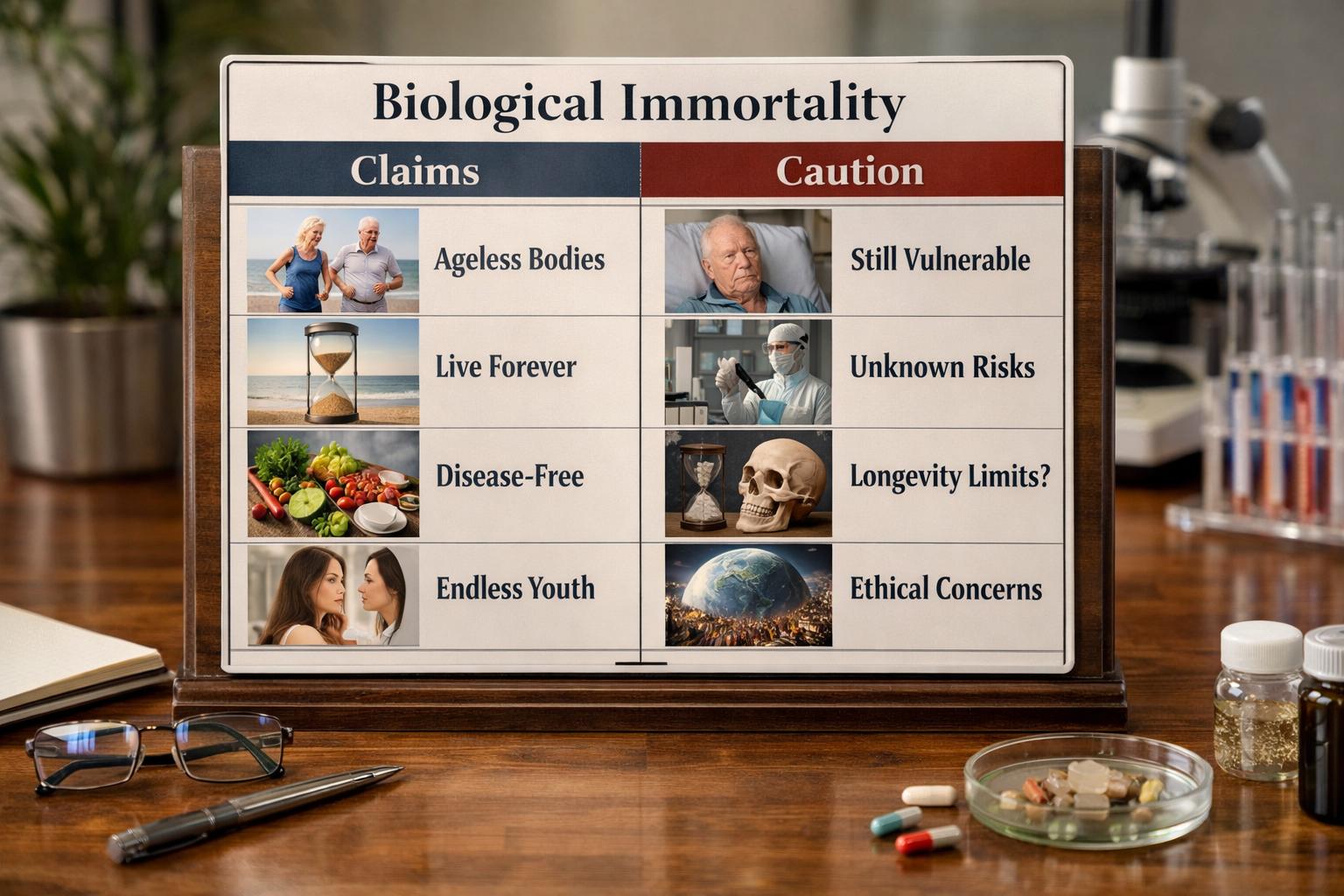
To keep your head while news cycles spin, it helps to sort claims by where they live on the evidence ladder. Here’s a quick reference.
| Claim | Best Current Evidence | Interpretation | Red Flags to Watch |
|---|---|---|---|
| Senolytics improve function | Animal models strong; early human trials in select tissues | Promising, context-dependent | One-size-fits-all dosing; sweeping claims |
| Telomerase extends life safely | Mixed data; cancer risk a concern | Potential in limited contexts | Blanket telomerase “cures” |
| Partial reprogramming reverses age | Convincing in mice; early large-animal steps | High potential; safety first | Whole-body reprogramming hype |
| CRISPR will end aging soon | Great for monogenic disease; aging polygenic | Helpful piece, not a panacea | “crispr immortality” product pitches |
| Nanobots fix everything | Nanoparticles, DNA origami real; true bots far off | Exciting, long horizon | Too-specific timelines for bots-in-blood |
Why the Dream Won’t Die (And Shouldn’t)
Immortality talk draws scoffs because it attracts charlatans. It also draws the best of us, because baked into it is a refusal to accept unnecessary suffering. History rewards the people who ask for more: cleaner water, safer childbirth, vaccines, surgeries that don’t come with a death wish. A hundred years ago, appendicitis was a coin toss; now it’s a billable code. Skepticism protects us from grift. Ambition gets the work done.
Here’s the sober stance: push on the boundaries of what is treatable; insist on rigorous trials; keep data honest and accessible; govern tools that can harm; and learn from species and systems that age differently. Keep the storytelling vivid but not reckless. If the path to longer, stronger lives is made of increments, make them add up.
Investor Heat Maps and Public Benefit
The surge of capital into longevity raises a familiar policy question: who benefits and when? Early therapies are expensive. Over time, manufacturing scales, competitors emerge, and regulators learn. Pressure for equitable access matters—not just morally, but because population-level benefits multiply when prevention and early interventions are available to everyone.
Public programs can help set the table: fund basic aging research; modernize clinical endpoints so trials can measure meaningful function; and encourage data-sharing that respects privacy. Philanthropy has a role too, keeping risky, weird, potentially brilliant work alive long enough to fail fast or surprise us. Venture capital and corporate R&D, for their part, translate ideas into products people can use—messy, necessary, imperfect, and ultimately how breakthroughs stop being just papers.
Looking Ahead: Scenarios Worth Planning For
Three plausible arcs stand out. One, the slow-build: aging biology yields disease‑focused therapies that, stack by stack, extend healthspan by years, with sporadic step changes when a platform like reprogramming clears a safety hurdle. Two, the fast-follow: AI and automation slash the cycle time from concept to clinic, stacking wins faster than expected, yet still distributed across many indications. Three, the surprise: an overlooked or dismissed lever—say, a precise immunological gear—cracks open broad rejuvenation in a way we failed to anticipate. None of these require conspiracy or magic, just relentless human tinkering.
In every scenario, guardrails matter. When platforms are powerful, you build culture and institutions that can bend and not break as they’re deployed: ethics boards that understand the tech, regulators with scientific depth, and public communication that neither sugarcoats nor sensationalizes. It’s slow work. It’s also the work that makes the future stick.
Conclusion
Biological immortality, in the strict sense, belongs to hydra and the occasional time‑reversing jellyfish; for us, the smart target is a long, lively healthspan pushed forward by therapies that repair and rebalance what time frays. The big names and the bold predictions—from Calico to Altos, from AI‑guided discovery to nanotech dreams—set a dramatic stage, but the plot advances through careful experiments, trial data, and standards of care that accrete into something extraordinary. Whether or not rumors of a hidden GNTC draw your imagination, the real drivers are in public view: scientists mapping senescence and the Hayflick limit into actionable levers, investors backing cellular rejuvenation and cautious CRISPR moves, and clinicians testing whether we can achieve biological immortality in the only meaningful way—by outpacing decline with repair. Between hype and hush, the path is neither simple nor sealed; it’s built, one verified result at a time, by people stubborn enough to make tomorrow’s eighty feel like yesterday’s forty.